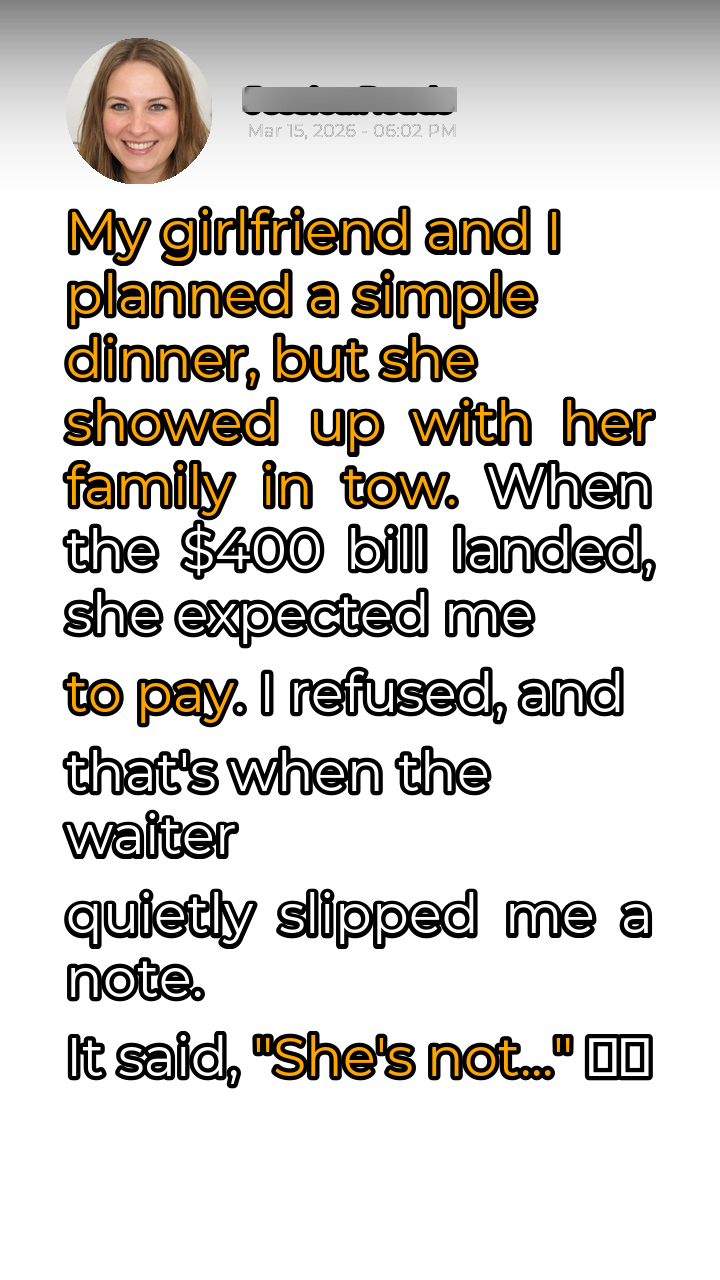
It all started with a simple text: “Dinner at Luigi’s on Friday? My treat.” I was thrilled. Luigi’s was our favorite Italian spot, and I’d been looking forward to some quality time with Sarah. We’d been dating for six months, and things were progressing nicely. I envisioned a relaxing evening, filled with laughter and maybe even a little romance. I made a reservation, picked out a nice shirt, and eagerly awaited Friday. When Sarah arrived, she wasn’t alone. Trailing behind her was a small army of people – her parents, her two younger siblings, and what appeared to be an aunt and uncle. My jaw nearly hit the floor. “Surprise!” she chirped, oblivious to my bewildered expression. “I thought it would be fun for you to meet the family!” Fun? This was beyond fun; this was a full-scale invasion of my personal space and bank account. I plastered on a fake smile and tried to make the best of it, but the evening only went downhill from there.
The family was loud, demanding, and seemed to have an insatiable appetite. They ordered appetizers, entrees, and desserts like there was no tomorrow. Sarah, meanwhile, sat back and let me play host, as if this extravagant family dinner was something we had planned together. I watched the bill climb higher and higher, each new dish adding another layer of dread to my already sinking stomach. I started doing mental calculations, trying to figure out how I was going to afford this unexpected financial burden.
Finally, the dreaded moment arrived. The waiter placed the bill on the table – a staggering $400. Sarah looked at me expectantly, her eyes gleaming with what I could only describe as mischievous glee. “So,” she said, “are you going to take care of this?” I stared at her in disbelief. This was HER family, HER surprise, and she expected ME to foot the bill? I politely but firmly refused. “I’m sorry, Sarah, but I was expecting a quiet dinner for two. I can’t afford to pay for your entire family’s meal.”
A tense silence fell over the table. Sarah’s smile vanished, replaced by a look of cold fury. Her parents glared at me, and her siblings exchanged uncomfortable glances. I braced myself for an argument, but before anyone could say anything, the waiter, who had been hovering nearby, approached our table. He discreetly slipped me a small, folded piece of paper. “Excuse me, sir,” he murmured, “I think you should see this.”
Confused, I unfolded the note. Scrawled in hurried handwriting were the words: “She’s not who you think she is. Her family does this all the time. She brings guys here, racks up a huge bill, and then expects them to pay. She never intends to pay herself.” My blood ran cold. I looked at Sarah, who was now glaring at the waiter with undisguised hatred. The pieces of the puzzle started to fall into place. Her “surprise” visit, the excessive ordering, her expectation that I would pay – it was all a carefully orchestrated scam.
I stood up, my voice trembling with anger and betrayal. “Sarah,” I said, “is this true? Are you using me to pay for your family’s dinners?” She stammered, trying to deny the accusations, but the guilt was written all over her face. I turned to her family, who looked equally ashamed. “I can’t believe you would do this,” I said, shaking my head in disgust. “I’m leaving. You can figure out how to pay the bill yourselves.”
I walked out of Luigi’s, leaving Sarah and her family to deal with the consequences of their actions. The waiter’s note had saved me from being scammed, but it had also shattered my trust in Sarah. The next day, I blocked her number and social media accounts. The relationship was over. I learned a valuable lesson that night: always trust your instincts, and be wary of anyone who tries to take advantage of your generosity. And, of course, always be grateful for a perceptive waiter with a conscience.