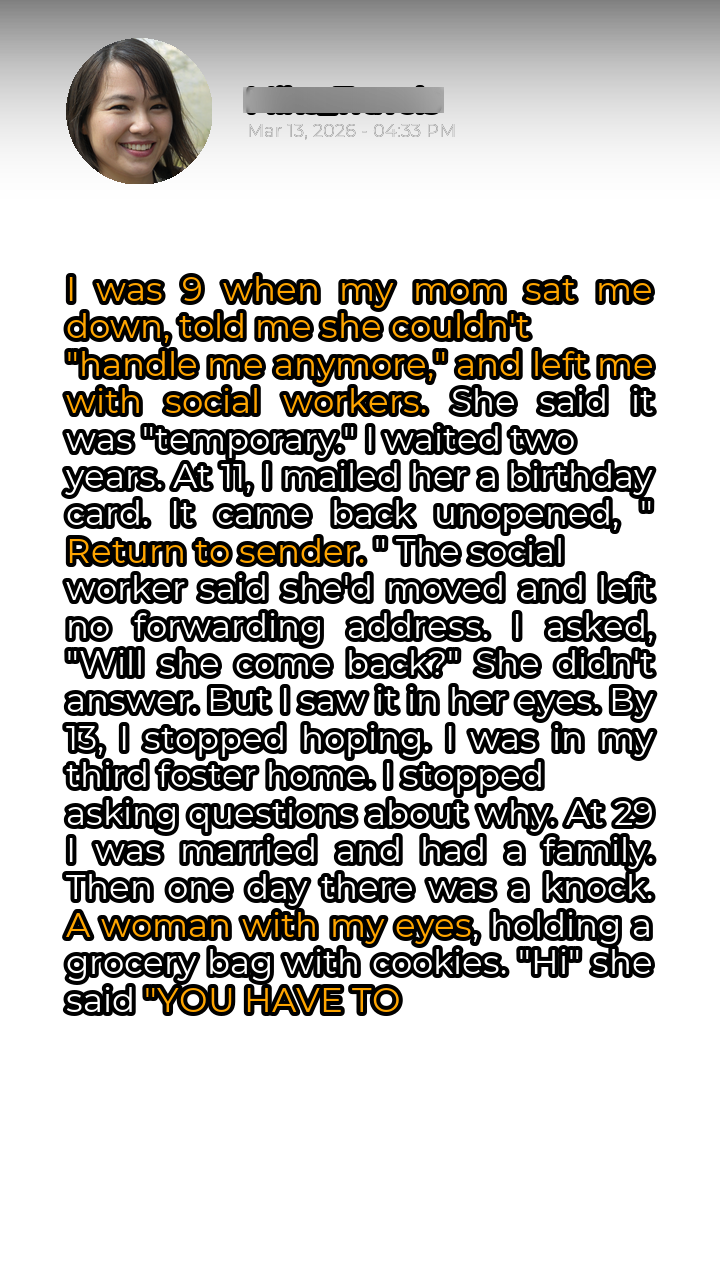
The sterile environment of the social worker’s office felt colder than the December air outside. I was nine, a small, bewildered child being told my mother couldn’t “handle me anymore.” The words echoed in my young mind, laced with a confusion that quickly morphed into a deep, gnawing ache. She promised it was temporary, a brief respite while she sorted things out. I clung to that promise like a lifeline. Two years bled into an eternity. Each birthday and holiday arrived and departed, marked only by the deepening silence where her presence should have been. At eleven, fueled by a desperate flicker of hope, I mailed her a birthday card, meticulously chosen and filled with the simple words of a child longing for her mother. Days later, it landed back in my hands, unopened, stamped with the stark, brutal message: “**Return to sender.**” The social worker, her face etched with a pity I couldn’t bear to meet, explained she’d moved, leaving no forwarding address. “Will she come back?” I pleaded, my voice barely a whisper. She didn’t answer, but the truth was mirrored in her eyes: no.
The slow, agonizing process of acceptance began. By thirteen, I had navigated three different foster homes, each a temporary shelter offering warmth but never belonging. The questions about why, once persistent and demanding, gradually faded into a dull ache. I learned to survive, to adapt, to bury the hope that had once burned so brightly. The pain of abandonment became a constant companion, a shadow that stretched long and dark behind me.
Time marched on, carrying me through adolescence and into adulthood. I found love, built a career, and created a family of my own – a husband, two beautiful children, a life filled with laughter and the comforting rhythm of everyday routines. The scars of my childhood remained, but they were hidden beneath layers of happiness and stability. I thought I had finally escaped the shadows of the past.
Then, one ordinary Tuesday afternoon, the past came knocking. I opened the door to find a woman standing on my porch, her face a distorted reflection of my own. Her eyes, the same shade of green as mine, held a mixture of fear and desperation. She clutched a grocery bag filled with cookies, a pathetic offering for the years of absence.
A nervous smile stretched across her face as she uttered a single word: “Hi.” The sound of her voice, unfamiliar yet achingly familiar, sent a shiver down my spine. Years of suppressed emotions threatened to erupt, a volatile cocktail of anger, hurt, and a lingering, unwanted hope.
Before I could speak, before I could even fully process the reality of her presence, she spoke again, her voice barely audible above the chirping of birds in the nearby trees. The words she uttered shattered the fragile peace I had so carefully constructed, plunging me back into the darkness of my past. “You have to hide me,” she pleaded, her eyes wide with terror.