PART 1

“We don’t let people like you wander into private celebrations meant for decent families.”
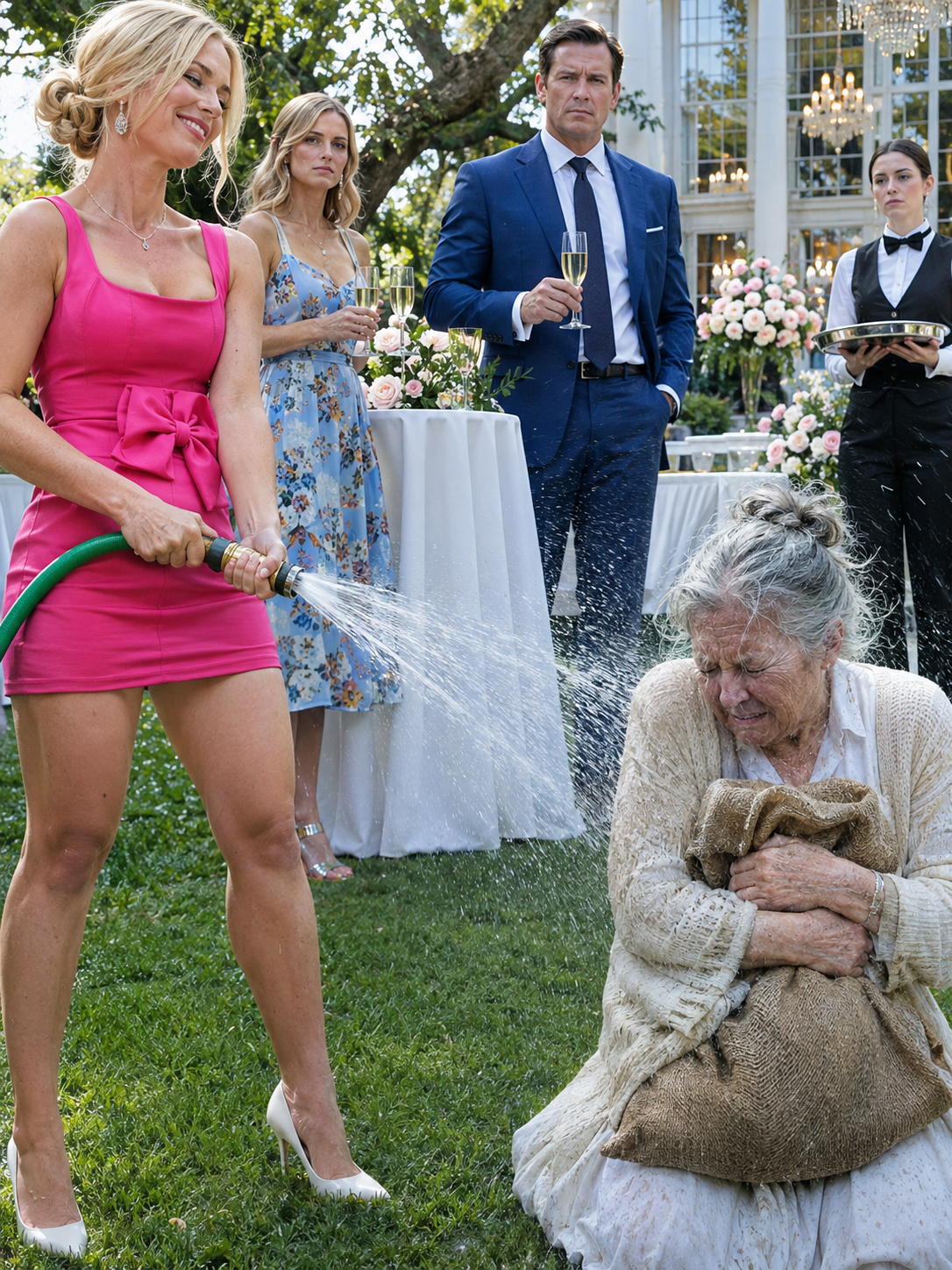
Before I could respond, a powerful stream of freezing water hit me squarely in the face.
I stumbled backward, gasping as water soaked through my faded blouse, worn shawl, and old secondhand shoes.
The magnificent Belle Meade estate became a blur behind the water streaming down my cheeks.
Just moments earlier, I had been admiring the breathtaking decorations. Pink roses decorated the garden, crystal lights shimmered beneath towering oak trees, and servers moved between thirty elegantly dressed guests carrying silver trays of champagne.
It looked like something straight out of a luxury wedding magazine.
But now, I was standing in the middle of that beautiful celebration, being publicly humiliated by a young woman who seemed to find the entire situation amusing.
And everyone was laughing.
Sloane Prescott, my son’s future wife, stood before me with a garden hose in one hand and a champagne glass in the other.
“Can you believe this?” she said to her friends. “She actually thought she could just walk in here like she belonged!”
Several women giggled behind their hands.
A guest in a navy suit even pulled out his phone to record the spectacle.
Not a single person intervened.
Not one guest asked Sloane to stop.
Another blast of water sent me stumbling onto one knee in the wet grass. I instinctively wrapped both arms around my reusable grocery bag, holding it tightly against my chest.
My phone was inside, protected by a waterproof case.
Its camera was still running.
It had captured everything: the insults, the laughter, and every cruel moment Sloane believed would become an amusing party story.
“I only came here to speak with Mr. Garrett Whitcomb,” I explained softly.
Sloane approached and crouched in front of me.
She wore a beautiful ivory dress, sparkling diamond earrings, flawless makeup, and perfectly styled hair. She looked every bit the glamorous bride-to-be.
Unfortunately, her behavior revealed a very different kind of person.
“Mr. Whitcomb doesn’t entertain strangers who trespass on private property,” she replied. “Especially not during his engagement party.”
I looked at her calmly.
“Would you mind telling him someone is here to see him?”
She burst out laughing.
“Oh, sweetheart. Do you really think someone like Garrett meets random women carrying grocery bags?”
Her mother, Bernadette Prescott, stood nearby, watching me with undisguised contempt.
“Sloane, please get rid of her before she ruins the photographs.”
Her husband, Howard, barely bothered to look at me before adding, “Someone should check her bag before she leaves. We have no idea what she might have stolen.”
I couldn’t believe what I was hearing.
They had already decided I was a thief simply because my clothes weren’t expensive.
I took a deep breath.
My name is Loretta Whitcomb, and the man Sloane was preparing to marry was my only son.
Garrett had spent most of the afternoon inside the mansion meeting investors and business partners who had traveled from Dallas, Atlanta, and Chicago.
He had absolutely no idea what was happening outside.
And that was exactly how I had planned it.
Earlier that morning, I had stopped at a thrift shop outside Nashville and purchased an inexpensive blouse, an old shawl, and a pair of worn shoes.
I deliberately left my expensive jewelry at home.
I didn’t bring my usual handbag or arrive with a driver.
I wanted to meet Sloane without allowing my family’s wealth or reputation to influence her behavior.
There was a reason for my decision.
Garrett constantly described his fiancée as compassionate, thoughtful, and generous. Yet I had occasionally noticed how differently she treated people who couldn’t offer her anything in return.
I wanted to know whether my suspicions were justified.
Deep down, I genuinely hoped I was wrong.
Instead, I found myself kneeling in the grass while thirty guests watched Sloane ridicule me.
Then something unexpected happened.
A young server approached, carrying a neatly folded napkin. He couldn’t have been older than twenty.
“Ma’am, are you okay?” he asked with genuine concern. “Please, let me help you.”
His kindness was the first thing that made me feel human since arriving.
But Sloane immediately turned toward him.
“If you touch her, you’ll be out of a job before dessert!”
The young man’s expression changed instantly.
He stopped, visibly frightened, caught between doing what was right and protecting his livelihood.
I gently reached for his hand.
“It’s okay, sweetheart.”
Then I turned toward Sloane.
“I think today has taught me quite a lot.”
She rolled her eyes.
“Oh, fantastic. Now the homeless woman wants to lecture us about manners!”
More laughter erupted around the garden.
Water dripped from my silver hair, and my soaked shawl clung to my shoulders.
But the embarrassment was beginning to disappear.
In its place, something much stronger was growing.
Anger.
Not because Sloane hadn’t recognized me.
Not because she had initially mistaken me for someone who didn’t belong at the estate.
But because she genuinely believed that someone’s appearance gave her the right to treat them with cruelty.
I slowly lifted my head.
“Sloane, I hope you remember what happened today.”
Her smile widened.
“What exactly is that supposed to mean?”
“Remember how you treated someone you believed had nothing to offer you.”
She moved closer, her expression turning hostile.
“Are you threatening me?”
“No,” I replied calmly. “I’m simply telling you that someday, you might wish you had behaved differently.”
She laughed again.
“Do you seriously believe anyone important would care about what happens to you?”
I held her gaze.
“You may be surprised.”
For a brief moment, her confidence seemed to falter.
Then she raised the hose again.
“Security!” she shouted. “Get this woman off the property!”
Before anyone could move, the enormous glass doors behind her swung open.
A familiar voice called from inside.
“Garrett, your guests are waiting!”
My heart began racing.
My son stepped onto the lawn, dressed in an elegant dark suit and holding a champagne glass. He was smiling at someone behind him, seemingly unaware of the commotion.
His eyes moved across the gathering.
First, he noticed the guests.
Then Sloane.
Then the garden hose in her hand.
Finally, he looked down at the woman kneeling in the grass.
Me.
My clothes were completely soaked, my hair was dripping, and I was still clutching my grocery bag against my chest.
Garrett suddenly stopped.
His smile disappeared.
For several seconds, he stood motionless, staring at me as though he couldn’t understand what he was seeing.
Then his face went pale.
“Mom?”
His voice was barely above a whisper.
Yet every person in the garden heard him.
Sloane froze.
She slowly turned toward my son.
“What did you just call her?”
Garrett didn’t respond.
He hurried toward me and dropped to his knees, completely ignoring the water soaking his expensive trousers.
“Mom, are you hurt? What happened to you?”
I looked at his worried face, then glanced toward Sloane.
The laughter had stopped.
The man who had been recording quickly lowered his phone.
Bernadette stood with one hand covering her mouth, while Howard suddenly found the grass much more interesting than the scene unfolding before him.
I gently squeezed Garrett’s hand.
“I’m okay, sweetheart.”
Then my eyes shifted toward the grocery bag.
My phone was still inside, and its recording indicator remained visible.
Garrett followed my gaze.
He noticed the device and looked back at me.
“Mom,” he asked quietly, “how long has your phone been recording?”
I slowly turned toward Sloane.
Her face had lost every trace of color.
“Long enough,” I replied.
Garrett stood up and faced the woman he had intended to marry.
For the first time that afternoon, Sloane looked genuinely terrified.
Because the man she was preparing to spend her life with had just witnessed the consequences of her cruelty.
And this time, there would be no denying what had happened.
My phone had recorded everything.
PART 2
Garrett didn’t raise his voice. That was the part that frightened Sloane most, I think. She had spent two years learning exactly how to manage his temper, and he didn’t have one to manage.
“Someone get my mother a towel,” he said.
Nobody moved for a moment. Then the young server, who had stood frozen by the flowerbeds, sprinted toward the house and came back with an armful of thick white linens from the pool cabana. He draped one around my shoulders so gently that my eyes stung.
“Thank you, honey,” I said. “What’s your name?”
“Tyler, ma’am. Tyler Briggs.”
“Thank you, Tyler.”
He ducked his head, scarlet to his ears, and glanced at Sloane as if expecting a thunderclap. It didn’t come. She stood by the hose with her arms wrapped around herself, suddenly smaller than her dress.
“Garrett, it was a misunderstanding,” she said. “She was dressed like… I thought she was a vagrant. I thought she was going to cause a scene.”
“She was kneeling in the grass,” Garrett said. “Soaking wet. Holding a grocery bag.”
“I didn’t know she was your mother!”
“I know you didn’t.” He looked at her steadily. “That’s what I’m trying to understand.”
Bernadette came forward, pearls at her throat, her face arranged into the expression she wore at charity luncheons. “Garrett, darling, you’re upset, and I understand. But think about it. Anyone would have been alarmed. A stranger turning up unannounced…”
“Mrs. Prescott, did anyone ask her why she was here?”
Bernadette opened her mouth.
“She told Sloane three times that she wanted to see me,” Garrett said. “Is that right, Tyler?”
Tyler’s throat worked. Sloane shot him a look, and I watched the boy weigh a minimum-wage job against the truth.
“Yes, sir,” he said. His voice shook, but it carried. “She asked nicely every time. And Miss Prescott said that if I helped her, I’d be fired.”
A murmur moved through the guests. The man in the navy suit, who had been filming, discovered something fascinating on his shoes.
“I didn’t mean it,” Sloane said quickly. “I was upset. I said things I didn’t mean.”
“You said them, though,” Garrett replied.
Howard cleared his throat. “Son, we’re all a little emotional. Why don’t we step inside, have a drink, and discuss this like adults?”
“You told them to search her bag,” Garrett said. “You said she might have stolen something.”
“I was being cautious.”
“Based on what, Howard?”
Howard had no answer. He was a man who built his fortune on contracts and confidence, and for once, neither was any use.
I stayed quiet through all of it. I had decided in the car that I would let my son lead, and standing there with a damp towel around my shoulders, I understood how much that choice would cost me. Every instinct I had said fix this, protect him, say something. But Garrett was thirty-two years old. He had built his own firm from a rented office and a borrowed desk. He didn’t need his mother to hold his hand through the worst afternoon of his life.
“Mom,” he said finally, turning to me. His voice was gentle. “Why the thrift-store clothes?”
I took a breath.
“Because I wanted to meet her without the money,” I said. “I’ve watched how she is with you. Warm, careful, perfect. And I’ve seen how she is with waiters, and the girl who does her nails, and the man who parks her car.” I swallowed. “I wanted to know whether the second woman was real or the first. I told myself I was worried about you. But I should have talked to you. I’m sorry, Garrett. It was a terrible way to do it.”
Garrett stared at me for a long moment. Hurt crossed his face, the particular hurt of a son realizing his mother had gone behind his back. Then, slowly, it softened.
“You were right to worry,” he said. “You were wrong about how. But you were right.”
Sloane made a small, wounded sound. “So this was a trap. She set me up!”
“No,” Garrett said. “She put on old clothes. You picked up the hose.”
Silence settled over the garden. Somewhere beyond the oak trees, a mockingbird sang, bright and oblivious.
I held up my phone. “I have the whole recording. Every word. I’m not going to post it anywhere. I’m not going to send it to anyone. But Garrett has the right to watch it, if he wants.”
“I don’t need to,” Garrett said quietly. “I just watched it happen.”
“Garrett.” Sloane’s eyes were filling. “Please. We’re getting married in four months. We have two hundred guests. The deposits alone…”
“I know what the deposits are.”
“I love you!”
“I know you think you do.” His voice cracked. “And I love who I thought you were. But I just watched you spray an old woman with a garden hose and laugh, and I don’t know which of you is real. I need time to find out.”
“You’re choosing her over me.”
“I’m not choosing anyone.” He shook his head slowly. “I’m trying to decide whether I can build a life with someone who only treats people well when it benefits her.”
Nobody spoke. Slowly, awkwardly, the guests began to drift toward the driveway. The champagne tower sat untouched. The pink roses, flawless in the late light, looked suddenly like a stage set after the play had closed.
Garrett turned to the young server.
“Tyler, you’re not in trouble. Not with her, not with me, not with anyone. If anyone at this event gives you grief for what you did, you tell them to call me directly.”
“Thank you, sir,” Tyler whispered.
“No,” Garrett said. “Thank you.”
We drove home in silence, my son at the wheel of the car I’d sent for. At a red light on West End Avenue, he rested his forehead against the steering wheel and let out a long, shaking breath.
“I should have seen it,” he said.
“You saw someone who was kind to you.”
“That’s not the same as seeing her.”
“No,” I said. “It isn’t. But you were looking at what she showed you. That’s what people do.”
He laughed, a short, painful sound. “You always say that. People show you who they are, eventually.”
“Eventually,” I agreed. “I just didn’t want it to take five years and a baby.”
The light turned green. He drove on.
PART 3
He didn’t sleep that night. Neither did I.
I sat at my kitchen table in Franklin with a mug of chamomile and my phone propped against the sugar bowl, and I watched the recording once, all the way through. I had to. I’d put him through this, and I owed it to him to know exactly what he’d seen.
It was worse than I remembered. Not the water. The laughter. The way thirty well-dressed adults had treated a stranger’s humiliation like a lawn game.
I deleted nothing. I sent it nowhere. I saved a copy in a folder and closed my laptop.
Garrett called at seven the next morning.
“I’m on my way over,” he said. “Are you decent?”
“I’m in a bathrobe.”
“I’ll bring biscuits.”
He arrived with a paper bag from the diner we’d gone to when he was a boy, and sat across from me with dark circles under his eyes. For a while we just ate. Then he said, “I called Sloane.”
“And?”
“I told her I’m postponing the engagement. Not the wedding, because there isn’t a wedding anymore. But I told her I need time, and that I’d like her to see someone. A counselor. About why she did it.”
“How did she take it?”
“She cried. Then she said the same things she said yesterday.” He turned his coffee cup slowly on the table. “She kept saying she was sorry she got caught. She kept saying it was one moment. She never said she was sorry for what she did.”
“Those are different apologies.”
“They are.” He looked at me. “I gave her until Friday to tell me the difference.”
On Friday, she called. Garrett put her on speaker, with my permission.
“I thought about what you said,” Sloane began. Her voice was thinner than before, stripped of its music. “I talked to my mother. She says you’re being dramatic.”
Garrett said nothing.
“I told her you were right.” A long pause. “That’s not a thing I’ve said very much, Garrett. That someone else was right.”
“No,” Garrett said gently. “It isn’t.”
“I’ve been thinking about Tyler. The boy. I looked him up, because I didn’t know his last name, and…” She stopped. “I threatened his job. I could have ruined his whole life over a napkin. I did that. And I told myself it was fine, because he was just staff.”
“Sloane.”
“I don’t know if I can be the person you want.” She was crying now, quietly, without the performance. “I don’t think I’m cruel. I think I’m someone who learned that other people’s comfort was my business only when they could do something for me. And I’ve been so scared of being ordinary that I treated everyone ordinary like a threat.”
Garrett closed his eyes.
“That’s the truest thing you’ve ever said to me,” he said.
“Does it matter?”
“It matters. I don’t know if it changes anything.” He let out a breath. “I’m not going to marry you in four months. Maybe not in four years. If you want to do the work, with someone who isn’t me, I’ll respect that. But I can’t be the reason you change. That’s not fair to either of us.”
“I understand.”
“I hope you do.”
She hung up first. Garrett set the phone down gently, as if it might break, and sat very still.
“Do you think she’ll change?” I asked.
“I think she’ll want to. I think wanting to is where it starts.” He rubbed his face. “I just don’t think I’m the one who gets to watch.”
The summer that followed was long and strange and quiet. Garrett moved back to his own house in Germantown and threw himself into work, then, to my surprise, stopped throwing himself into work and started coming to Sunday dinners. He grew a beard and shaved it. He took up fly fishing. He adopted a three-legged retriever mix from a shelter and named him Biscuit, who ate one of my good slippers on the first visit.
Sloane sent one letter, handwritten, on plain cream stationery. She didn’t ask for anything. She said she’d started seeing a therapist, a woman in Brentwood. She said the hardest part so far was learning that cruelty wasn’t always loud, and that sometimes it just looked like laughing along. She said she’d written to Tyler Briggs and left a check at his workplace, which he’d returned uncashed, with a polite note.
I read it twice and handed it to Garrett. He read it and set it on the counter.
“Are you going to write back?”
“Not yet.” He looked at the letter. “Maybe someday. I’d like to be able to say I hope she’s well and mean it. I’m not quite there.”
“That’s honest.”
“It’s all I’ve got.”
In September, I invited Tyler Briggs to lunch.
It took some doing to find him. He was nineteen, a sophomore at Nashville State studying hospitality management, working three catering shifts a week and sending half his paychecks home to his mother in Murfreesboro. When I called, he thought it was a prank. When I explained who I was, he went silent for so long I thought the line had dropped.
“Ma’am,” he said finally. “I really didn’t do anything.”
“You offered a stranger a napkin at the risk of your livelihood,” I said. “I’d call that something.”
We met at a little place on Hillsboro Pike, white tablecloths, no garden hoses. He wore his one good shirt. He ordered the cheapest thing on the menu until I told him to order what he wanted, and then he ordered the chicken and looked guilty about it.
“I run a company,” I said, over dessert. “Whitcomb Hospitality. Hotels, mostly. Eleven properties across the Southeast. I started it thirty-two years ago with one motel off I-65 and a loan I couldn’t afford.” I stirred my tea. “I built it on the idea that people deserve to be treated well by the folks who serve them, and that the folks who serve them deserve the same. I haven’t always lived up to that. But I try.”
Tyler said nothing.
“I’d like to offer you a scholarship,” I said. “Full tuition, through graduation. No strings. And a paid summer internship in our corporate office, if you want it. You’d learn the business from the ground up, and I’d make sure you got real work, not coffee runs.”
His eyes widened. “Mrs. Whitcomb, I can’t…”
“You can. You earned it.”
“I didn’t do it for…”
“I know you didn’t. That’s exactly why.”
He looked at me for a long moment. Then his face crumpled, and the kid who had stood frozen in a garden with a napkin in his hands put his head down on the tablecloth and cried, quietly, the way young men do when they’ve been strong for too long.
I reached over and patted his shoulder.
“It’s all right, honey,” I said. “It’s all right.”
He started his internship the following June.
Garrett took him under his wing, to my quiet delight, though they never made a fuss about it. They ate lunch together on Tuesdays. Garrett taught him how to read a profit-and-loss statement, and Tyler taught Garrett how to fold a napkin into a swan, which Garrett insisted was a necessary management skill.
“The best managers have worked every job,” Tyler told me once, with the grave confidence of the very young. “That’s what Garrett says. He says you can’t lead people if you don’t know what their feet hurt like.”
“He gets that from me,” I said.
“He gets a lot from you.”
I looked at him, this serious, grateful boy in a pressed shirt, and thought: There is the real thing. Not the champagne towers. Not the diamond earrings or the perfect photographs. Just a kid with a folded napkin and the nerve to use it.
Two years after the garden, on a bright afternoon in April, Garrett brought a woman to Sunday dinner.
Her name was Juliet Ramsey. She was a pediatric nurse at Vanderbilt, thirty-one, with ink on her wrist from a pen that leaked and a laugh that arrived before she did. She showed up in jeans and a borrowed sweater, because her car had broken down on the way and a tow truck driver had spilled coffee on her blouse, and she apologized so many times for being late that I finally put a plate in her hands to make her stop.
She asked me about my hotels. She asked about the thrift shop I’d gone to, which Garrett had apparently mentioned, and she laughed when I admitted the shawl had been itchy. She helped me clear the table without being asked, and when she thought no one was watching, she paused to scratch Biscuit behind the ears and tell him he was the handsomest three-legged dog she’d ever met.
Later, as Garrett walked her to her repaired car, I stood at the window and watched them. He was talking with his hands the way he did when he was happy. She was laughing. Between them, in the long light, I saw something I hadn’t seen on that manicured lawn two years earlier.
I saw two people who spoke to each other as equals.
That evening, after she’d gone, Garrett found me in the kitchen drying the last of the dishes.
“Well?” he said.
“She’s lovely.”
“That’s it?”
I put down the towel. “She asked the dishwasher’s name at the restaurant where you took her last week. You told me that yourself. She tipped him twenty percent on a lunch check and said thank you like she meant it.” I looked at my son. “I don’t need to test her, Garrett. I think I’ve learned my lesson on that front.”
He laughed. “I’d say.”
“But I’ll tell you what I told you two years ago.” I took his face in my hands, the way I had when he was small. “Pay attention to how she treats people who can’t do anything for her. Not once. Every time. That’s all you ever need to know about anybody.”
He covered my hands with his own.
“I learned it,” he said. “The hard way. From the best teacher I ever had.”
“I got a hose to the face for that lesson.”
“Mom, the lesson was yours. You just let me finish it myself.”
I smiled, and my eyes stung, and I told him to hand me the towel.
On the shelf above the sink, in a small frame, sat a photograph Tyler had given me at his graduation the year before, the two of us at the restaurant on Hillsboro Pike, me with my tea and him with his dessert and his tears long dry. Under it, in his careful handwriting, he’d written a line I read most evenings.
Thank you for seeing me.
I’d been seen too, I thought. On the worst afternoon of my life, in a wet shawl and a thrift-store blouse, kneeling in the grass, I had been seen, by one frightened boy with a napkin and one furious son with an open heart.
That was enough. That had always been enough.
The rest, the money and the name and the manicured lawns, was only what we stood on while we waited to find out who would kneel down beside us.