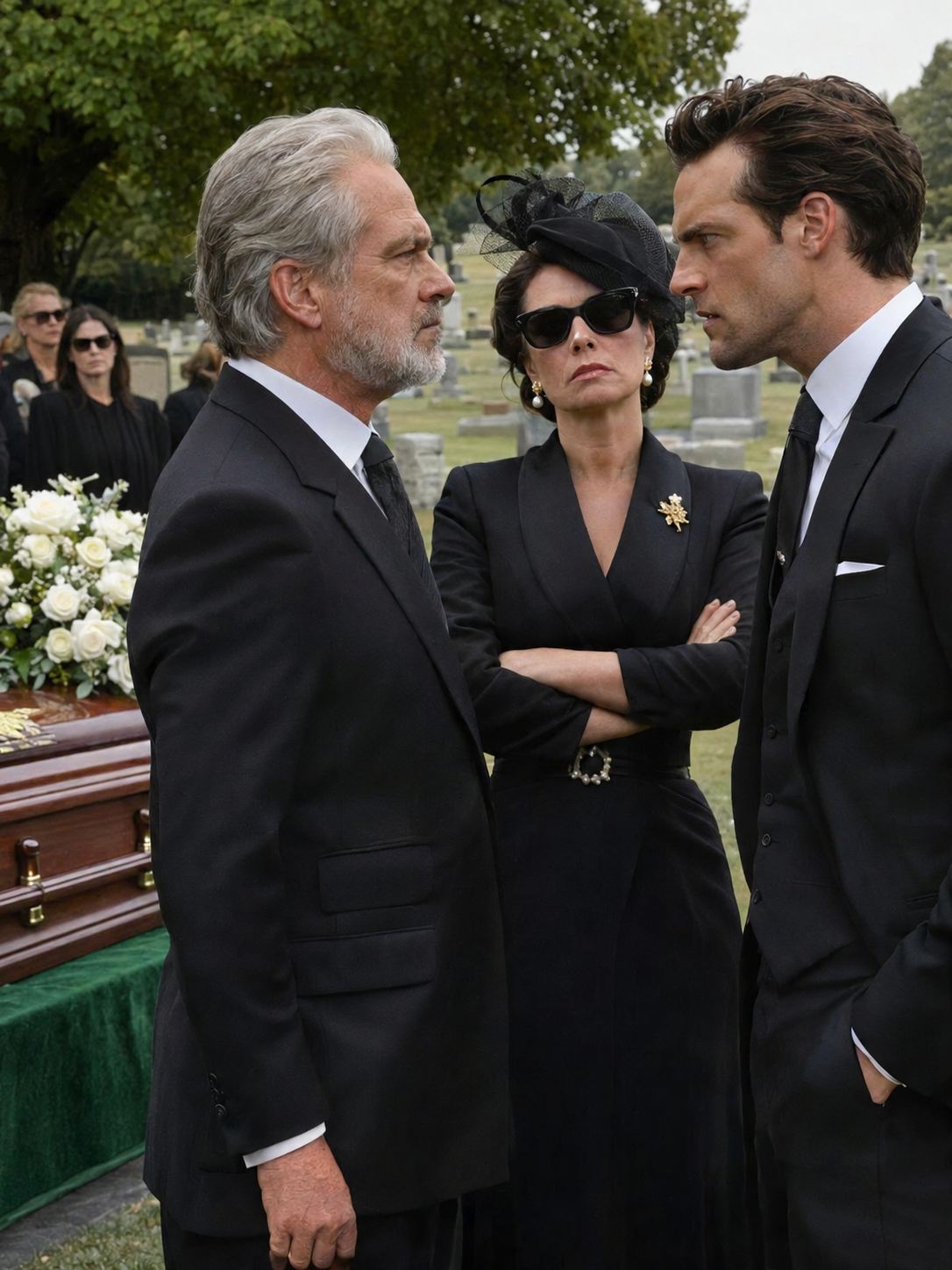
I didn’t argue or show any anger. I simply nodded. That Saturday, I packed a single suitcase and vanished without telling anyone where I was going. By midnight, my phone was flooded with 140 missed calls. They had always treated me like a helpless old man who had nowhere else to go. But they were about to learn a shocking truth about the luxurious six-bedroom house they called home—and who really held the keys to it…
PART 1

At my wife’s funeral, my son pulled me aside and coldly said, “Dad, we’re cutting off your allowance. You’ll have to support yourself from now on.” His wife stood beside him smiling without a hint of shame. I simply nodded. That Saturday, I packed one suitcase and disappeared. By midnight, my phone showed 140 missed calls. They thought I was just a helpless old man, until they discovered who actually owned the luxurious six-bedroom house they were living in…
My wife had been buried for less than an hour when my son pulled me aside and announced that he and his wife were cutting off my monthly allowance. Four days later, I left with a single suitcase, and by midnight, my phone displayed 140 missed calls from people who suddenly seemed desperate to find me.
My name is Gerald Hollis. I’m seventy-one years old, and for forty-six years, I was married to Dorothy, the kindest and most loving woman I’d ever known. When cancer finally took her from me, it felt as though the warmth had disappeared from my entire world.
On the day of her funeral, I stood beside her coffin, barely able to hold myself together as friends and relatives offered their condolences. I was still struggling to accept that the woman I’d shared nearly half a century with would never come home again when my son, Trevor, approached me.
“Dad, we need to talk about something.”
I turned toward him, exhausted and overwhelmed by grief. His wife, Kendra, stood a few steps behind him, adjusting the expensive pearl necklace around her neck while watching us with an expression that showed little sympathy.
“Trevor, can this please wait? We haven’t even finished saying goodbye to your mother.”
He shook his head, apparently determined to have the conversation immediately.
“No, Dad. It’s about money, and Kendra and I think it’s important to settle this now.”
I stared at him in disbelief. Dorothy’s funeral flowers were still arranged around the church, and the people who had loved her were only beginning to leave.
Trevor lowered his voice slightly, although his expression remained firm.
“Kendra and I have decided we can’t keep paying for your lifestyle. Starting next month, we’re stopping your allowance. You’ll need to cover your own expenses.”
Before I could respond, Kendra stepped forward and folded her arms.
“Gerald, you’re seventy-one years old. It’s time you learned to be financially independent. We have our own future to worry about, and we can’t keep supporting you forever.”
For a moment, I almost laughed at the absurdity of what I was hearing. They were speaking to me as though I were a helpless old man who had spent years depending on their generosity.
The truth was very different, but neither of them knew it.
For the previous three years, I’d allowed Trevor to deposit $2,000 into my checking account every month. He believed those payments were helping me survive, and I’d never bothered correcting that assumption because Dorothy had wanted him to feel that he was taking care of his aging parents.
What Trevor didn’t know was that I had never needed a single dollar of his money. Every month, I quietly transferred twice that amount, $4,000, into a college savings fund for his children.
While my son congratulated himself for supporting me, I was secretly putting away money to help secure his children’s education. I never mentioned those contributions because I believed that doing something good for family shouldn’t require recognition.
But the money wasn’t the biggest secret.
Trevor and Kendra lived in a beautiful six-bedroom house in an expensive neighborhood. They had raised their family there for years, entertained friends, and enjoyed a lifestyle that made them appear far more financially comfortable than they actually were.
Trevor believed the property belonged to him.
It didn’t.
Fourteen years earlier, I’d purchased that house through a family property company and allowed my son and his family to live there without paying rent. I’d also quietly covered the property taxes, homeowners insurance, and maintenance expenses.
When everything was added together, Trevor’s family received nearly $80,000 in financial benefits every year. Yet somehow, standing at his mother’s funeral, my son had convinced himself that the $2,000 he sent me each month was an unbearable burden.
Dorothy had always insisted that we keep our financial arrangements private. She believed that allowing Trevor to feel independent would help him develop confidence and pride in providing for his family.
“Let them feel like they’re standing on their own feet, Gerald,” she used to tell me. “We don’t need credit for every good thing we do.”
I’d agreed because making Dorothy happy had always mattered more to me than proving how much money I possessed. But as the years passed, she’d occasionally expressed concern about the way Trevor and Kendra had begun taking our generosity for granted.
One evening, she’d said something I never forgot.
“Gerald, there’s a difference between helping someone and teaching them that they’re entitled to everything you have. Generosity becomes dangerous when people start mistaking it for weakness.”
At the time, I’d reassured her that Trevor would eventually understand everything we’d done for him. I believed my son had a good heart and that his occasional arrogance was simply the result of being young and ambitious.
Now, standing beside Dorothy’s grave, I realized how badly I’d misjudged the situation.
Trevor reached out and patted my shoulder with the confidence of someone delivering an unpleasant but necessary lesson.
“Don’t take this personally, Dad. You’re getting older, and we can’t carry you forever. You need to start taking responsibility for yourself.”
Kendra stood beside him without the slightest sign of embarrassment. Neither of them seemed to understand how cruel their timing was or how deeply their words had hurt me.
I looked at my son for several seconds before slowly nodding.
“You’re right, Trevor. Everyone should be responsible for their own expenses.”
His expression immediately relaxed, and he smiled as though we’d just reached a sensible agreement.
“I’m glad you understand, Dad. I knew you’d eventually see things our way.”
I didn’t argue or reveal anything about the house, the college fund, or the expenses I’d been covering for years. There was no point discussing those matters while I was still standing at my wife’s funeral.
Instead, I quietly said goodbye and returned to the small guest apartment behind Trevor’s house, where Dorothy and I had been living.
The apartment felt unbearably empty without her. Her favorite chair was still beside the window, her belongings remained exactly where she’d left them, and the faint scent of her perfume lingered in the bedroom.
As I approached her dresser, I noticed a sealed envelope resting on top.
My name was written across the front in Dorothy’s familiar handwriting. She had prepared it before entering the hospital, but until that moment, I hadn’t found the strength to open it.
I sat on the edge of our bed and carefully unfolded the paper inside.
There were only six words.
Gerald, please start living for yourself.
I read the message several times, tracing the letters with my fingers. Dorothy had spent forty-six years knowing exactly what I needed, and somehow, even in her final days, she’d understood something about my life that I had refused to acknowledge.
For years, I’d devoted myself to making sure Trevor and his family had everything they needed. I’d given them a home, financial security, and countless opportunities while asking for almost nothing in return.
And now, less than an hour after burying his mother, my son had informed me that I was no longer worth supporting.
I sat alone on our bed and cried, grieving not only the woman I’d lost but also the years I’d spent believing that keeping everyone comfortable was the same as keeping everyone happy.
Eventually, I wiped my face, folded Dorothy’s letter, and placed it carefully beside me.
Then I reached for my phone and called the attorney who had managed our family’s financial affairs for years.
She answered after a few rings.
“Patricia speaking.”
I took a deep breath and looked once more at the six words Dorothy had left behind.
“Patricia, it’s Gerald. I’ve made a decision.”
She immediately recognized the seriousness in my voice.
“Of course, Gerald. What do you need?”
I glanced toward the window, beyond which stood the beautiful six-bedroom house my son believed was his.
“It’s time to make some changes.”…
PART 2
Thursday morning, my attorney, Patricia Quinn, knocked on the door of the guest apartment with her worn leather briefcase in hand. She had handled our family’s legal matters for twenty years, and she knew our finances better than anyone. “Gerald, are you completely sure about this?”
Through the window, I could see Kendra out by the swimming pool, directing a landscaper where to plant new hedges. For years, Dorothy and I had paid for the life they showed off to the neighbors. That was about to change. “I’m sure, Patricia.”
We spread the property records, bank statements, insurance policies, and trust papers across the kitchen table. Every document told the same story: Hollis Property Holdings, a company I owned outright, held the deed to the house.
I’d bought it fourteen years earlier and rented it to Trevor at a steep discount. The $2,000 he sent me each month, the “allowance” he’d been so proud of, was really his rent, and it didn’t cover even a quarter of what the house cost to keep.
Patricia reminded me that Trevor’s lease was still valid. “We honor it, Gerald. But you aren’t required to renew it, and you certainly aren’t required to keep paying their personal bills.”
I nodded. I had no intention of putting my grandchildren on the street. I only wanted my son and his wife to live by the rules they’d laid out for me at his mother’s funeral. “Accountability, Patricia. Not revenge.”
By afternoon, I’d called the pool service, the lawn company, and the housekeeping agency to tell them my payments would stop once their current billing periods ended. I also canceled the extra credit card I’d given Trevor and stopped covering his household charges.
Patricia sent Trevor a formal notice that the lease would not be renewed at its expiration. Every step was done by the book, and it gave them plenty of time to find another place to live.
As for me, I’d decided to move to the lake cottage Dorothy and I had bought years ago. It was paid off, quiet, and exactly where we’d always pictured spending our retirement.
Over the next two days, I slowly carried most of my things out there, careful not to run into Trevor or Kendra. I wanted everything in place before another fight could start.
Saturday morning, they drove off to a pricey brunch. I put my last few clothes, my medications, Dorothy’s wedding photo, and her wooden music box into a single suitcase.
Before I left, I set my house keys on the kitchen counter next to a handwritten note.
Trevor,
At your mother’s funeral, you told me everyone should cover their own expenses. I thought about it, and you were right.
As of today, I’m no longer paying for your household. Have your lawyer contact Patricia Quinn about the house.
Dad
Pulling out of the driveway of the place where Dorothy and I had spent our last years together hurt more than I expected. Still, underneath the grief, I felt something like relief. For the first time in a long while, my life was my own.
At the cottage, I set Dorothy’s photograph on the mantel and sat by the window facing the lake. The afternoon was calm until my phone buzzed at exactly 4:12.
It was Trevor. I let it ring. Four minutes later he called again, then Kendra, and by six o’clock I’d counted forty-seven missed calls.
Around seven, Patricia forwarded me a voicemail Trevor had left on her line, shouting.
“This is insane! Dad can’t just vanish! Who’s supposed to pay the bills on the house now?”
I listened twice. Not once did he ask if I was okay. All he cared about was that the money had stopped.
Patricia’s reply was calm and professional. “Your father is safe. He has chosen to end his voluntary support. Your tenancy is still governed by your existing lease.”
At about 8:30, a text from Trevor arrived. The anger was gone, replaced by bewilderment. “Dad, the county records say Hollis Property Holdings owns our house. Is that your company?”
I read it with a heavy heart. After fourteen years, my son had finally learned that the house he’d always called his had never been his at all.
A few minutes later, Kendra’s message came through, furious. “You can’t do this, Gerald! We have guests coming next month! What are we supposed to tell people?”
I shook my head. Even now, her biggest worry was her dinner party. Then her next text made me sit up straight. “We put $180,000 into renovating this place! You can’t just say it isn’t ours!”
I read it again and again. I had never approved renovations anywhere near that amount, and not one contractor had ever mentioned a project that large.
I sent a screenshot to Patricia right away. She called within minutes, and her voice was tense in a way I rarely heard.
“Gerald, we need to look into those renovations right now.”
“Why? What is it?”
“If they really spent $180,000, we have to find out where the money came from and what paperwork they used to get it.”
My stomach dropped.
“You think Trevor took out a loan?”
“Maybe. And I’m worried he may have borrowed against a property he doesn’t legally own.”
For a moment, I couldn’t find words. Hollis Property Holdings owned that house, and I had never given Trevor permission to use it as collateral for anything.
If he’d gotten a loan against it, I needed to know what he’d told the lender and whose signature he’d used.
“Could he really do that without me?”
“I can’t say yet, Gerald. Let me see the financing records before we assume anything.”
Patricia promised to start digging first thing and urged me not to confront Trevor. I agreed, but the thought wouldn’t leave me alone.
When we hung up, I stayed by the window and watched night settle over the lake. I’d come here hoping to find the peaceful retirement Dorothy wanted for me. Instead, Kendra’s text had cracked open something far darker.
My son might have borrowed $180,000 against a house that wasn’t his, without my knowledge or consent.
What started as an argument over a $2,000 monthly “allowance” was turning into something that could end in a courtroom.
I looked over at Dorothy’s photograph, wishing more than anything that she were sitting beside me. Then I picked up my phone and read Kendra’s message one more time, certain now that whatever lay behind those renovations would hurt far worse than anything I’d already faced…
PART 3 (FINAL)
Patricia called at nine the next morning. She didn’t bother with a greeting.
“Gerald, I’m sending you the documents now. Sit down before you open them.”
I was already sitting, a cup of coffee going cold beside me, Dorothy’s photograph watching from the mantel. The email arrived a minute later, and I opened the first attachment.
It was a home equity loan agreement from Lakeshore Federal Credit Union for $180,000, secured by the house on Maple Ridge Drive. The borrower was listed as Hollis Property Holdings. At the bottom, in blue ink, was a signature that said Gerald T. Hollis, Managing Member.
It looked like mine. It was very nearly mine. But I had never seen this paper in my life.
“He copied it from the lease,” Patricia said quietly. “The signature on the loan is identical to the one on the lease he’s held for fourteen years, down to the little hook on the G. He traced it, Gerald. Or scanned it and pasted it.”
I set the phone down and pressed my hands against my eyes. A son can disappoint you. A son can be selfish and thoughtless and cruel at the worst moment of your life. But this was something else entirely. This was my name, used like a tool.
“There’s more,” she said when I picked the phone back up. “The loan officer’s notes say Trevor presented himself as your authorized representative. He told them you were elderly, in declining health, and had delegated everything to him. He used the word ‘incapacitated.’”
“I played golf with the man who manages that branch three weeks ago,” I said. “I beat him by four strokes.”
“I know. That’s going to be useful.”
We drove to the credit union together that afternoon. Patricia carried the same worn briefcase, and I wore the gray suit I’d last put on for Dorothy’s funeral. I hadn’t planned that. It was simply the first thing my hand found in the closet.
The branch manager, Raymond Pratt, went pale the moment he saw me walk through the door alive, upright, and clearly in full command of my faculties.
“Mr. Hollis,” he said. “We were told that you…”
“That I was incapacitated,” I finished. “As you can see, I’m not. And I never signed this.”
Patricia laid out the documents with the calm of someone who had done this before. A forged signature. A false representation of authority. A lien recorded against property the borrower had no legal right to encumber. By the time she finished, Raymond had loosened his tie twice.
“The bank will cooperate fully,” he said. “Mr. Hollis, I’m very sorry. We relied on the paperwork we were given.”
“I understand,” I said, and I did. The man hadn’t betrayed me. My son had.
The lien would be voided, Patricia explained on the drive home, because the loan was never validly authorized. But that didn’t make the debt vanish. Someone had still taken $180,000 from that bank, and under the law, that someone was Trevor.
“He’s looking at serious felony charges,” she said. “Forgery, fraud, possibly elder financial abuse. That last one carries enhanced penalties.”
I watched the road for a long time before answering.
“What would you do, Patricia?”
“It isn’t my decision to make, Gerald. But I’ll tell you what I think Dorothy would say.”
“So do I,” I said. “That’s the problem.”
Trevor and Kendra showed up at the cottage that evening without calling first.
I saw their car pull into the gravel drive from the window. Trevor got out slowly, his shoulders slumped, his expensive shirt wrinkled as though he’d slept in it. Kendra stayed in the passenger seat for a moment, then followed him, her pearls conspicuously absent.
I met them on the porch and didn’t invite them inside.
“Dad.” Trevor’s voice cracked. “Dad, please. I can explain.”
“Then explain.”
He looked at his shoes. “The business wasn’t going well. Last year, then this year. I didn’t want to tell you, and I didn’t want Kendra’s parents to find out. The renovation was supposed to make the house worth more, and then I was going to refinance and pay everything back before anyone noticed.”
“Before I noticed.”
“Before anyone noticed,” he said weakly.
“You told them I was incapacitated.”
His face crumpled. “I didn’t know what else to say.”
Kendra stepped forward. “Gerald, we can fix this. We’ll pay you back. We just need time, and if you’d just help us with the…”
“Kendra.” I said it gently, and she stopped. “Four days ago, you stood at my wife’s funeral and told me it was time I learned to be financially independent. I took your advice. I’d like you to try it.”
She opened her mouth, then closed it again.
I turned back to my son. “Do you know what your mother wrote to me before she died? Six words. Please start living for yourself. I thought she meant I should stop giving. I understand now that she meant I should stop letting you mistake giving for owing.”
Trevor was crying openly now, a grown man of forty-three on his father’s porch. I’d have given anything, once, to spare him that. I found, to my surprise, that I could stand there and let him feel it.
“Here is what’s going to happen,” I said. “Patricia has drawn up an agreement. You will sign a full written statement admitting what you did. You will cooperate completely with the credit union to resolve the debt. You’ll repay every cent, to the bank, on a schedule Patricia will set. I will not pay it for you.”
“And if we don’t?” Kendra asked, her voice small.
“Then the district attorney receives the file the same day. I haven’t contacted anyone yet, and I won’t, as long as you honor the agreement. That’s more mercy than you showed me, and it’s more than the law requires of me.”
Trevor nodded. He couldn’t speak.
“The lease will end on its original date. You’ll have ninety days after that to find a new home. Sophie and Jack will not be put out on the street. If you need help finding a rental or a school transfer, Patricia knows people. But I won’t be your landlord anymore.”
“What about the…” Trevor swallowed. “The college fund?”
I felt something tighten in my chest. Even now, it was his first thought. Then I saw his face and realized it wasn’t greed this time. It was fear for his children.
“The college fund has always belonged to Sophie and Jack,” I said. “It’s in an irrevocable trust. Neither you nor Kendra can touch it, and neither can I. It will pay for their education, whatever else happens. They’ll never know what it cost me to build it, or what it cost you to break what we had.”
Trevor sat down on the porch step and put his head in his hands. After a while, I sat beside him, because he was still my son. We watched the light fade over the water without saying a word.
Eight months have passed.
Trevor kept the agreement. He sold the car, took a salaried job, and sends Patricia a check on the first of every month. Kendra went back to work too. Last spring, they moved into a three-bedroom rental across town. It isn’t grand, but I’m told the backyard has a good tree for climbing.
We aren’t what we were, and we may never be. Trust doesn’t grow back on a schedule. But two weeks ago, Trevor drove out to the lake by himself, stood on my porch, and said, “I’m not here to ask for anything, Dad. I just wanted to see you.”
I made him a sandwich. We talked about the house, about his mother, about nothing in particular. When he left, he hugged me for a long time, and for the first time in years, I believed it was only a hug.
Sophie and Jack come out most Sundays now. They fish off the dock, badly, and Jack has decided that Dorothy’s wooden music box is the most important object in the world. I let him wind it. Its thin little melody drifts across the water, and I think she’d have loved watching them.
Sometimes, in the evenings, I sit by the window and read her letter again. Six words, in the handwriting I’d know anywhere.
She was right, of course. She usually was.
I did start living for myself. It turned out that meant living honestly, with open hands and a closed door when the situation called for one.
And the lake, I’ve found, is very quiet in the evenings. Quiet enough to hear what love sounds like when it no longer needs credit.
THE END