Part 1

My name is Russell Bannister. I built companies worth billions by making fast decisions, never hesitating, and never letting anyone question my authority. For years I mistook that certainty for intelligence. Then came the afternoon when the sound of splashing water in my kitchen led me to the worst mistake of my life.
I still remember the smell of the soap, the sunlight on the countertop, and the laughter of my son, Jonah, eight months old. Those details stayed with me because, minutes later, I would have given my entire fortune to hear him laugh again.
“WHAT THE HELL DO YOU THINK YOU’RE DOING?” I shouted from the doorway.
Tessa Moreno, our newly hired housekeeper, looked up, startled.
My son sat in a small plastic tub set inside the kitchen sink. He splashed happily in the warm water while Tessa held him with both hands.
But there was a problem.
Tessa wasn’t his nanny. For that, I had hired Doreen, an experienced woman I had personally trusted with Jonah’s care.
I had come home early that day without telling anyone. I wanted to see how my house ran when I wasn’t there. I had always run my companies that way: watching, catching mistakes, making instant decisions.
What I saw made me furious.
“Mr. Bannister, please let me explain,” Tessa said, still holding my son.
“Explain what? Why you’re bathing my baby in the sink where we wash dishes? Where is Doreen?”
Tessa swallowed. “She stepped out for a few minutes. Jonah had been crying so hard. I tried everything to calm him down. Then I thought a warm bath might help.”
“You thought?” I cut in. “Since when do you make decisions about my son?”
Her fingers tightened around the tub.
She didn’t look defiant. She looked afraid.
Jonah laughed and slapped the water. A few drops landed on the counter.
“Sir, I checked the temperature three times,” Tessa went on. “He was so uncomfortable earlier. He cried in a strange way, weakly, almost like he couldn’t get enough breath behind it. And something else…”
Those words should have made me ask what was wrong with my son.
Instead, I heard only one thing: an employee had made a decision without my permission.
“Step away from him. Now.”
Tessa lowered her eyes and carefully drew back her hands as I reached in to take him.
I wrapped Jonah in a clean towel and held him against my chest. His small body was warm. His hair was damp, his cheeks pink, his expression perfectly peaceful.
For a moment, I felt him nestle against my heart.
I should have paid attention to that moment.
But I was too busy proving who was in charge.
“You’re fired,” I said.
Tessa’s eyes widened. “Mr. Bannister, please. I wasn’t trying to disrespect you. I was only worried about Jonah.”
“I didn’t hire you to look after him. That’s what Doreen is for.”
“I know, sir. But there’s something I noticed about him when…”
“I don’t want any more excuses.”
The kitchen went quiet except for water dripping from the tub into the sink.
Tessa looked at Jonah. There was something odd in her face. It wasn’t only sorrow at losing her job. She seemed to be weighing whether to say more.
Finally she gathered her courage.
“Mr. Bannister, there’s one more thing I saw while I was bathing him. Doreen has been…”
“I DON’T PAY YOU TO THINK!” I exploded. “I PAY YOU TO FOLLOW INSTRUCTIONS!”
She closed her mouth.
I saw her eyes grow wet, but she didn’t cry in front of me.
She slowly took off her cleaning gloves and set them down. Then she walked toward the door.
Before she left, she turned.
She didn’t look at me. She looked at Jonah.
That last glance held a worry so deep that I can still see it with unbearable clarity.
I let her go.
I didn’t ask what she had noticed. I didn’t let her finish her sentence. I didn’t even wonder how long my son had been crying before I walked in.
In my mind, the matter was settled. I had corrected a breach of discipline.
Or so I believed.
Part 2
Less than ten minutes later, Jonah stopped moving.
At first I thought he had fallen asleep against my chest. His head rested on my shirt and his hands hung limp. The small sounds that always came with his movements had stopped.
“Jonah?” I murmured. “Are you sleeping, buddy?”
He didn’t answer.
I looked down and felt something break inside me.
His lips were turning blue.
His chest hardly seemed to move.
“Jonah…”
I stroked his cheek. Then I took one of his hands.
Nothing. The hand was soft and heavy, with no grip at all.
“Jonah, sweetheart. Wake up. Daddy’s here.”
I held him to my face, searching for a breath, a flicker, any sign.
Nothing.
“SOMEBODY CALL 911!” I screamed so hard it hurt my throat.
I don’t remember the next few minutes clearly. I remember the phone, my shaking voice, the instructions I tried to follow, and the horror of looking at my son without knowing whether he would ever open his eyes again.
I remember repeating his name over and over.
Jonah. Jonah. Jonah.
I had negotiated impossible contracts. I had lost millions in an afternoon and won them back the next day. I had walked into rooms full of powerful people without a flicker of nerves.
But holding my baby, I understood there was nothing to negotiate.
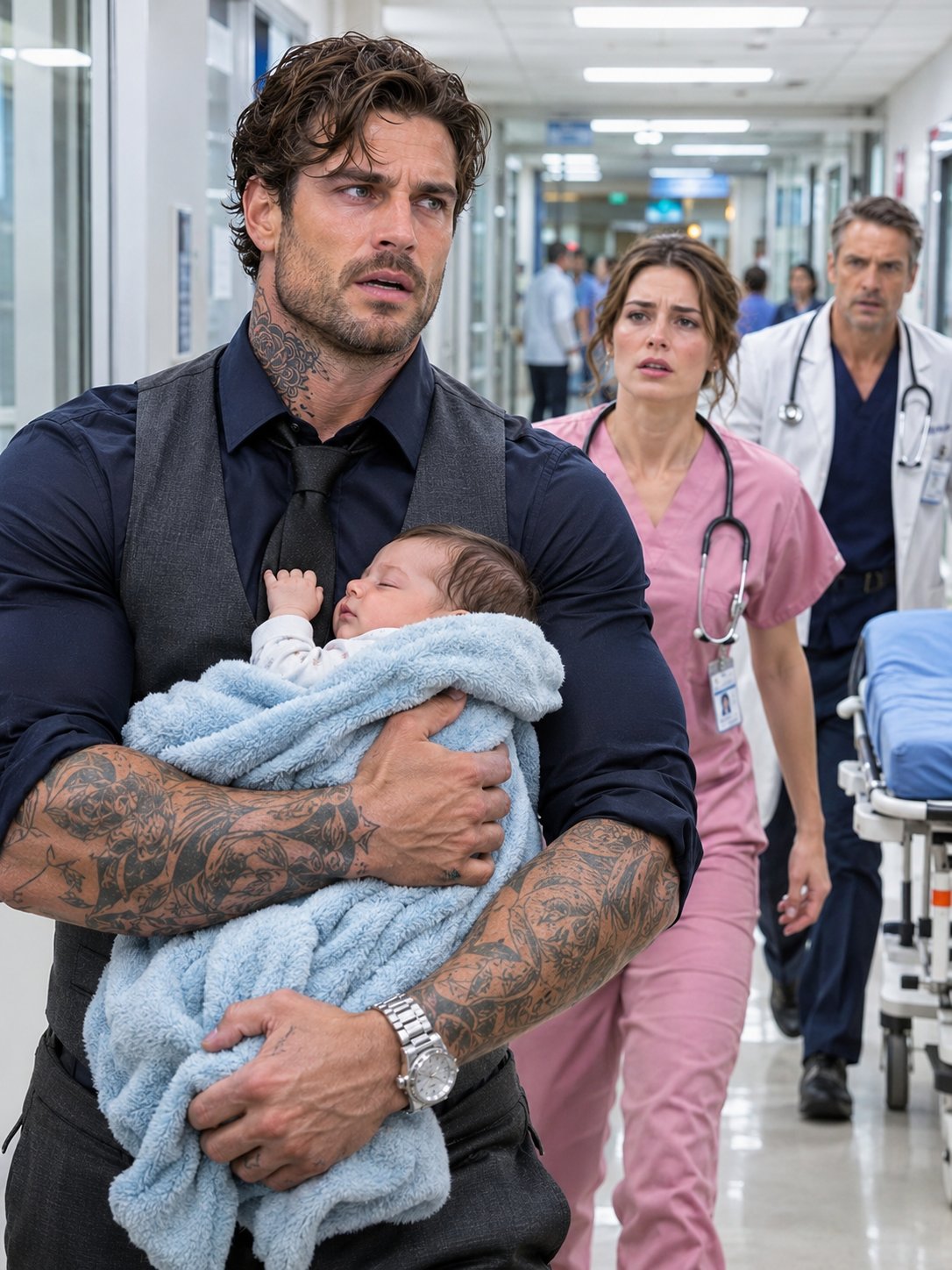
The sirens reached the house far sooner than I expected. Two paramedics ran in with a pediatric bag and oxygen already in hand. One of them looked at Jonah and said, “That’s what she described.”
I didn’t understand. I didn’t have time to.
They fitted a tiny mask over his face and squeezed air into his lungs. In the ambulance, I held his foot, the only part of him I could reach.
At Children’s Memorial, a team took him the moment the doors opened. A gurney crashed through a pair of double doors and vanished.
I tried to follow.
“Sir, you need to stay here,” a nurse said.
“He’s my son,” I said. “He’s my only son!”
I don’t know how long I waited. I sat, stood, paced. My hands were cold, and my shirt was still damp from Jonah’s bath.
Every time the doors opened, my heart stopped.
At last a doctor came out, a woman in her forties with tired eyes and a badge reading Dr. Priya Raman, Pediatric Critical Care.
I jumped to my feet. “My son? Is he alive?”
“Mr. Bannister, he’s breathing with support, and he’s stable for now.”
I had to lean against the wall.
But she didn’t smile.
“We still need to understand what happened, and I have some questions.”
“Anything,” I said.
“Did Jonah have a bath shortly before he stopped breathing?”
The question threw me. “Yes. Our housekeeper was bathing him when I got home.”
“Was she the person who normally looked after him?”
“No. She’d only just started working for us.”
“And where is she now?”
I felt a twinge of discomfort. “I fired her right after I found her bathing my son.”
Dr. Raman’s expression changed.
It wasn’t a dramatic reaction. It was worse: a sudden seriousness, as though I had told her something she needed to grasp urgently.
“Mr. Bannister, who was looking after Jonah before that woman took over?”
“Doreen. His regular nanny.”
“And where was Doreen when the bath happened?”
“According to Tessa, she’d stepped out for a few minutes.”
The doctor was silent. Then she asked, “Did the housekeeper tell you why she decided to bathe him?”
I remembered her shaking hands, her pleading voice, the sentence I had cut off with a shout.
“She said he’d been crying a long time and warm water seemed to calm him.”
“Did she say anything else?”
I swallowed. “She tried to tell me she’d noticed something about him. About Doreen.”
“What was it?”
My mouth went dry. “I don’t know.”
“You don’t know?”
I stared at the floor. “I didn’t let her finish.”
For the first time since I arrived, Dr. Raman looked truly alarmed by something I had said.
She stepped closer. “Mr. Bannister, I need you to listen carefully. What that woman was trying to tell you may be very important.”
My legs felt unsteady.
She lowered her voice. “When Jonah arrived, he showed signs we don’t see often. He had very weak muscle tone, almost no head control, a faint cry, and he hadn’t had a bowel movement in days, which the paramedics learned from your nanny’s own log when they arrived. Those symptoms together make us suspect infant botulism.”
“Botulism?” I whispered. “That’s from bad canned food.”
“In babies, it’s usually from spores that grow in the gut. The most common source is honey.”
Honey.
I stood very still.
“Mr. Bannister,” she said, “does anyone in your household give Jonah honey?”
Part 3
I called Doreen from the hospital hallway. She answered on the sixth ring, out of breath.
“Mr. Bannister? I just got back to the house, and the paramedics said…”
“Doreen. Have you been giving my son honey?”
The silence lasted too long.
“Just a little,” she said finally. “On his pacifier. When he’s fussy. My grandmother did it for all of us, and it never hurt anyone. He’s been colicky, sir, and nothing else works.”
I leaned my forehead against the cold wall. I had hired the most highly recommended nanny in the city. I had never asked what was in her bag.
“For how long?”
“A few weeks,” she whispered. Then, in a rush: “I didn’t know, I swear I didn’t know. Is he all right?”
I couldn’t answer. I hung up.
Dr. Raman was waiting. She had heard enough from my face.
“It would explain why the symptoms built up slowly,” she said gently. “Weak sucking, constipation, a feeble cry, and then, in the worst cases, the muscles that control breathing begin to fail.”
“And the bath?” I asked. My voice cracked. “Did she do something to him? Did the bath…”
“No.” She said it firmly. “The warm bath did not cause this. If anything, the person who gave him that bath is the reason your son is alive.”
I stared at her.
“Mr. Bannister, the 911 call that brought the ambulance to your house didn’t come from you first. Dispatch received a call six minutes earlier from a woman who said she had just left a house at that address, where an eight-month-old was showing signs of botulism and might stop breathing. She gave the street number, described his floppy limbs and weak cry, and said she had seen a honey-smeared pacifier in his crib. She told them to bring oxygen and a pediatric airway kit.”
“Tessa,” I whispered.
“Her name is Tessa Moreno. She did not leave your property until the ambulance was on its way. She was on the sidewalk when the paramedics pulled up. They said she pointed to the front door and told them which room.”
I couldn’t speak.
“When she was a teenager, she worked as a nursing assistant at a children’s rehabilitation center,” Dr. Raman went on. “She helped care for infants with botulism. She recognized the signs the moment she saw your son. She told the dispatcher she’d tried to tell his father, but he wouldn’t listen.”
The doctor looked me in the eye.
“Mr. Bannister, if she had not made that call, the ambulance would have been twelve minutes later, not four. In a baby that weak, those minutes are the difference between a ventilator for a few weeks and a funeral.”
Something came loose in my chest. For the first time in decades, I couldn’t stand upright. I slid down the wall and sat on the hospital floor in my ruined shirt.
“I fired her,” I said. “I screamed at her.”
“I know,” said Dr. Raman, not unkindly. “That’s something you’ll have to live with. What you do next is up to you.”
Part 4
Jonah spent twenty-three days in the pediatric ICU.
For the first nine, a ventilator breathed for him. He received an antitoxin treatment designed specifically for infants, delivered through a tiny line in his arm. The nurses told me recovery would be slow, because the toxin had to wear off as his body grew new nerve endings.
I slept in a chair beside his crib. I held his hand. I sang to him, badly. I called off every meeting on my calendar and cancelled a deal worth four hundred million dollars without a second thought.
On the tenth day, Jonah’s fingers curled around my thumb.
On the fourteenth, they took the tube out.
On the nineteenth, he cried, a loud, indignant, perfect cry, and I sobbed so hard that a nurse put a hand on my shoulder and quietly left a box of tissues.
I couldn’t stop thinking about Tessa.
It took my assistant three days to find her. She was living in a small apartment in Jersey City and had already taken another cleaning job at a dental office.
I drove there myself. I didn’t take the car service. I didn’t bring a lawyer or an envelope.
She opened the door with the chain on.
“Mr. Bannister.” Her voice was careful. “Is Jonah…”
“He’s alive,” I said. “He’s going to be fine. He’s home with a nurse and three hundred toys he can’t use yet.”
She closed her eyes and let out a breath that seemed to come from somewhere very deep.
“Thank God,” she said.
I had rehearsed a speech on the drive. It dissolved.
“I owe you more than I can say,” I told her. “I fired you for caring about my son. I yelled at you when you were trying to save his life. I didn’t listen. I’ve never been wrong like that.”
Tessa opened the door slowly.
“I understand why you were angry,” she said. “You came home and found a stranger bathing your baby.”
“That’s no excuse.”
“No,” she said, with a small, tired smile. “It’s not.”
We sat in her small kitchen. I told her everything: the diagnosis, the ICU, the honey. She told me what she had seen that day. When she noticed Jonah’s weak cry and floppy arms, she had gone to his crib and found the pacifier, sticky, with a smear of amber. She had put two and two together in an instant. She tried to warn Doreen when the nanny came back to collect her phone. Doreen had waved it off. When Tessa hurried downstairs to tell me, she found me in the kitchen.
“I thought the warm water might help his breathing relax until someone listened,” she said. “I knew it wouldn’t fix anything. I just didn’t want him to feel alone.”
I put my hand over my mouth.
“I was going to leave without saying anything more,” she said. “But I couldn’t. I kept thinking about his lips. I called 911 from the driveway.”
“Why didn’t you just come back inside?”
“Because you’d told me to go.” She said it simply, without anger. “I didn’t think I had the right.”
I understood then how much of my life had been spent teaching people that they didn’t have the right.
Part 5
Doreen was not charged with a crime. The hospital’s social worker and the county child-welfare office reviewed everything, and the investigators concluded that she had acted from ignorance, not malice. She’d believed an old family remedy was harmless. I still ended her employment, and I made sure she knew exactly why. She cried, and so did I.
“I loved that baby,” she said at the door. “Every day.”
“I know,” I told her. “That’s what makes it so hard.”
I made some changes in my own house, too. I installed cameras in the nursery, not because I distrusted anyone, but because I wanted someone else to be able to prove what happened if I ever wasn’t there to see it. More importantly, I changed how I hired. I replaced one nanny with two caregivers who rotated shifts and kept a shared log. I required a pediatric first-aid certification for every adult who touched my son.
I also called a meeting at my company. I gathered four hundred employees in the main auditorium. I told them exactly what had happened: how I had fired a woman for trying to save my child’s life, and how close I had come to losing everything because I didn’t listen.
“From today, anyone in this company, from the mailroom to the boardroom, can flag a concern about safety, ethics, or care directly to me,” I told them. “If you tell me something I don’t want to hear, you will not be punished. You will be thanked.”
Some of them looked skeptical. A few looked moved. A man in the back row, a warehouse supervisor, slowly started to clap.
Tessa came to the first anniversary of that day at my house, along with Dr. Raman and the two paramedics who had arrived first. Jonah, almost two now, toddled across the living room on sturdy legs, gripping a plastic truck in one fist. He walked straight up to Tessa, lifted his arms, and said, loudly, “Up!”
She laughed and swept him onto her hip.
“I never fully got to say goodbye,” she said, her eyes bright.
“You don’t have to now,” I said.
I had offered her a position years before she could have imagined, not as a housekeeper but in the foundation I’d just established, a program that funded pediatric first-aid training for home caregivers and daycare workers across the state. She had turned it down at first. She said it felt like charity.
“It isn’t,” I’d told her. “It’s a job. You know more about this than I do. I’m asking you to teach me.”
She finally accepted, on one condition: that I never again cut her off mid-sentence.
“Deal,” I said.
That afternoon, I watched her kneel on my living room floor with my son in her lap, showing a room full of nervous new parents how to check a baby’s breathing, how to recognize a weak cry, how to tell when something isn’t right.
“If something feels wrong,” she told them, “trust it. Even if the person in charge says otherwise. Even if you’re afraid of losing your job.”
I stood at the back of the room and listened to every word.
Later, when the guests had gone, I found Jonah asleep on the couch with the plastic truck still in his hand and a sticker of a gold star on his forehead, which Tessa had given him for being brave during the demonstration. I sat beside him and watched his chest rise and fall.
I had built an empire on the idea that authority meant never being questioned. I had learned, almost too late, that it meant the opposite: being the sort of person to whom others dared to tell the truth.
I covered my son with a blanket, turned off the lamp, and sat there in the dark, listening to him breathe.
It was the most beautiful sound I had ever heard.
THE END