PART 1

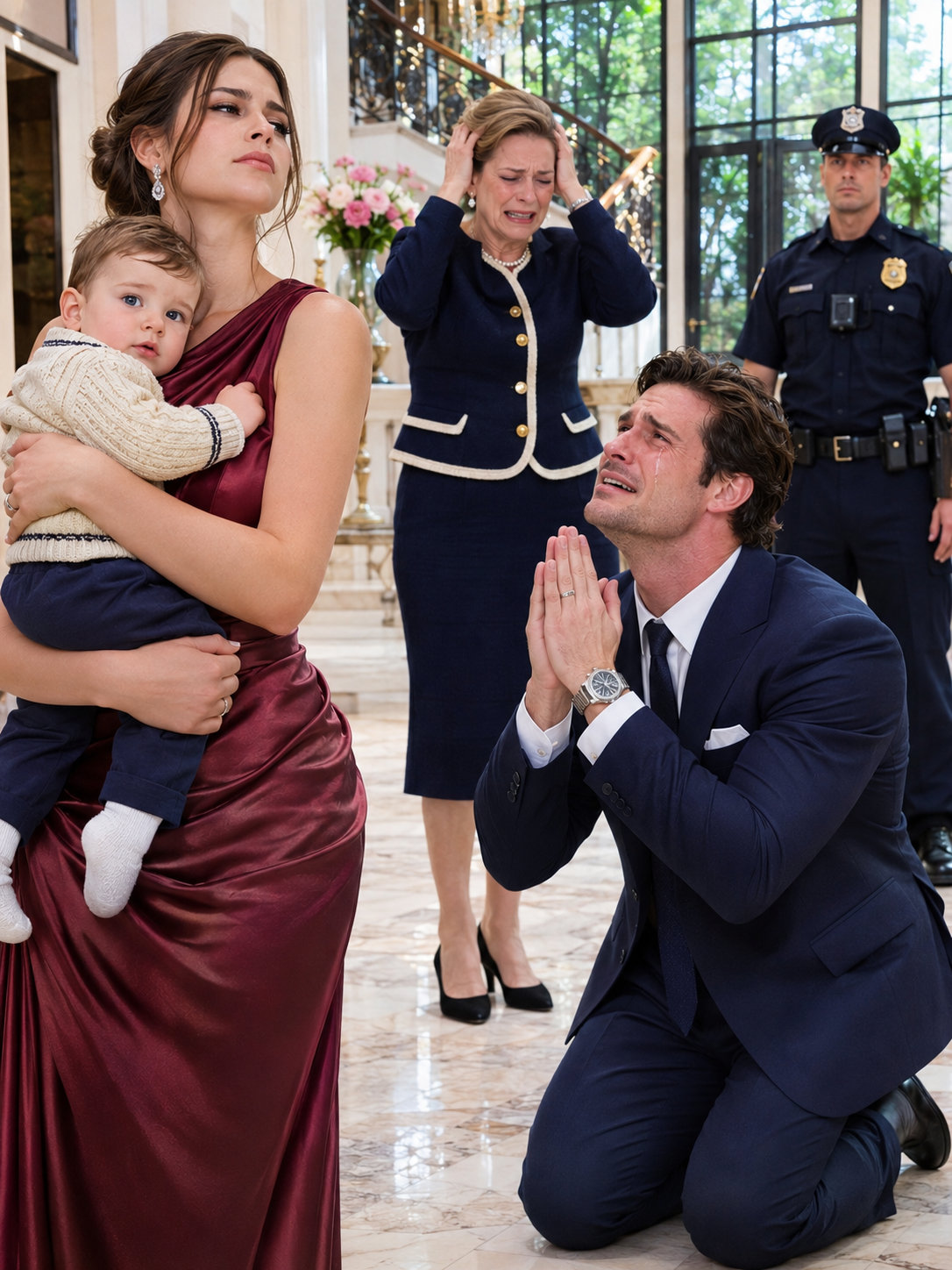
“Ma’am, put the baby down and step out of the house with your hands where we can see them!”
It was eleven-forty at night. Three patrol cars lit up the yard of my late mother’s old house in Yellow Springs, Ohio, with their flashing lights. My ten-month-old son, Miles, slept against my chest. I had a jacket over my pajamas and mud caked on my shoes.
“She took my grandson!” my mother-in-law, Rhonda, screamed, down on her knees in front of the officers. “My daughter-in-law lost her mind after the birth!”
Brent, my husband, appeared behind her. He had driven up from Kettering, same as I had, but he’d found time to comb his hair and rehearse his worried face.
“Paige, please,” he begged. “Give me Miles. I know you’re sick. Nobody’s going to judge you.”
An officer looked at me with suspicion.
“Your husband reported that you threatened him with a knife and left with the baby. We need to clear up what happened here.”
I wanted to scream. Instead, I adjusted Miles’s little blanket and asked, “Is that what he said? Is it on record in those words?”
Brent stopped crying for a second.
Eight years earlier, I would have believed anything that man told me. I worked as an accountant for a trucking company, and when we married, I put nearly all my savings and my mother’s life insurance money into buying our house in Kettering. He contributed little, but I insisted we both be on the deed.
“What we have is forever,” he told me that day.
Rhonda seemed to love me, too. She brought me soup when I was sick, and after Miles was born, she came over to watch him so I could sleep. My own mother had died years before. So when Rhonda told me, “You’re like a daughter to me,” I felt as if I’d gotten something back that I had lost.
Until the strange things began.
First I saw a text on Brent’s phone from a woman named Courtney: I put a hold on the apartment. Don’t let me down on the deposit. He said she was a client. Then I found my driver’s license and a copy of the deed outside the drawer where I always kept them.
A week earlier, Rhonda had insisted I go out and get some rest. I came back early and caught Brent going through my documents, even though he was supposedly at work.
“I was looking for an IRS receipt,” he improvised.
That afternoon I called an attorney who had been a friend of my mother’s. She advised me to gather evidence and not to confront them alone.
Today, while Rhonda watched Miles, I went to a hair salon. I opened the app for the nursery camera and saw that it was disconnected. My mother-in-law had pulled the plug. What she didn’t know was that the new unit had a backup battery and saved recordings to the cloud.
I heard her voice on the phone:
“Courtney, relax. The money comes through tomorrow. Then we get Paige taken to the hospital, and we keep the baby.”
I drove straight home, picked up Miles while Rhonda was in the bathroom, and headed for Yellow Springs. My attorney knew where I was.
Now I understood why they had come after me.
But just as I was about to show the recording to the officer, a private ambulance pulled up beside the patrol cars. Two men got out with a gurney.
Brent smiled and pointed at me.
“That’s her. We have the order to have her committed tonight.”
PART 2
“An order from whom?” I asked, hugging Miles as the officer stepped between us and the gurney.
One of the men held up a folder with the logo of a private clinic in Columbus. Inside was a note signed by a psychiatrist, a description of supposed violent episodes, and a transfer request filed by my husband.
“The family says she’s a danger,” the paramedic explained.
“That doesn’t authorize you to take her by force,” the officer replied. “We’re going to verify everything first.”
Rhonda leaped to her feet.
“Look how she’s squeezing that baby! She’s out of her mind! Listen to her husband!”
Her performance made me sadder than it frightened me. For months I had been grateful that Rhonda made me chamomile tea when I couldn’t sleep. I had also let Brent come with me to a doctor’s appointment because he said he was worried about how tired I was. He answered most of the doctor’s questions.
“You need help, babe,” he kept saying. “You can’t take care of Miles if you don’t rest.”
What none of them knew was that two weeks earlier I had stopped drinking that tea. It had a bitter taste it never used to have. I saved a sample and had it tested. The preliminary result found a prescription sedative that no one had ever prescribed me.
I looked at the officer.
“I have a complaint ready. And proof that they tried to medicate me without my consent.”
Brent let out a nervous laugh.
“See? That’s her paranoia. She thinks everyone’s out to hurt her.”
I took out my phone. First I showed the alert I’d received from the bank about a $160,000 home equity loan application secured by our house. The signature attributed to me wasn’t mine. Then I opened the camera recording.
Rhonda’s voice came through clearly in the darkness:
“Once she’s sedated, we sign what’s left. The house gets pledged and Paige walks out of there with nothing. If we keep Miles, she’ll agree to whatever we ask.”
Another voice followed. Brent’s.
“Tell Courtney not to make a scene. As long as Paige looks unstable, we’ve bought time.”
The officers exchanged glances. The paramedic slowly closed the folder.
“Sir, we didn’t know anything about this,” he told Brent.
My husband tried to snatch the phone from my hand. The officer held him back. Rhonda put a hand to her chest and started saying the recording had been edited.
Then I showed the lab results, the messages from the supposed clinic, and the confirmation that my attorney had asked the bank to block any unauthorized transaction.
“The loan hasn’t been funded,” I said. “And not a dollar goes out without an investigation of those signatures.”
Brent went pale.
“You froze the money?” he asked, forgetting Miles entirely.
At that moment Rhonda’s phone buzzed. The name on the screen was Kyle, Brent’s older brother. My mother-in-law tried to silence it, but her hands shook so badly that she answered the call while trying to put it away.
“Mom!” a desperate voice said. “Is the Paige thing ready? Tomorrow I have to pay the ninety-five thousand or they take my business!”
I stood frozen. I had believed they wanted my house to finance Brent’s new life with his girlfriend.
But I had just discovered that Courtney wasn’t the only person who’d been promised my money.
And when Kyle mentioned what they’d planned to do with Miles, even my mother-in-law tried to cover the phone.
PART 3
“Don’t say another word!” Rhonda shrieked.
Too late.
The officer standing next to us told her not to delete the call and offered to let me sit in a patrol car with Miles while they verified the situation. Before I could move, I heard Kyle’s voice still coming through the speaker.
“What’s going on? Did they take Paige to the clinic yet? Brent said with her committed, nobody would argue about the house. And the kid would go to an aunt until things calmed down.”
My mother-in-law ended the call.
For a few seconds nobody spoke. Not even Brent. All I could hear were crickets, the ambulance engine, and the small breathing of Miles, who had woken up and was looking at me without understanding why my arms were shaking.
“You said you came to rescue your grandson,” I told Rhonda. “I just heard that you meant to send him to an aunt so you could keep my house.”
“Kyle is desperate!” she answered. “He doesn’t know what he’s saying.”
“Then you explain it to us,” the officer cut in. “Why did your son call asking for money from a loan the lady says she never applied for?”
I knew Kyle owed money. He ran an auto parts shop outside Dayton and was always borrowing to buy inventory. What I hadn’t known was that for almost a year he’d been gambling huge sums at underground games. He had lost the shop, then his truck, and finally signed promissory notes with lenders who had begun hounding him.
Brent had agreed to cover part of those debts. And his mother, unable to let her favorite son face the consequences, decided the solution lay in someone else’s name: mine.
“A hundred sixty thousand dollars,” I said. “Ninety-five thousand for Kyle, fifty thousand for Courtney’s apartment, and the rest for expenses and fees. Am I wrong?”
Brent looked up as if he’d been struck.
“How do you know the amounts?”
“Because I also know you promised the loan broker a commission if he got a forged signature through. And because I’m an accountant, Brent. I’ve spent eight years reviewing invoices and transfers. I wasn’t going to stop just when it was my own house.”
It had all started when I saw Courtney’s text. I didn’t confront anyone. Instead, I went through our statements and found small deposits going into Rhonda’s account and leaving almost immediately. I saved the records I had access to. Then I found a hotel receipt and a photograph of Brent with his arm around a woman in a red dress.
That led me to consult the bank directly. Their fraud prevention department confirmed there was an application under review, submitted through an intermediary, but that they needed to verify my identity and consent before finalizing any lien.
I told the bank I had signed nothing. The transaction was halted. My attorney kept their written response and began preparing a complaint for the misuse of my information and the forgery of my signature.
“So there was never a hundred sixty thousand ready to transfer,” he murmured, livid.
“There was never a dollar you could take out behind my back,” I replied. “But you did leave an application, messages, and signatures you’ll now have to explain.”
“Paigey, honey, listen,” Rhonda said, stepping closer. “Kyle did something stupid. A mother gets desperate when she sees her children in danger. You’re a mother too. You should understand me.”
I remembered her hands holding Miles in the hospital. Her hugs when I cried for my mother. The lunches we shared, when she told me how lucky I’d been to join her family.
“Understand you?” I asked. “How am I supposed to understand that you planned to take my son?”
On the recording, Rhonda had been talking to Courtney while Miles slept in his crib.
“Brent never wanted to stay with Paige. It suited us that she bought the house with what her mother left her. When everything’s signed, we push her out. The boy stays wherever he won’t be in the way.”
“And remember the ring he gave her at the wedding? She thinks it’s a diamond. It’s cubic zirconia. I kept the real one for the woman who truly deserves to join this family.”
My eyes filled with tears. Not over the price of a piece of jewelry, but because I remembered how carefully I had treasured it. For eight years I never took that ring off. Sometimes I kissed it before going to sleep, convinced it symbolized the acceptance of a mother I no longer had.
“Don’t ever call me honey again,” I told her.
Brent tried to touch my shoulder. I pulled away.
“Paige, I didn’t know about the ring. Mom went too far, I swear. I only wanted to help Kyle.”
“And Courtney? Was she to help your brother too?”
“And the medication? Was that also help?”
The officer asked to see the ambulance paperwork. The folder held an evaluation attributed to a Dr. Raymond Pruitt claiming I suffered from psychotic episodes. It also contained an authorization signed by Brent, but no current assessment of me by anyone. The paramedics admitted they had come based solely on the family’s account and had no authorization to take me against my will.
“The transport is not happening,” the officer told them. “Stay here and give us your information and who requested the service.”
I explained why I had stopped drinking the teas Brent made me. When I woke up I felt a strange heaviness. Twice I hadn’t heard my phone alarm, something that never happened to me. I got suspicious when the taste changed. I saved a sample without drinking it and took it to a private lab. The report indicated the presence of zolpidem, a medication I had no prescription for.
The private result alone didn’t prove who had put it there. I knew that, and I told the officer so. That was why I had also kept the container, Brent’s texts about “giving me something to sleep,” and the recording of a conversation in which he asked Rhonda whether she had dissolved the pill well enough.
“We’ll need to preserve everything and request the proper lab analysis,” the officer replied.
Then Brent’s phone began to ring. The screen read “Court.”
He rejected the call. Seconds later a text flashed across the screen in front of the officer: If the payment doesn’t happen, I’ll tell about the doctor and the pills.
Courtney wasn’t a woman deceived into falling for a married man. She knew he was trying to use my assets. She had taken part in the conversations about the doctor and the supposed transfer. But she didn’t know the whole truth, either: Brent had promised her fifty thousand dollars to start a life with her, while he was putting nearly double that toward covering Kyle’s gambling debts.
“Did you really think you could build a family on the ruin of ours?” I asked him.
“You’re no saint either!” he spat. “You always bragged that you paid for the house. You made me feel like a kept man.”
“I never held it over you,” I answered. “I put you on the deed because I loved you. Don’t confuse my trust with a debt I owed you.”
Rhonda screamed that I was destroying her family.
“Your family fell apart when you decided to use Miles to force me to sign,” I said.
The officers separated us. They offered me support in formally filing my complaint and requesting a protective order. They told Brent he had to come give a statement and could not interfere with the investigation. When he tried to grab my arm to take my phone, one officer pulled him back and documented the assault.
There was no miraculous verdict that night. There was something more important: for the first time, my version was on record, with evidence, in front of people who weren’t under Brent’s control.
At dawn I arrived at the county prosecutor’s office with my attorney. Miles stayed a few hours with Mrs. Hollis, the neighbor who had looked after my mother’s house since she died. I turned over the original camera files, the lab report, the bank’s communications, and Brent’s messages. I requested protection for my son and myself.
But I wasn’t left alone. My attorney helped me protect my share of the house and start the divorce. I went back to work little by little. A coworker covered for me when I had to attend a hearing, and Mrs. Hollis took Miles whenever needed.
The forensic analyses supported several charges. Brent and the broker were investigated for the forged documents and the attempted fraud. The evidence about the medication given without my consent opened a separate case. Courtney ended up supplying messages to try to reduce her own liability, and the communications revealed how much she knew of the plan. The doctor whose signature appeared in the file was also investigated.
One day, during a hearing, Brent asked to speak with me.
“You have no idea how sorry I am,” he said, not looking at me. “I lost my job. Courtney left me. My mom is sick. I don’t want Miles to grow up hating me.”
For a moment I recognized his old voice, the one that used to promise to take care of us. I felt a pang in my chest. Eight years don’t vanish because one night the truth comes out.
“Miles has no reason to hate you,” I told him. “But I won’t teach him that loving someone means putting up with being destroyed.”
“So you won’t forgive me?”
I looked at him closely. He didn’t ask how our son was. He didn’t ask whether I could sleep, whether I was afraid, or whether I’d managed to keep the house. He wanted to know if his consequences could end.
“Forgiveness doesn’t erase evidence or restore trust,” I answered. “I’m not going to lie to save you.”
Later, rulings and agreements were issued on the property and the family situation. I didn’t get the lost years back, but the fraudulent loan was never finalized. The house stayed protected while the property dispute was resolved, and measures were set so that any contact with Miles would serve his safety and best interests. The criminal case went on its own course, and no plea for forgiveness could cancel it.
The last time I saw Rhonda was as I left a hearing. She had aged all at once. She studied me for a long time, as if expecting me to still call her Mom.
“I only wanted to save my sons,” she whispered.
“And to do it, you were willing to leave mine without his mother.”
I drove back to Yellow Springs that afternoon. The house smelled of fresh coffee and the apples Mrs. Hollis had brought from the farmers market. Miles, who was just beginning to walk while holding on to the furniture, burst out laughing when he saw me come in.
I knelt, opened my arms, and he came toward me in two clumsy steps. He fell against my chest and laughed even harder.
That was when I truly cried. Not in front of the police, or Brent, or when I heard my mother-in-law mocking me. I cried for the woman I had been, the one who mistook silence for peace and sacrifice for love. And I cried because, in spite of everything, my son could still run to me without fear.
If I learned anything that night, it’s that the cruelest betrayal doesn’t always come from a stranger. Sometimes it comes from the person who makes your tea, tucks a blanket around you, and then swears she’s doing it all for your own good.
And if Miles ever asks me why I left our house with him in my arms, I’ll tell him the truth a child deserves to hear: that his mother didn’t run because she was weak. She left because she decided that no love should cost us our freedom.