PART 1

The day my husband filed for divorce, he wore the same gray suit he’d worn at our wedding. He smiled at me from across the courtroom as if he’d already buried me.
Russell Calloway wanted the house, the savings, and sole custody of our eight-year-old daughter, Penny. His petition claimed I was unstable, overly emotional, irresponsible with money, and unfit to be a good mother. According to his attorney, I had “abandoned my responsibilities as a wife and mother.”
I sat in my navy dress with my hands folded in my lap, listening to strangers describe a woman I didn’t recognize.
Constance, Russell’s mother, sat behind him in a string of pearls and a cream blazer, dabbing at eyes that had no tears in them.
“My son just wants peace,” she whispered, loud enough for the front row to hear.
Peace. That was what they called it.
Peace was Russell emptying our joint account two weeks before filing. Peace was canceling my credit cards. Peace was Constance telling Penny, “Mommy is confused, sweetheart. Daddy knows what’s best.”
Beside Russell sat Brianna, the manager of his office, posing as a concerned family friend while wearing the diamond bracelet I had found hidden in the glove compartment of his car.
Judge Whitfield, a silver-haired woman with a piercing gaze, turned a page. “Mrs. Calloway, is your attorney not present?”
“I’m representing myself today, Your Honor,” I said.
Russell could barely suppress a laugh. His lawyer didn’t even try.
“Very well,” the judge said.
They thought I had come alone because I had no one. They thought my silence was weakness.
They didn’t know I had spent ten years as a forensic accountant before leaving my firm to raise Penny. They didn’t know I had already traced every hidden transfer, every fake invoice, and every phony consulting payment Russell had run through his company.
But numbers weren’t enough. Not yet.
Because Russell had done something worse than steal money.
He had taught my daughter to be afraid of telling the truth.
When Penny walked into the courtroom with her guardian ad litem, her navy cardigan buttoned unevenly and her teddy bear tucked under her arm, my heart broke.
She looked at me first.
Then at Russell.
Russell’s smile tightened.
Remember what we practiced, Russell mouthed, without making a sound.
Penny’s small fingers clamped around the bear.
And for the first time that morning, I saw fear cross my husband’s face.
PART 2
The hearing moved quickly.
Russell’s attorney, Mr. Prescott, rose, polished and sure of himself. “Your Honor, Mr. Calloway has stable employment, adequate housing, and a strong support network. Mrs. Calloway, by contrast, currently has no income, no attorney, and has exhibited erratic behavior.”
“Erratic?” I repeated quietly.
He smiled. “We have witness statements.”
Constance stood as if she’d been waiting in the wings for her cue. “She screamed at my son in front of the child. She broke dishes. She locked herself in the bathroom for hours.”
“That was after Russell changed the lock on our bedroom door,” I said, keeping my voice steady.
Russell shook his head, feigning hurt. “Meredith, please. Don’t do this here.”
There it was, the performance: the wounded husband, the patient saint.
Brianna leaned over and whispered something to him. Russell squeezed her hand under the table, but not quite discreetly enough.
I saw it.
So did the judge.
“Mrs. Calloway,” Judge Whitfield said, “do you have evidence to respond to these allegations?”
I opened my folder and took out a stack of financial statements, tax returns, and bank records. “Your Honor, I have a complete forensic audit documenting forty-two wire transfers over the past eighteen months from my husband’s company to an offshore account in Nevis. It also includes direct payments toward the rent on Ms. Brianna Hayes’s apartment, made with marital funds.”
Mr. Prescott shot to his feet. “Objection, Your Honor! These are baseless accusations, and there’s been no formal discovery request…”
“Overruled,” Judge Whitfield said sharply, reviewing the documents the bailiff had handed her. “These are certified bank records, counsel. Your client signed them.”
Russell went pale and turned to glare at me. But before his attorney could react, a small voice rose from the side table, near the guardian ad litem.
“Your Honor?”
The whole courtroom fell silent.
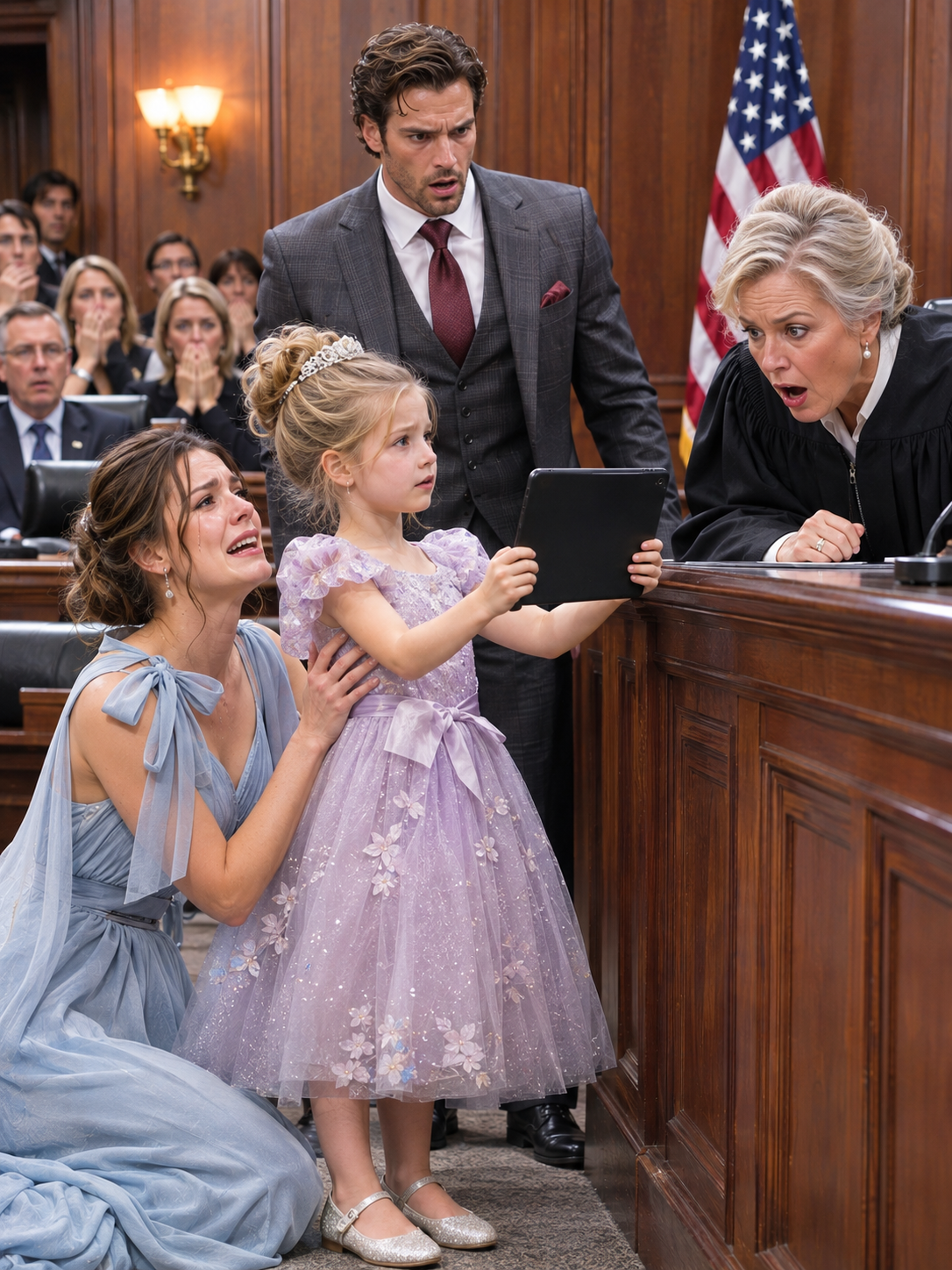
Penny stood up from her chair. From the Velcro pocket on her teddy bear’s back, she pulled a small silver digital camera, the old one my father had given her two years earlier.
“Can I show you something Mommy doesn’t know about, Your Honor?” Penny asked. Her voice trembled a little, but her eyes stayed fixed on the bench.
PART 3
Judge Whitfield leaned forward and softened her voice. “What is it you’d like to show me, young lady?”
“A video,” Penny said. “I wasn’t supposed to have the camera in the den. But Grandpa said if I ever heard something that scared me, I should record it, like a scientist.”
My father had died in the spring. Hearing his words in my daughter’s mouth made my throat close.
“Your Honor, I object,” Mr. Prescott said, his composure cracking. “A child’s recording, with no foundation, no authentication…”
“Mr. Prescott,” the judge said, without looking at him, “I’ll decide what this court watches.” She turned to the guardian ad litem, Ms. Alvarez, who had risen. “Ms. Alvarez, have you seen this?”
“I have, Your Honor. Penny showed it to me yesterday, and she asked me to bring it to the court. I made a copy immediately and logged it.” She hesitated. “I believe the court needs to see it. It bears directly on the child’s welfare.”
“Play it.”
Russell half rose from his chair. “Your Honor, my daughter is eight. She’s been confused…”
“Sit down, Mr. Calloway.”
He sat.
The bailiff connected the camera to the monitor on the wall. The screen flickered, then settled on a crooked image of the den at home: the brown leather couch, the shelf of my father’s old books, and, in the corner of the frame, the legs of the coffee table where Penny must have propped the camera.
The timestamp read October 14, 6:48 p.m.
Russell’s voice came first.
“Come here, sweetheart. Sit down. We need to go over it again.”
Penny’s smaller voice: “Do I have to?”
“You want Daddy to be happy, don’t you?” Constance was there too, her tone sugary. “Now, what do you say when the judge asks about Mommy?”
A pause. Then Penny, flat and mechanical, the way a child recites something she doesn’t understand:
“Mommy gets mad and throws things. Mommy locks the door and cries. I don’t feel safe with Mommy.”
My hand flew to my mouth.
In the gallery, someone drew a sharp breath.
On the screen, Russell said, “Good. That’s good. And what about the part where she hit you?”
“She didn’t hit me,” Penny’s voice said.
“Penny.” Russell’s voice dropped. “We talked about this.”
“But she didn’t.”
“If you don’t say it, the judge will make you stay with a mother who can’t take care of you.” That was Constance. “And Daddy won’t be able to come see you. Is that what you want? For Daddy to go away?”
On the screen, there was a long, terrible silence. Then a small, wet sound, a child trying not to cry.
“No,” Penny whispered.
“Then say it. Mommy hit me.”
“Mommy hit me,” Penny repeated.
I heard myself make a noise I didn’t recognize. Beside the monitor, Ms. Alvarez had gone rigid. The judge’s pen had stopped moving.
Then the video cut to another clip, same room, a different night. October 19. Now Brianna’s voice came through, light and amused.
“The accountant is going to be a problem. She was always sniffing around the books.”
“She can’t prove anything,” Russell said. “She hasn’t worked in years. By the time she figures out what she’s looking at, I’ll have custody, and she’ll be too busy trying to see her kid to fight me on money.”
“And the Nevis account?”
“Is in my mother’s maiden name. I’m not an idiot.” A short laugh. “Once she’s declared unstable, nobody listens to her. Judges love a father with a clean house and a crying kid.”
Constance’s voice: “She’s so good at crying on cue. Penny, I mean. We just need to keep her scared enough.”
The screen went dark.
Nobody in that courtroom moved.
I turned to look at Russell. His face had drained of color, and his mouth hung slightly open, as if the next words would come if he waited long enough. Behind him, Constance’s hand had flown to her pearls. Brianna stared at the table. Mr. Prescott had taken half a step away from his client, the way a man shifts when he realizes the ground beneath his chair isn’t solid.
“Your Honor,” Mr. Prescott said, very carefully, “I would like a recess to confer with my client.”
“I’m sure you would,” Judge Whitfield said. Her voice was calm and very cold. “Not yet.” She looked down at my daughter. “Penny, can I ask you something?”
She nodded, hugging the bear.
“Did your mother ever hit you?”
“No, ma’am.” Her voice cracked. “Never. She sings when I’m sick. She makes pancakes shaped like dinosaurs. I wasn’t supposed to say that.” She looked at me then, tears spilling over. “I’m sorry, Mommy. I didn’t want to lie. I just didn’t know how to say it, so I made the video.”
I was out of my chair before I knew it. I crossed the floor, and no one stopped me. I dropped to my knees in front of her and pulled her against my chest, and she buried her face in my shoulder and sobbed.
“You didn’t do anything wrong,” I whispered into her hair. “Not one thing. You were so brave.”
“Grandpa said to be like a scientist,” she hiccupped.
“You were,” I said. “You were exactly like a scientist.”
Above us, Judge Whitfield cleared her throat, and I realized she was working to keep her own voice steady.
“We will take a twenty-minute recess,” she said. “Mr. Calloway, you will remain in this courtroom. Bailiff, please see that he does.”
When we came back, the room had changed. Russell sat alone at the petitioner’s table. Mr. Prescott had moved to the far end of it, and I noticed he’d pulled his briefcase closer, as if preparing to leave. Constance and Brianna sat in the gallery, but not together.
Judge Whitfield took the bench.
“I have viewed the recording in its entirety, along with the forensic documentation submitted by Mrs. Calloway,” she said. “In more than twenty years on this bench, I have rarely seen a case where a child was so plainly used as a tool against her own mother.”
Russell began to speak. She held up one hand.
“Mr. Calloway, you will have the opportunity to respond through counsel in the proceedings that follow. For today, I am ruling on temporary orders.” She turned her pages. “The petitioner’s request for sole custody is denied. Temporary sole legal and physical custody of the minor child is awarded to the respondent, Mrs. Meredith Calloway. Mr. Calloway’s parenting time will be supervised, pending a full evaluation, and his mother is prohibited from any unsupervised contact with the child.”
Constance gasped. The judge ignored her.
“The marital accounts, including all accounts identified in the forensic audit, are frozen effective immediately. Any further transfers will be treated as contempt of this court. I am also ordering the respondent’s financial records and the video recording to be preserved and forwarded, along with this transcript, to the county prosecutor’s office and the state attorney general for review of possible fraud and witness coaching.”
“Your Honor,” Mr. Prescott began, his voice thin.
“Counsel, I would advise you to speak with your client about whether this firm can continue to represent him.” She looked at the bench in front of her. “And I would advise Ms. Hayes to consider whether she wishes to be found in this courtroom when the prosecutor’s investigators arrive.”
Brianna was already gone, her heels clicking down the aisle toward the exit. A deputy followed her out at a measured pace.
“Mrs. Calloway,” Judge Whitfield said, and her expression softened, “you represented yourself with extraordinary competence. But I would strongly encourage you to retain counsel for what comes next.”
“I will, Your Honor. Thank you.”
“Don’t thank me.” She nodded toward Penny, who stood pressed against my side. “Thank her.”
She struck the gavel. It was over, at least for that morning.
Outside the courtroom, the hallway was loud with the ordinary noise of other people’s problems. I sat Penny on a bench and crouched in front of her.
“Are you mad at me?” she asked.
“Mad?” I laughed, and it came out wet. “Sweetheart, no. I’m the one who’s sorry. You shouldn’t have had to carry that by yourself.”
“Daddy said you’d go away if I told.”
“I’m not going anywhere. Not ever.”
She studied my face, the way she’d studied it all those weeks, searching for the tell. Then she nodded slowly and put her small hand in mine.
“Can we get pancakes?”
“Dinosaur-shaped,” I said.
“Dinosaur-shaped,” she agreed, and she almost smiled.
The months that followed were not clean or quick. Russell hired a new attorney, who didn’t last long once the prosecutor’s office began returning subpoenas. The Nevis account was traced within weeks, with help from a banking contact I’d kept from my forensic days. It had been funded with nearly four hundred thousand dollars siphoned from Russell’s own company and from two clients who, as it turned out, were very interested in getting their money back.
Constance never apologized. In the end, she didn’t have to. The court’s supervised-contact order held through the entire evaluation, and a child psychologist wrote a report that I read only once. It said Penny had been “systematically coached by two adults whose motives were financial rather than protective.” After that, the family court stopped treating Russell as the wounded husband.
Russell took a plea eventually. Fraud, tampering with a witness, and a count of conspiracy that Brianna, ironically, provided the evidence for once she realized she could trade it for leniency. He served eleven months, with five years of probation to follow. The marital property was divided, with the court weighing his financial misconduct heavily. I kept the house, most of the savings, and full custody. Russell kept his supervised visits, and, after some time and a lot of therapy for all of us, a slow, careful chance to earn back whatever trust Penny was willing to give.
I went back to forensic accounting, this time as a partner in a small firm that handled domestic financial abuse cases. My first client was a woman who had come into a courtroom alone, in a navy dress, holding a folder she didn’t know how to open.
I taught her how.
One evening the following spring, Penny and I sat on the back porch, watching fireflies come up out of the grass. She held the silver camera in her lap, turning it over and over.
“Mom?”
“Yeah, sweetie?”
“Grandpa said a scientist keeps the evidence even when it’s sad. So I kept it. But I don’t want to watch it anymore.”
I put my arm around her. “You don’t have to. The judge and the lawyers have copies. It’s safe. You don’t have to carry it anymore.”
She thought about that for a while.
“Can I use the camera for something else?”
“Like what?”
She pointed at the yard, where one firefly had drifted higher than the rest and hung there, blinking against the dark.
“Like that.”
I smiled and handed her the camera. She held it up, carefully, the way my father had taught her, and held very still.
Somewhere in the house, my phone buzzed with a new case file. It could wait.
Tonight, my daughter was filming fireflies, and for the first time in a very long while, nobody was telling her what to say.