PART 1: The Unclaimed Signature

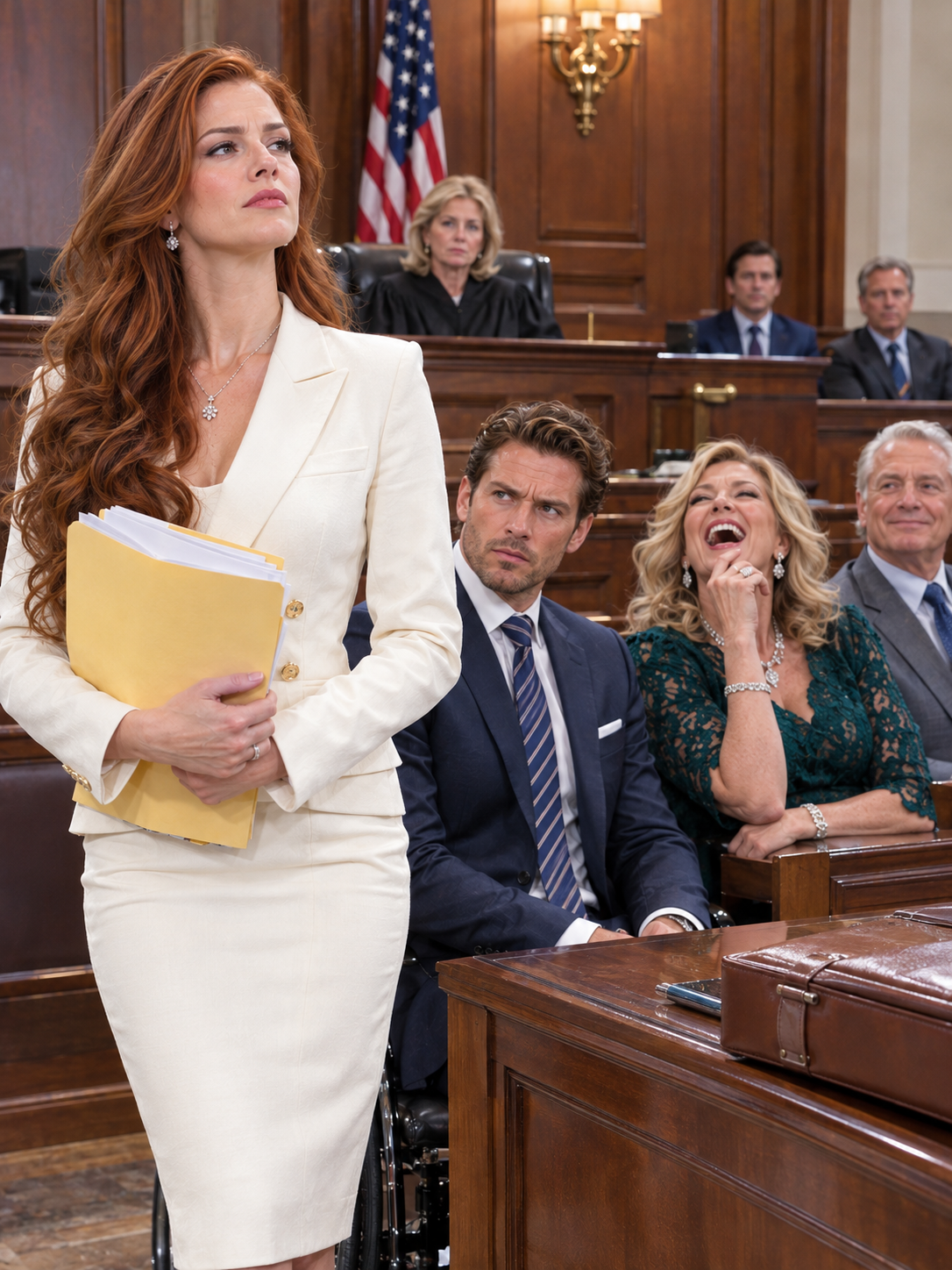
My mother-in-law actually laughed out loud when I walked into the divorce courtroom completely alone, while my husband sat smugly beside three expensive attorneys, certain they were about to strip me of everything I owned. They had no idea that when I told the judge I had never signed their divorce agreement and opened my leather folder, the entire room was about to discover a truth my husband’s family had never bothered to learn about me.
“Well, look who finally decided to show up,” Miriam Prescott whispered loudly enough for everyone in the front rows to hear. “And she arrived without a single lawyer, which is truly embarrassing for all of us.”
Her heavy diamond bracelet glittered under the fluorescent ceiling lights as she raised a manicured hand to her mouth, pretending to hide another cruel laugh. Beside her, my father-in-law, Harold, leaned across the wooden bench with a satisfied smirk on his face.
“David was completely right about her,” Harold murmured back to his wife. “She really doesn’t stand a chance against our legal team.”
Across the wide aisle, my husband, David, adjusted his silk tie and exchanged confident smiles with his three attorneys. At the front of the room, Judge Margaret Thornton looked down over the rims of her reading glasses and addressed me calmly.
“Mrs. Prescott, do you fully understand that you have the constitutional right to legal representation in these proceedings?” Judge Thornton asked.
“Yes, Your Honor, I understand completely,” I replied in a steady voice.
“And you have voluntarily chosen to represent yourself today?” the judge continued.
“That is entirely correct, Your Honor,” I confirmed.
David’s lead attorney, Lawrence Mercer, immediately pushed his chair back and stood up. “Your Honor, we are deeply concerned that Mrs. Prescott may unnecessarily complicate what should be a very straightforward divorce settlement.”
Straightforward was the exact same word David had used three weeks earlier when he dropped a thick stack of divorce papers right beside my morning coffee plate.
“Just sign these papers, Tessa, and please do not make this difficult for either of us,” David had said that morning without even looking up from his phone.
“Seven years, David,” I had answered quietly, staring at the cold ink on the page. “Seven years of managing your household, hosting your executive dinners, organizing your travel schedules, and driving your parents to every single medical appointment, and you are claiming in writing that I contributed nothing?”
“You simply took care of the house, Tessa, so please do not exaggerate your importance to my career,” David had replied dismissively before walking out the front door.
For seven long years, his wealthy family had treated me like a quiet, obedient housewife whose only purpose in life was making David’s days run smoothly. They never once asked a genuine question about my past, and they certainly never cared what I had accomplished before marrying into their name. Because of that willful ignorance, David never understood why I could remain so completely calm whenever someone tried to intimidate me in a closed room.
Before I became Tessa Prescott, I was Captain Tessa Bennett, a seasoned prosecutor and attorney in the United States Army Judge Advocate General’s Corps. I had spent years examining complex financial evidence, dismantling dishonest arguments, and standing firm in military courtrooms where a single overlooked detail could destroy an entire case. I had willingly walked away from that demanding career because I genuinely hoped for a peaceful, loving marriage.
“Mrs. Prescott?” Judge Thornton called out, bringing my focus back to the bench. “You may proceed with your opening statement.”
I slowly unclasped my worn leather briefcase and pulled out a slim manila folder. Behind me, Miriam leaned forward and whispered to her husband, “Oh, this little performance should be quite entertaining.”
I stood tall at the plaintiff’s table and looked directly at the judge. “Your Honor, before we discuss a single line of their proposed settlement, there is a critical fact this court needs to know.”
Across the room, David’s confident smile instantly faltered.
“I never signed the divorce agreement they submitted to this court,” I stated clearly, unfolding the top sheet to reveal the very first document.
PART 2: The Letter Walter Left Behind
Lawrence Mercer rose from his leather chair so quickly that the heavy oak frame struck the polished table behind him with a sharp crack. “Your Honor, I strenuously object to the introduction of any private documents that have not been properly disclosed during the discovery phase!”
Judge Thornton lifted one calm hand to silence him before he could continue. “Mr. Mercer, you may formally raise your objection after Mrs. Prescott explains to the court what this specific document is.”
In the gallery behind him, Miriam leaned forward and whispered to the attorney with sudden, sharp urgency. “What on earth did she bring in that folder?”
David shook his head slowly, his brow furrowing as he stared at my hands. “I honestly have no idea what she is holding.”
“Well, you certainly should know, David!” Miriam hissed under her breath.
Judge Thornton turned her attention back to me at the front table. “Mrs. Prescott, please identify the first document for the official record.”
I lifted the cream-colored page from my folder and held it carefully by the edges so the ink would not smudge. “Your Honor, this is a handwritten letter from Walter Prescott, David’s late grandfather, written exactly eight months before David and I were married.”
A faint, startled murmur moved through the spectators sitting in the courtroom gallery. Walter Prescott had been dead for nearly six years, yet his name still carried immense authority and weight throughout the entire Prescott family. He had founded Prescott Industrial Systems at the age of thirty-two and built it into the massive manufacturing empire that paid for the family’s estates, private vacations, charitable foundations, and carefully polished public reputation. More importantly to me, he had been the only person in that entire family who ever asked me a thoughtful question and actually waited to hear the complete answer.
David shifted uncomfortably in his seat, leaning toward his microphone. “Why on earth would my grandfather write a private letter to you?”
“That is precisely what I am about to explain to the court,” I replied evenly.
I handed a certified copy to the court clerk, who walked it up to the bench for Judge Thornton to inspect. Walter’s bold, slanted handwriting had always been unmistakable to anyone who knew him. Judge Thornton read the two pages silently for nearly a full minute, and as her eyes moved down the paper, the smug color drained rapidly from Miriam’s face.
Harold noticed his wife’s sudden tension and leaned closer to her shoulder. “What is going on with you?”
Miriam kept her lips pressed tightly together and refused to answer him. Judge Thornton finally looked up from the letter and fixed her gaze on me.
“Mrs. Prescott, while this appears on the surface to be a personal letter, it explicitly references financial instruments and legal obligations that may be directly relevant to the proposed settlement,” the judge noted.
“Yes, Your Honor, that is correct,” I agreed.
“Please explain the nature of those instruments to the court,” Judge Thornton instructed.
The entire hearing room felt noticeably quieter than before, even though the bailiff had not asked the spectators to stop moving. “Walter Prescott established an irrevocable trust in my name several months before David and I were married,” I explained clearly.
“A private trust?” Judge Thornton asked, making a brief note on her legal pad.
“Yes, Your Honor, and it was funded through blue-chip investments, commercial property interests, and a separate cash account managed by an independent trustee completely outside the Prescott family,” I continued.
Lawrence Mercer immediately stood up again, his face flushing slightly red. “Your Honor, this is precisely why we objected earlier, because this alleged trust has never appeared in any of the financial disclosures exchanged during our settlement negotiations.”
“Counselor, that omission is hardly a legal basis for suppressing relevant evidence,” Judge Thornton replied briskly.
“With respect, Your Honor, a premarital trust may be entirely irrelevant to the marital estate,” Mercer argued.
“On the contrary, it may also be highly relevant depending on how those funds were utilized,” Judge Thornton countered firmly.
I reached into my folder and placed a second bound document neatly on the wooden table. “This trust was never created as a financial gift to David, Your Honor.”
David’s eyes remained locked on the papers resting on my table as I spoke. “It was created specifically to protect me,” I added steadily.
From the gallery behind him, Miriam let out a small, involuntary gasp that echoed in the quiet room. Judge Thornton folded her hands over the letter on her bench.
“Mrs. Prescott, why would Mr. Walter Prescott feel the need to create a protective trust for you before your marriage even began?” the judge asked.
My gaze dropped briefly to the familiar handwriting on the copy in front of me. The very first time I had read those words, I was sitting completely alone in Walter’s quiet study just three days after his funeral, while David was downstairs with his parents receiving condolences from wealthy relatives. Walter’s study had remained almost exactly as he left it, with a heavy brass clock ticking steadily on the stone mantel. The envelope had been addressed not to Mrs. David Prescott, and not to Tessa Prescott, but simply to Tessa.
The letter began with a deeply sincere apology from an old man who saw far more than his family realized. Walter wrote that he had watched me enter a household that valued blind obedience far above personal honesty, and he had noticed how often I softened my own opinions just to keep peace at the dinner table. He wrote that he knew I had given up a promising legal career because David wanted a quieter domestic life and because I believed a good marriage required equal sacrifice from both partners.
“You have mistaken silence for peace, Tessa, and my family has mistaken your peace for weakness,” Walter had written in dark blue ink.
Realizing Judge Thornton was still waiting for my response, I raised my head and spoke clearly. “Walter knew that I had served as a United States Army attorney before meeting his grandson.”
David turned sharply in his chair to stare at me across the aisle. “You actually told my grandfather about that?”
“I told him all about my service before we were married, David,” I answered calmly.
“You never told me much about your time in the service,” David protested, sounding genuinely caught off guard.
“I told you clearly that I had worked in military law,” I reminded him gently.
“You told me you worked in military administration!” David insisted.
“No, David, I said I worked in military law, though the distinction never seemed important enough for you to ask a follow-up question,” I replied.
Back when we were engaged, I had naively assumed David’s lack of curiosity meant he trusted me completely without needing to inspect my resume. Walter, however, had listened closely to every word I said and had questioned why I was willing to walk away from the courtroom. I had smiled at the old man back then and told him that loving David mattered far more to me than any legal title.
Walter had studied my face for a long, quiet moment before offering a warning I had failed to heed at the time. “Love should always add to your life, Tessa, and it should never require you to disappear from it,” he had told me softly.
Judge Thornton turned over the first page of Walter’s letter on her bench. “Mrs. Prescott, does this trust instrument contain specific provisions concerning your marriage?”
“Yes, Your Honor, it contains a strict disclosure clause,” I confirmed.
“What do those provisions require?” the judge asked.
“The trust requires that David disclose all major marital and business assets honestly in any legal proceeding involving our joint finances,” I explained.
Lawrence Mercer scoffed loudly beside his client. “Your Honor, we have no legal reason to believe a private trust provision written by a deceased relative is enforceable against Mr. Prescott.”
“It does not need to be independently enforceable against him for his mandatory disclosure obligations to exist under state family law, Mr. Mercer,” Judge Thornton said sharply.
“Even so, a separate premarital trust is not marital property,” Mercer pressed.
“That specific legal question has not yet been decided by this court,” Judge Thornton replied coolly.
Behind the defense table, Miriam was no longer pretending to be amused by the morning’s proceedings. I reached into my folder once more and pulled out a thick stack of certified financial ledgers.
“I also brought authenticated bank records showing the trust’s direct financial contributions during our seven years of marriage,” I stated.
David finally turned to look at me directly, his posture stiffening. “What financial contributions are you talking about?”
For a brief second, I remembered him as the ambitious young man I had met eight years ago. Back then, he was trying to build an independent engineering division inside Prescott Industrial Systems, determined to prove he could create something without relying entirely on his father’s approval. When he told me he wanted to spin off and launch his own precision manufacturing firm, I had stayed up late every night helping him draft the business plan. I built the financial spreadsheets whenever his excitement outran his bookkeeping, and I negotiated calmly with suppliers whenever he was too proud to admit he had missed a shipping deadline.
I had not invested my own military savings because I had very little left after leaving the service, so I had quietly authorized disbursements from the investment account Walter left for my protection. Part of that money paid the entire down payment on our first house in Fairview Heights. Another substantial portion covered the early payroll and operating expenses of David’s startup firm, while smaller monthly transfers paid our household bills so he could reinvest every single dollar of profit back into company expansion.
The trust had never made us overnight billionaires, yet it had made it possible for David to take bold business risks while I quietly absorbed the financial pressure. Whenever the topic of money came up at Sunday dinners, his parents had smugly referred to our lifestyle as generous family support.
“During the course of our marriage,” I answered clearly for the court record, “funds from my personal trust paid approximately six hundred and eighty thousand dollars toward our real estate, David’s business expenses, and our daily household obligations.”
David’s face drained of whatever little color remained in his cheeks. “That simply cannot be right, Tessa.”
“Every single penny is documented right here,” I replied evenly.
“I would have known if that much money was coming from your account,” David argued, his voice rising slightly.
“You knew money was always available whenever you needed it,” I pointed out.
“I only knew my grandfather had left a small nest egg for you,” David stammered.
“You knew more than enough to spend it without asking where it came from,” I answered quietly.
David’s mouth opened as if to argue, but no sound came out. Judge Thornton leaned over the certified statements I had handed the clerk.
“Are these official bank statements, Mrs. Prescott?” the judge asked.
“Yes, Your Honor, every page is an original bank record,” I confirmed.
“And have they been properly authenticated for evidentiary purposes?” she inquired.
“They were produced directly by the independent trustee and officially certified under seal by the holding bank,” I explained.
For the first time that morning, Lawrence Mercer looked less like a high-powered corporate attorney directing a routine case and more like a man realizing the entire lawsuit had never truly belonged to him. Miriam leaned forward over the wooden railing and whispered frantically to the lawyer, “Those private accounts were supposed to remain completely confidential.”
Miriam’s eyes widened the instant she realized how loudly she had spoken, and Harold turned toward her with a sharp, warning glare. In that single second, everything clicked into place for me because they had known about Walter’s trust fund all along.
Judge Thornton looked sharply over her glasses at the defense table. “Mrs. Prescott, are you suggesting to this court that the opposing party was fully aware of this trust and intentionally failed to disclose it?”
“I am suggesting that this court should conduct a thorough investigation before approving any divorce agreement that falsely states I made no financial contribution during our marriage,” I replied firmly.
Lawrence Mercer cleared his throat and buttoned his suit jacket. “Your Honor, the proposed settlement was drafted entirely based on the financial information provided to our firm by my client.”
“Your client is Mr. David Prescott sitting beside you?” Judge Thornton asked.
“Yes, Your Honor,” Mercer confirmed.
“Then Mr. Prescott may answer the court’s questions directly for himself,” Judge Thornton declared.
Mercer gave David a small, tightly restrained shake of his head. It was the exact sort of silent warning gesture I had witnessed countless times during our marriage whenever his parents were nearby, signaling him not to say a single word more than necessary. David had always hated direct confrontation, preferring to let Miriam speak for him at family gatherings, let his lawyers speak for him in business negotiations, and let me speak for him whenever someone asked what he genuinely wanted out of life.
Judge Thornton fixed her gaze squarely on my husband. “Mr. Prescott, did you know about this trust established by your grandfather?”
David swallowed hard before speaking into his microphone. “I knew my grandfather Walter had arranged something modest for Tessa.”
“When exactly did you learn about that arrangement?” the judge pressed.
“Shortly after we were married, Your Honor,” David admitted quietly.
“Did you know the full extent of the assets held inside that trust?” Judge Thornton asked.
“No, Your Honor, I never saw the balance sheets,” David replied.
“Did you know that funds from her trust had directly contributed to your real estate purchases and business operating expenses?” she continued.
“I simply knew Tessa had access to personal money when we needed help,” David hedged.
“That was not the question I asked you, Mr. Prescott,” Judge Thornton said sternly.
David’s hands tightened nervously around one another on top of the polished table. “I knew she helped us financially during the early years, yes.”
Judge Thornton returned her attention to the handwritten letter resting on her bench. “Mrs. Prescott, what does Mr. Walter Prescott state in this letter regarding the ultimate purpose of the trust?”
“He wrote that if I ever needed to enforce my legal rights against the Prescott family, I should never allow myself to be intimidated by their wealth or their public reputation,” I read aloud.
In the gallery behind David, Miriam’s expression hardened into pure venom. “That is an utterly outrageous interpretation of my father-in-law’s words!”
Judge Thornton fixed a cold stare on the older woman. “Mrs. Miriam Prescott, you are not a party to this hearing, so please do not interrupt these proceedings again.”
Miriam lowered her gaze immediately, though not before I caught a distinct flash of genuine fear moving behind her eyes. Walter had never trusted his daughter-in-law, even though I had spent years organizing her charity luncheons, tracking her specialist appointments, and listening patiently to endless stories about the sacrifices she claimed she had made for her family. Looking at her now, I realized she had never wanted a daughter-in-law at all, because she simply wanted total respect and obedience without ever offering a shred of it in return.
Judge Thornton read through the final paragraph of Walter’s letter one more time before speaking. “Mr. Mercer, I will not be approving this proposed divorce settlement today.”
“Your Honor, if I may—” Mercer began urgently.
“The proposed agreement contains material financial representations that now appear severely incomplete, if not deliberately inaccurate,” Judge Thornton interrupted firmly.
Behind the table, Miriam gripped the wooden railing so tightly her knuckles turned white. Judge Thornton continued in a brisk, authoritative tone. “I am hereby ordering a comprehensive forensic financial investigation into the premarital trust, all marital assets, Mr. Prescott’s corporate business interests, and any financial transfers executed during the course of the marriage.”
Harold’s heavy wooden cane struck the marble floor with a dull thud. “Your Honor, this level of intrusion is completely unnecessary.”
Judge Thornton turned her sharp gaze toward him without blinking. “Unless you wish to be held in contempt of court, Mr. Prescott, I strongly suggest you sit quietly and allow legal counsel to speak.”
Harold’s face flushed a deep, angry crimson as he sank back against the bench. Judge Thornton directed the court clerk to enter the formal discovery order into the record, instructing both parties to preserve all accounting ledgers, electronic communications, bank statements, property deeds, and corporate records under penalty of perjury.
Twenty minutes later, as I walked out into the quiet marble corridor outside the courtroom, David hurried after me and caught up near the tall arched windows. “Tessa, please wait a second.”
“What do you want, David?” I asked, stopping beside a stone pillar.
“Why didn’t you ever tell me about that letter from my grandfather?” he asked, looking genuinely shaken.
“I actually tried to tell you,” I replied evenly.
“When did you ever try to tell me?” David demanded.
“Right after Walter passed away six years ago,” I reminded him.
“You never said a single word about a trust or a letter!” he insisted.
“I told you plainly that I had found a sealed letter addressed to me in his study,” I answered.
“You told me it was just a personal farewell note,” David argued.
“It was deeply personal, David, and you never asked a single question about what was inside it,” I pointed out.
“Did you know about all of these bank figures before walking into court today?” he asked quietly.
“I knew about the trust and its purpose from the very beginning,” I confirmed.
“And you just let me believe we were negotiating a normal, quiet divorce?” David asked, sounding almost betrayed.
“You walked into my kitchen and handed me an agreement claiming I made zero financial contribution to our seven-year marriage,” I reminded him sharply.
“I didn’t personally draft that legal language, Tessa,” David said defensively.
“You signed your name at the bottom of the page, David,” I countered.
“I trusted my attorneys to handle the paperwork properly,” he pleaded.
“You trusted everyone in this room except your own wife,” I said softly.
For one brief, unguarded instant, the polished corporate executive who had sat so smugly beside three expensive attorneys completely vanished. “I honestly never thought you would do something like this to me,” David whispered.
“Do what, David?” I asked.
“Turn our divorce into an all-out public war,” he replied.
“I brought authenticated bank records to court because you brought a calculated lie,” I answered firmly.
Ten yards down the corridor, Miriam was speaking urgently in low tones to Lawrence Mercer, while Harold stood beside her looking pale and unusually rigid. David glanced back over his shoulder at his parents before turning his eyes back to me.
“Did my grandfather leave anything else in that study for you?” David asked in a low voice.
“Yes, he did,” I answered truthfully.
“What else did he leave?” he pressed, stepping a fraction closer.
“He left a sealed estate file that the trustee instructed me to open only if I ever suspected the Prescott family had concealed marital assets,” I explained.
David went entirely still in the middle of the hallway, and ten yards behind him, Miriam abruptly stopped speaking mid-sentence. I had not yet broken the wax seal on that heavy file, yet looking at their sudden terror, I knew Walter had hidden a truth inside it that could destroy far more than our marriage.
PART 3: The Price of Silence
For several tense seconds after I mentioned the sealed estate file, nobody in the marble corridor moved a muscle. David’s face had gone completely pale beneath the harsh hallway lights, Miriam had stopped breathing loudly enough for everyone nearby to hear, and Harold’s weathered hand tightened until his knuckles bleached white around the handle of his cane.
“Who exactly told you to open that file?” Miriam demanded, stepping forward with her composure visibly cracking.
“The independent trustee who manages Walter’s estate,” I answered calmly.
“Which trustee are you talking about?” Harold snapped.
“Carolyn Mercer,” I said, watching their reactions closely.
“She still manages Walter’s personal estate?” Miriam asked sharply, turning her head toward her husband.
“She manages the private trust Walter established,” I clarified.
Miriam whipped around to glare at David with pure fury in her eyes. “You told me months ago that Carolyn had retired from family business!”
“I told you she no longer handled the charitable foundation, Mother,” David replied tightly.
That small factual correction appeared to unsettle Miriam even more deeply than my courtroom revelation had. Lawrence Mercer stepped smoothly between his clients and me, raising a placating hand.
“Mrs. Prescott, as an officer of the court, I strongly advise you not to open or distribute any private document without allowing legal counsel to review it first,” Mercer said smoothly.
“Are you referring to your legal counsel or mine, Mr. Mercer?” I asked coolly.
“Any document that may potentially affect the marital estate must be handled strictly through proper discovery channels,” the attorney insisted.
“I completely agree with following proper legal procedure,” I replied.
“Then you surely understand why ambush disclosures in open court are deeply problematic,” Mercer pressed.
“I understand far better why concealing millions of dollars in assets is problematic, Counselor,” I answered without blinking.
David flinched visibly at my words, and beside him, Miriam let out a sharp breath. That was the exact moment I began to wonder whether David was far less certain of his parents’ version of events than he had allowed me to believe.
“The court-ordered forensic investigation will determine what is legally relevant,” Mercer stated stiffly.
“Yes, it certainly will,” I agreed.
“And until that audit concludes, everyone involved should avoid jumping to reckless assumptions,” he added.
“I have spent the last seven years avoiding assumptions, Mr. Mercer, and today that habit officially ends,” I said before turning down the hall toward the elevators.
When I reached the courthouse lobby, the elderly clerk from Judge Thornton’s courtroom caught up with me near the revolving doors to hand me a stamped copy of the preservation order. Perhaps she recognized my name from the divorce docket, or perhaps she simply recognized the quiet exhaustion of a woman who had walked into a courtroom carrying far too much weight on her own shoulders.
That night, checked into a quiet downtown suite at the Riverview Grand Hotel, I slept through the night without once lying awake listening for David’s key turning in the front door lock. When I woke up the next morning, pale autumn sunlight stretched across the heavy curtains, and the decision I had been avoiding for six years suddenly felt completely simple.
I was going to open Walter’s sealed estate file. I was not doing it because I wanted to ruin David’s career, nor because I craved petty revenge against Miriam or Harold. I was opening it because Walter had entrusted me with a solemn responsibility, and because the dishonest divorce agreement presented in court had proven beyond doubt that my silence was no longer protecting anyone worth saving.
At nine o’clock sharp, I picked up my phone and dialed Carolyn Mercer’s private office line. “Tessa,” Carolyn answered on the second ring, her voice carrying the exact same calm precision I remembered from Walter’s memorial service.
“Carolyn, I am sorry to call you so early in the morning,” I began.
“You are not actually sorry, Tessa,” Carolyn replied dryly.
“No, I suppose I am not,” I admitted honestly.
“Then you are frightened by what you found in court yesterday,” she observed gently.
“Yes, I am,” I confessed.
“Good, because honesty is a much safer starting point than politeness,” Carolyn said. “Did the preliminary divorce hearing take place as scheduled?”
“It did, yesterday morning,” I confirmed.
“And did David’s attorneys present the settlement agreement to the judge?” she asked.
“Yes, they tried to push it right through,” I told her.
“Did you sign a single page of it?” Carolyn inquired.
“No, I refused,” I answered.
“I suspected strongly that you would not sign,” she remarked with quiet satisfaction.
“How could you possibly be so sure?” I asked.
“Because Walter told me years ago that a former Army prosecutor would never sign a contract she had not thoroughly cross-examined,” Carolyn explained.
“He knew me far better than my own husband did,” I murmured.
“He certainly did, my dear,” Carolyn agreed.
“Carolyn, can you tell me what is waiting inside that sealed file?” I asked, staring at the heavy envelope resting on the hotel desk.
“If I simply told you over the phone, Walter’s careful instructions would be completely meaningless,” she replied.
“Then please tell me what I need to understand before I break the wax seal,” I urged.
“You need to understand that the entire file was assembled solely for your protection,” Carolyn said seriously.
“Protection from David?” I asked.
“Not specifically from David alone,” she clarified.
“From whom, then?” I pressed.
“From anyone in that family who might try to persuade you that protecting the Prescott name was the exact same thing as protecting yourself,” Carolyn answered.
For most of my marriage, I had genuinely believed that loyalty meant quietly carrying heavy burdens without ever asking whether they actually belonged to me. Sitting in that quiet hotel room, I realized Walter had recognized that dangerous flaw in my character long before I ever saw it in myself.
“Why did Walter wait until after his death to let me see this?” I asked.
“He never expected you to need it while he was still alive to keep his family in check,” Carolyn explained.
“And what did he expect after he passed away?” I questioned.
“He expected you would need several years of marriage to figure things out on your own,” she replied.
“Time to figure out what?” I asked softly.
“Time to determine whether you had married into a merely difficult family or a fundamentally dishonest one,” Carolyn said quietly.
My fingers tightened around the edge of the wooden desk. “Carolyn, did Walter know that Miriam and Harold were hiding family assets?”
“As trustee, I cannot answer that question directly,” she replied carefully.
“Can you answer it indirectly for me?” I pleaded.
“I can tell you that Walter grew deeply concerned about the charitable foundation’s accounting records during the final year of his life,” Carolyn admitted.
“You mean the Prescott Veterans Foundation?” I asked, sitting up straighter in my chair.
“Yes, that exact organization,” she confirmed.
“The charity dedicated to supporting wounded service members?” I repeated in disbelief.
“That is certainly what the public brochures called it,” Carolyn answered coolly.
The Prescott Veterans Foundation supposedly funded physical rehabilitation programs, pro bono legal assistance, and transitional housing grants for former military personnel. Over the last five years, I had personally helped Miriam organize four of its major annual fundraising galas, and I had even edited the emotional speeches she delivered at the podium whenever she asked me to make her words sound less formal.
“Did Walter believe the foundation was misusing donor money?” I asked, feeling a cold knot form in my stomach.
“He believed the financial accounting required an immediate, independent examination,” Carolyn replied carefully.
“That is not quite the same thing as accusing them of theft,” I noted.
“No, Tessa, it is not the same thing at all,” she agreed.
“Did Walter ask you to launch an investigation before he died?” I asked.
“He asked whether I would safeguard the records so you could investigate if the need ever arose,” Carolyn revealed.
“Why would he leave that job to me?” I asked quietly.
“Because Walter knew you understood both military law and human nature,” she answered.
For seven years, I had assumed my legal background was something David merely tolerated because it belonged to a chapter of my life before we met. Now I understood that Walter had always viewed my legal training as the core of who I truly was.
“Where are you staying right now, Tessa?” Carolyn asked suddenly.
“I checked into a downtown hotel last night,” I told her.
“Good, stay right where you are,” Carolyn instructed firmly.
“Why is being at a hotel so important?” I asked.
“Because you should never open that file inside a house where other family members can walk in and out freely,” she warned.
“I am completely alone in the suite,” I assured her.
“Then remain completely alone until you have read every single page, and do not take photographs of the contents with your phone,” she added.
“Why shouldn’t I photograph them?” I asked.
“Because the file contains privileged legal communications and sensitive financial records that must remain secure,” Carolyn explained.
“I have no desire to publicly humiliate anyone, Carolyn,” I said softly.
“I know you don’t, Tessa,” she replied.
“Then why do you sound so worried about me?” I asked.
“Because people who are terrified of the truth rarely distinguish between malicious exposure and simple accountability,” Carolyn warned before hanging up.
After we ended the call, I sat completely motionless at the desk for nearly ten minutes, staring at the thick envelope sealed with dark green wax bearing Walter’s embossed initials. That wax seal had remained completely unbroken since the afternoon I discovered it tucked behind his law books. Using a silver letter opener from the hotel stationery tray, I carefully sliced open the top edge and slid out a handwritten note, a small tarnished brass key, and a thick stack of financial papers bound neatly with linen thread.
“Tessa,” the handwritten note began in Walter’s familiar script. “If you are reading this letter today, then either my old man’s caution was entirely justified, or your loyal heart has finally stopped making excuses for people who profit from your silence. Begin your review with the foundation account ledgers, and do not begin by blaming David.”
I set the note aside and unfolded the first bound document, which turned out to be a confidential letter from Walter to Carolyn dated fourteen months before his death. In crisp, unsentimental language, Walter wrote that several large foundation grants had been approved and disbursed without complete supporting documentation. Some payments had been wired to consulting entities with patriotic-sounding names that possessed no verifiable operating history, while other massive sums had been routed directly through a private family holding company connected to Prescott Industrial Systems.
I read that terrifying paragraph twice to make sure my eyes were not playing tricks on me. Walter had instructed Carolyn to preserve certified copies of every foundation ledger so an auditor could determine whether those transfers were harmless administrative errors, unauthorized private loans, or deliberate criminal diversions of charitable funds. Anger can easily distort how a lawyer reads evidence, so I forced myself to take a slow breath and examine the second document objectively.
The second attachment was a multi-page accounting ledger tracking foundation disbursements over a three-year period. Several large line items carried cryptic initials rather than registered charity names, and an entire column marked temporary allocation listed outgoing transfers ranging from twenty thousand to nearly two hundred thousand dollars each. Every single one of those transfers had moved directly into bank accounts belonging to a corporation called Prescott Strategic Holdings.
My breath caught in my throat as I recognized the name. David had casually mentioned Prescott Strategic Holdings once during a holiday dinner with his parents, describing it as a routine family investment vehicle created to manage legacy real estate. Back then, I had politely asked whether it was connected to his own manufacturing startup, and he had quickly changed the subject.
I turned immediately to the third document in the stack, which was a certified state corporate registration filing. Prescott Strategic Holdings had been legally incorporated exactly six weeks before David dropped the divorce papers beside my breakfast plate. Beside the corporate filing, I laid out the proposed divorce settlement agreement David had tried to force me to sign in court, which explicitly swore under oath that David owned no financial interest in any business entity other than his small technology firm.
Looking back at the corporate registration, I saw that the initial managing directors of Prescott Strategic Holdings were listed as Harold Prescott and Miriam Prescott, operating out of a private suite downtown. One of the corporation’s very first recorded transactions involved the quiet transfer of a controlling block of shares from David’s manufacturing firm, valued at slightly over four million dollars. While the registration document itself did not explicitly label the transfer fraudulent, the timing told an unmistakable legal story.
I picked up my cell phone from the desk and dialed David’s direct office number. “Tessa?” David answered quickly, sounding breathless.
“Where are you right now, David?” I asked calmly.
“I am sitting at my office desk,” he replied.
“Do you know anything about a company called Prescott Strategic Holdings?” I asked directly.
There was a long, heavy pause on the other end of the line before he spoke. “Who on earth told you that company name?”
“So you do know exactly what it is,” I stated coldly.
“I know my family maintains several private investment entities for tax purposes,” David hedged.
“Did you transfer your controlling company shares into that holding company right before filing for divorce?” I demanded.
“Tessa, please listen to me,” he began.
“Answer the question directly, David, because I am holding the corporate transfer records in my hand,” I warned.
“I didn’t initiate the transfer personally, Tessa,” he stammered.
“That was not my question,” I replied sharply.
“Yes, I signed the transfer paperwork,” David finally admitted in a defeated voice.
“When did you sign those papers?” I pressed.
“Fairly recently,” he muttered.
“How recently, David?” I demanded, watching traffic move in orderly streams far below my hotel window.
“Just a few weeks before the divorce filing,” he confessed quietly.
“Why would you hand over four million dollars in company equity right before asking for a divorce?” I asked.
“My father told me it was part of a necessary corporate restructuring,” David explained defensively.
“Was it your own company’s restructuring?” I asked.
“No, it was tied to my parents’ broader estate planning,” he replied.
“Your sworn divorce agreement claims you own no interest in any business other than your startup firm,” I reminded him.
“Technically, I still own an indirect interest in the company,” David argued.
“Hidden safely inside a family holding company that conveniently omits my marital share,” I pointed out.
“Holding those shares inside the entity does not mean I personally control them,” he protested.
“Then who actually controls Prescott Strategic Holdings, David?” I asked.
“The family trustees control it,” he replied vaguely.
“That is not a real answer, and you know it,” I said firmly.
“It is a very complicated legal structure, Tessa,” he sighed.
“That word complicated has shielded you from accountability for seven entire years,” I told him.
“Tessa, you have to listen to what I am trying to tell you,” David pleaded.
“No, David, today you are going to listen to me,” I snapped. “You filed a sworn legal agreement in family court that intentionally omitted a four-million-dollar equity transfer executed weeks before our separation.”
“I did not personally draft that settlement agreement,” David repeated.
“You signed your name on the signature line, David!” I countered.
“I honestly believed the shares were only being held there temporarily,” he insisted.
“For what legitimate business purpose?” I demanded.
“I already told you, my father said it was for estate restructuring,” David replied.
“Who specifically instructed you to sign those transfer papers—was it Miriam or was it Harold?” I asked.
“Tessa, I didn’t stop to think about how it would look,” David whispered.
“That has been the entire problem throughout our marriage,” I answered coldly.
“I was genuinely trying to keep the manufacturing firm financially stable,” he argued.
“Stable for whom, David?” I pressed.
“For the four hundred employees who depend on our payroll every week,” he replied.
“If your motive was purely protecting your workers, then why hide the transfer from the court?” I asked.
“I wasn’t trying to hide anything from you,” David insisted.
“Your three expensive attorneys certainly failed to disclose it on your financial affidavit,” I noted.
“I assumed my lawyers knew what was required under state law,” he muttered.
“Did your parents explicitly tell you to sign that equity transfer before filing for divorce?” I asked again.
“Tessa, please…” David trailed off miserably.
“My father insisted the company needed immediate legal protection,” David finally admitted.
“Protection from what threat?” I demanded.
“Protection from our divorce proceedings,” he confessed softly. “My father warned me that if the shares remained in my personal name, everything we built could be frozen and disrupted.”
“Everything meaning your manufacturing company, or everything meaning your family’s total financial control?” I asked sharply.
“I honestly don’t know anymore, Tessa,” David admitted, sounding completely exhausted.
“Yet you picked up a pen and signed the papers anyway,” I stated.
“I was under tremendous pressure from both of them,” he pleaded.
“Family pressure is not the same thing as legal coercion, David,” I reminded him.
“I know that, Tessa,” he whispered.
“Do you really know that?” I asked.
“I knew exactly how dishonest it looked on paper,” David confessed.
“And you went ahead and did it anyway,” I said quietly.
“Yes, I did,” he admitted.
“Did Miriam know about the share transfer before you signed?” I questioned.
“Yes, she was right there in the room,” David confirmed.
“Did she specifically instruct you to conceal the transfer from me?” I pressed.
“She told me that you would inevitably misunderstand the business reasons behind it,” David replied.
“Perhaps your mother was right about me for once, because I understand the fraud completely,” I said icily.
“Tessa, please don’t use that word,” he begged.
“Were charitable foundation funds also involved in these transfers, David?” I asked suddenly.
“What foundation funds are you talking about?” he asked, sounding genuinely confused.
“I am asking whether money belonging to the Prescott Veterans Foundation was routed through that same holding company,” I clarified.
“I swear to you I don’t know anything about foundation money,” David insisted.
“Do not lie to me again today, David,” I warned.
“I am not lying to you, Tessa!” he protested.
“You just admitted that you signed multiple corporate documents without reading them,” I reminded him.
“I only signed routine tax and restructuring papers prepared by my father’s longtime accountant,” David explained.
“Which accountant prepared those papers?” I asked sharply.
“Arthur Pendelton,” David answered.
Arthur Pendelton had handled the Prescott family’s corporate taxes for over twenty years. I suddenly remembered a charity gala two autumns ago when Arthur had quietly tried to correct an inflated fundraising figure in Miriam’s printed speech, only for her to publicly humiliate him in front of twenty wealthy donors. Back then, I had simply felt sorry for the older man’s embarrassment, never realizing he was trying to prevent a felony.
David spoke again on the line, his voice sounding tight. “I truly didn’t know anything about foundation money moving through that account.”
“Even if that is true, you knew something was seriously wrong with the company’s books,” I stated.
“I knew the main family accounts were under severe financial pressure,” David admitted reluctantly.
“Why would a massive manufacturing empire be under financial pressure?” I asked.
“Because my father made several catastrophic private investments over the last three years,” David revealed.
“What kind of investments?” I asked.
“Speculative commercial real estate and high-risk private lending,” David explained.
“How bad were his losses?” I pressed.
“Bad enough that he secretly borrowed millions against Prescott Industrial assets to cover his margin calls,” David confessed.
Looking down at the financial ledger on my hotel desk, my eyes caught a single sentence Walter had underlined in dark ink near the bottom of the page: “Protect Tessa from financial obligations created by men who believe family loyalty excuses criminal recklessness.”
“Did your grandfather Walter know about your father’s gambling with company assets?” I questioned.
“Walter knew my father had made several reckless mistakes before he died,” David admitted.
“Did Walter know that you were helping cover up your father’s debts?” I asked.
“I never covered up anything, Tessa!” David protested.
“You literally just admitted you signed corporate transfers to shield the company from scrutiny,” I reminded him.
“I genuinely believed I was protecting our factory workers’ jobs,” David insisted.
“And whose money actually paid off your father’s emergency debts, David?” I asked softly.
“I honestly don’t know how my father settled his loans,” he replied.
“Yes, you do know, David,” I said firmly.
“Tessa, I swear I don’t,” he repeated.
“You used hundreds of thousands of dollars from my personal trust fund,” I revealed.
I heard a sharp scraping sound over the phone line, as if David had suddenly pushed his heavy desk chair backward. “What did you just say?”
“You already admitted in court that my trust paid business expenses during our marriage,” I reminded him.
“Yes, I knew your trust helped cover startup costs,” David stammered.
“Some of those exact wire transfers were used to pay down loans connected directly to your father’s failed real estate deals,” I explained.
“That is completely impossible, Tessa,” David gasped.
“Every single wire transfer is documented in the bank statements sitting right in front of me,” I told him.
“My grandfather Walter would never have allowed his trust to bail out my father,” David argued.
“He didn’t allow it, because they waited until after he died to divert the money,” I answered.
David’s breathing grew ragged and shallow over the phone line. “What exactly are you accusing me of doing?”
“I am telling you that money meant solely to protect my future was quietly drained to keep your family’s financial failures out of the newspapers,” I said clearly.
“I never authorized a single transfer for my father’s debts,” David insisted.
“Did you ever once bother to ask where that money was actually going?” I challenged.
“I simply knew funds were available in the operating account,” he muttered.
“And having the cash available was all you cared about,” I replied.
“No, Tessa, it wasn’t like that,” he pleaded.
“Yes, David, it was exactly like that,” I countered.
“My mother told me those transfers were simply part of your trust’s normal investment strategy,” David explained weakly.
“Did Miriam tell you that?” I asked.
“She told me Walter wanted my manufacturing firm to succeed at all costs,” he admitted.
“And what did Harold tell you?” I pressed.
“My father promised me those funds would be repaid in full once his real estate deals closed,” David confessed.
“Were any of those loans ever repaid to my trust, David?” I asked, glancing down at the ledger columns showing repeated outgoing wires without a single incoming deposit.
“David, how much of this scheme did you actually know about?” I demanded into the silence.
“I knew there were short-term bridge loans,” he whispered miserably.
“Loans made to whom?” I asked.
“To the main manufacturing company,” he answered.
“And what about Prescott Strategic Holdings?” I pressed.
“I swear to you I didn’t even know that holding company existed until earlier this year,” David insisted.
“Yet you willingly signed four million dollars in company shares directly into its accounts,” I pointed out.
“I was told it was a temporary legal holding structure to protect the patent rights,” he stammered.
“Who told you that lie?” I demanded.
“My mother did,” David whispered.
Miriam had not merely known about the fraudulent asset transfer; she had actively orchestrated the entire trap. “Why did your mother claim that transfer was so urgent?” I asked.
“She told me my father had created personal liabilities that could bankrupt the entire family if we didn’t shield the stock,” David explained.
“And what did she say would happen if you refused to sign?” I asked softly.
David’s voice dropped so low I could barely hear him over the connection. “She told me I would lose my entire inheritance and be removed from the board.”
“She claimed Grandfather’s estate would be completely reorganized without me,” he continued rapidly.
I suddenly remembered the unmistakable flash of terror in Miriam’s eyes in the courtroom corridor when I mentioned Walter’s sealed file. “Did your mother actually threaten to disinherit you, David?”
“She never called it a threat,” he replied bitterly.
“What did she call it?” I asked.
“She called it a necessary family ultimatum,” David answered.
“What were the exact terms of her ultimatum?” I pressed.
“She told me that if I wanted to remain president of my own company, I had to divorce you immediately and transfer the shares into the family trust,” David confessed.
Before I could even process that betrayal, David rushed on in a broken voice. “She convinced me that you would use your legal background to take advantage of the family if we stayed married.”
“She painted me as a financial predator?” I asked in disbelief.
“She claimed your premarital trust gave you dangerous leverage over the Prescott board,” he explained.
“Your mother spent seven years happily accepting money from that exact same trust!” I snapped.
“She told me that accepting family help was completely different from giving an outsider control,” David muttered.
“Of course she said that,” I replied coldly.
“I should have stood up to her and stopped it right then,” David whispered.
“Yes, David, you certainly should have,” I agreed.
“I know I failed you, Tessa,” he said quietly.
My eyes dropped back to the underlined warning at the bottom of Walter’s handwritten note: “Do not begin with David.” Suddenly, I understood why the old man had written those four words, because he knew his grandson would end up trapped as both a helpless victim and a willing accomplice.
“You helped them defraud me, David,” I said evenly.
“Yes, I did,” he admitted without making another excuse.
“You may have been under tremendous pressure from your parents, yet you still chose to help them,” I added.
“Yes, I know that now,” he replied softly.
“And worst of all, you let me walk around believing I was being discarded simply because you no longer loved me,” I said, feeling the old ache rise briefly in my chest.
“I never stopped loving you, Tessa,” David whispered urgently.
“Love without basic honesty quickly becomes just another form of abandonment, David,” I replied.
That single truth summarized every quiet dinner where he had dodged my questions, every tax form he had told me not to bother reading, and every evening I had swallowed my own instincts just to keep peace in our home. After a long, heavy silence, David finally spoke again.
“What are you going to do with those documents now?” he asked quietly.
“I am going to hand every relevant record over to the court-appointed forensic investigator,” I answered firmly.
“Are you going to give them the foundation ledgers too?” David asked, sounding terrified.
“If they show diverted charitable funds, yes, I will hand over everything,” I replied.
“Tessa, if the state attorney general gets involved with the foundation, my parents could lose control of the entire company,” he pleaded.
“If the foundation’s money was stolen, those funds belong to wounded veterans, not to your parents’ real estate brokers,” I countered sharply.
“They are in their seventies, Tessa—they could actually face criminal prison sentences,” David warned.
“I am a witness, David, not a prosecutor anymore, so I am not deciding what criminal charges anyone faces,” I replied.
“You could completely destroy my entire family with one phone call,” he said desperately.
“No, David, I am not destroying anyone,” I answered calmly. “Your parents made those criminal choices years before I ever broke the wax seal on this envelope.”
Suddenly, a sharp, familiar female voice cut directly into our phone conversation. “Tessa, listen to me right now.”
David must have accidentally hit the speakerphone button on his desk, or else Miriam had barged directly into his office without him ending our call. “Hello, Mrs. Prescott,” I said coolly.
“You clearly do not understand what Walter intended when he wrote those notes,” Miriam said, her voice tight with controlled panic.
“Then by all means, explain his intentions to me,” I invited.
“Walter was nearly eighty-five years old, deeply suspicious, and increasingly confused about modern corporate finance,” Miriam claimed smoothly.
“Was he confused when he accurately documented three years of fraudulent wire transfers from a veterans’ charity?” I asked sharply.
“He completely misunderstood temporary inter-company accounting arrangements,” Miriam insisted.
“Did he also misunderstand the forged grant receipts in the foundation ledgers?” I pressed.
Over the speakerphone, Miriam’s breathing grew noticeably ragged. “Those private corporate records do not belong to you, Tessa.”
“They are legally in my possession because Walter entrusted them directly to me,” I replied.
“Walter never truly trusted anyone in his entire life!” Miriam snapped.
“He trusted me enough to leave me the key,” I answered calmly.
“Do you seriously believe a sentimental letter makes you a real member of this family?” Miriam sneered.
“No, Mrs. Prescott,” I said softly, turning my gaze toward the framed wedding photograph still sitting inside my open suitcase. “I foolishly thought seven years of marriage made me family.”
Miriam’s sharp tone softened unexpectedly into a pleading murmur. “Tessa, please think carefully—if you release those raw ledgers, hundreds of innocent people who had nothing to do with this will suffer terribly.”
“Are you suddenly worried about the factory employees?” I asked skeptically.
“I am worried about the employees, their young families, and the charitable recipients who rely on our grants,” Miriam claimed smoothly.
“If you truly care about protecting them, then tell the forensic investigator the complete truth immediately,” I challenged.
“You still think the truth is simple, don’t you?” she sighed.
“No, I know the truth is painful, which is why hiding it only makes the eventual collapse much worse,” I replied.
“You have no idea what Harold has had to do over the last five years just to keep that manufacturing company afloat,” Miriam whispered fiercely.
“Then let Harold explain his actions directly to the court investigator,” I answered.
“If you hand over those ledgers, Harold will go to federal prison!” Miriam cried out.
“Is that what has you so terrified today—not the wounded veterans, and not your son, just your husband facing consequences?” I asked.
In the background, David spoke softly and firmly. “Mother, please stop talking right now.”
Miriam completely ignored her son. “You were always sitting quietly in the corner waiting for an excuse to turn against us, weren’t you?”
That single accusation stung deeply because it revealed exactly how she had viewed me from the very first day we met—never as a daughter-in-law, and never as an equal partner to her son. “No, Mrs. Prescott, I spent seven years waiting patiently for a reason to believe you respected me,” I replied before pressing the button to end the call.
I spent the remainder of the afternoon spread out on the hotel bed, carefully organizing and cross-referencing every single page from Walter’s file. While the stack of papers did not contain every missing bank statement, the financial pattern was undeniable: charitable foundation grants had been systematically routed into shell accounts linked to Prescott Strategic Holdings, four million dollars in David’s company stock had been transferred days before the divorce filing, and hundreds of thousands of dollars from my personal trust had been quietly siphoned off to cover Harold’s bad real estate debts.
Near the very bottom of the folder, tucked beneath a tax schedule, I discovered a smaller sealed envelope addressed directly to Carolyn Mercer. Inside was a single index card bearing one name written in Walter’s bold hand: Arthur Pendelton. Beside the accountant’s name, Walter had written one clear sentence: “He knows exactly where the missing ledgers are hidden.”
I immediately picked up my phone and dialed Carolyn Mercer’s office again. “You finally reached the index card with Arthur’s name,” Carolyn said as soon as she answered.
“How did you know what I was looking at?” I asked in surprise.
“Because Walter told me that finding Arthur’s name would be the exact moment you stopped wondering whether the Prescotts were merely troubled and realized they were criminal,” Carolyn explained.
“What did Arthur Pendelton actually know about the accounts?” I asked urgently.
“He knew enough to resign from the firm quietly six months ago,” Carolyn revealed.
“If he knew about the stolen foundation funds, why didn’t he come forward to the authorities?” I questioned.
“Out of sheer terror, most likely,” Carolyn answered sympathetically.
“Terror of Miriam?” I asked.
“Terror of losing his accounting license, his remaining clients, and his ability to support his sick wife,” Carolyn explained.
“Do you know where Arthur is living right now?” I asked.
“Actually, Tessa, he contacted my office yesterday afternoon,” Carolyn said.
“Why would he reach out to you after six months?” I asked.
“He heard about the court order freezing the Prescott records, and he said he has something important he needs to give you personally,” she replied.
“What does he have?” I demanded.
“Printed copies of private emails,” Carolyn answered.
“Emails sent by whom?” I asked.
“Sent directly between Miriam and Harold Prescott,” she confirmed.
“Are they discussing the charitable foundation?” I pressed.
“Both the charitable foundation and the equity transfer from David’s manufacturing firm,” Carolyn explained.
“Does Arthur know who truly controls Prescott Strategic Holdings?” I asked.
“He claims he was forced to draft the original incorporation paperwork for them,” Carolyn said.
“Then why hasn’t Arthur turned those emails over to the court investigator already?” I wondered aloud.
“Because he insisted on speaking with you face to face first,” Carolyn replied.
“Why on earth would he need to see me first?” I asked.
“Because one of the earliest emails in his possession directly concerns you, Tessa,” Carolyn said softly.
“What does that email say about me?” I demanded.
“I honestly have not opened the envelope he left at my reception desk,” Carolyn replied.
“Carolyn, please tell me you are joking,” I groaned.
“Walter strictly instructed me never to read private communications intended for you unless you explicitly granted permission,” she reminded me firmly.
“Then what did Arthur tell you when he dropped off the envelope?” I asked.
“He told me those emails prove the Prescott family did not merely conceal marital assets from the divorce judge,” Carolyn answered slowly.
“What else do they prove?” I asked, feeling a chill run down my spine.
Carolyn hesitated for a fraction of a second before speaking. “They prove that David’s decision to divorce you was never actually his own idea.”
My mind flashed back instantly to David standing pale and exhausted in the courthouse corridor, confessing to his mother’s ultimatum. Before I could ask another question, Carolyn added the final detail that made my blood run completely cold. “Arthur also mentioned that those emails prove Miriam knew every single detail about your premarital trust years before Walter passed away.”
“How many years before he died?” I whispered.
“Long enough to explain the real reason Walter felt forced to create that trust in the first place,” Carolyn answered.
Before I could even respond to her words, a sharp, hesitant knock sounded against my heavy hotel room door. Setting the phone down on the desk, I walked over and pulled the door open to find an older man standing nervously in the hallway, noticeably thinner than I remembered, clutching a worn leather briefcase tightly against his chest.
“Mrs. Tessa Prescott?” he asked softly, glancing nervously up and down the empty corridor.
“Yes, please come inside,” I said, stepping back quickly.
“My name is Arthur Pendelton,” the accountant whispered as he stepped into the room, “and I am deeply sorry it took me this long to find the courage to bring you the truth.”
He walked over to the small desk, unclasped his worn briefcase, and pulled out a thick packet of printed emails secured with a heavy rubber band. “The very first message in this stack was written over six years ago, just days after Walter’s funeral, and it was sent directly from Miriam’s private email account,” Arthur explained, his voice trembling slightly.
“What did Miriam write in that email?” I asked, staring at the paper in his hands.
Arthur’s weathered face tightened with disgust as he handed the packet across the desk to me. “She wrote that Walter had made a terrible mistake by setting up a trust to protect you, and she swore that if David ever tried to walk away from the family business, she would personally make sure you paid the ultimate price for it.”
PART 4: Walter’s Final Instruction
Arthur Pendelton held the thick packet of printed emails out toward me, yet for several seconds I simply stood beside the hotel desk unable to reach forward and take it. “If David ever tried to walk away from the family business,” I repeated quietly, testing the weight of those words in the silent room.
Arthur nodded slowly, his shoulders sagging beneath his tweed jacket. “Miriam wrote explicitly that you would be the one forced to pay for his rebellion.”
“Why on earth would she blame me for David wanting to build his own company?” I asked in disbelief.
“Because she was convinced you were the reason David had finally started questioning his father’s reckless business decisions,” Arthur explained.
“That makes no logical sense whatsoever, because I never interfered with Prescott Industrial,” I protested.
“It made complete sense to a woman who measures every relationship purely in terms of obedience and control,” Arthur replied softly.
I stepped aside so the older man could sit down in the upholstered armchair near the window, while I slowly took the printed emails from his trembling hands. Arthur set his worn leather briefcase on the carpet and pulled out a second, much thinner folder marked with Walter’s stamped initials on the cover.
“Carolyn mentioned on the phone that there were still missing accounting records,” I said, placing the emails carefully beside the lamp.
“Yes, there are several critical ledgers missing from the main corporate servers,” Arthur confirmed.
“Where are those missing records hidden?” I asked.
“Several of the electronic transfers are documented right inside those printed emails you are holding,” Arthur explained.
“And where are the remaining original ledgers?” I pressed.
“Walter’s longtime corporate attorney kept certified copies locked away in a private vault,” Arthur revealed.
“Are you talking about Carolyn Mercer?” I asked.
“No, Carolyn only handled the family trust, whereas Walter retained an old-line law firm downtown called Sterling, Vance—excuse me, Sterling and Caldwell—no, let me look at my notes, it is Thorne—no, it is Whitaker—let me check the letterhead right here,” Arthur corrected himself quickly, pulling out a cream business card reading Whitmore and Crane.
Whitmore and Crane was one of the oldest and most respected probate law firms in the entire state, famous for handling complex estate litigation and maintaining the kind of ironclad discretion wealthy families treated as a private form of insurance. “Why didn’t Walter’s estate attorneys ever contact me after he died?” I asked, staring at the embossed card.
“Because Walter left strict legal instructions forbidding them from contacting you unless the specific conditions outlined in his letter were met,” Arthur explained.
“What specific conditions did he require?” I asked quietly.
Arthur’s tired expression softened with genuine respect. “You had to uncover concrete evidence of financial wrongdoing on your own and formally challenge the family in court.”
My mind drifted back to the handwritten letter tucked safely inside my leather briefcase. Walter had not merely anticipated that I might one day need financial protection from a messy divorce; he had anticipated that I might need undeniable proof to give myself permission to stop protecting everyone else at my own expense.
I looked down at the top page of the printed email packet Arthur had brought me. The message had been sent from Miriam’s private webmail account to Arthur’s office address six years earlier, less than a week after we buried Walter in the family plot, bearing the subject line: David’s future.
“Arthur,” Miriam’s email read in cold, clipped sentences. “Walter made a serious mistake by creating that independent trust to protect Tessa. She has already begun subtly influencing David against the Prescotts and encouraging his ridiculous dream of running an independent operation. If David insists on leaving the main manufacturing division, the financial consequences will be his own responsibility, but Tessa must understand that she will not walk away from this marriage untouched. Do not discuss this message with Harold. Miriam.”
I read that short paragraph twice before setting the paper down on the polished wood surface. “She wrote this less than a week after Walter’s funeral,” I murmured aloud.
“Yes, the very same week,” Arthur confirmed grimly.
“Why did she believe Walter made a mistake by setting up my trust?” I asked.
“Because she realized immediately that an independent source of income gave you personal freedom,” Arthur explained.
“It certainly gave me security,” I agreed.
“And to Miriam Prescott, any woman inside her family who possessed financial independence was an unacceptable threat,” Arthur added.
Outside the tall hotel windows, autumn dusk was settling rapidly over the city skyline, turning the concrete office towers into dark silhouettes against a deep violet sky. “Did David ever know his mother sent emails like this behind his back?” I asked softly.
“Not that I am aware of, no,” Arthur answered honestly.
“You worked closely with the entire family for over two decades,” I noted.
“I did, right up until my conscience finally forced me to walk away,” he said.
“Did David at least know you were preserving backup copies of these ledgers?” I pressed.
Arthur lowered his eyes to the carpet between his shoes. “No, Mrs. Prescott, nobody knew I was keeping a private archive.”
I turned to the second printed email in the stack, which was a reply sent from Harold Prescott to Arthur two years later. While Harold’s tone was slightly more formal than his wife’s, the underlying fraud was even more alarming.
“The main operating company cannot absorb another unscheduled cash withdrawal this quarter,” Harold had written. “Walter’s trust arrangements must remain strictly segregated from our corporate operating funds on the public balance sheet. If the fund must be accessed again to cover our short-term bridge notes, classify the outgoing transfers on the ledger as personal advances connected to Tessa’s household obligations. David must not be shown the complete reconciliation ledger.”
“Another unscheduled withdrawal,” I repeated aloud, feeling a cold wave of disgust wash over me.
Arthur nodded heavily in his armchair. “Your premarital trust had already been tapped secretly twice before your wedding day.”
“Tapped for what purpose?” I demanded.
“To cover overdue corporate credit lines,” Arthur admitted miserably.
“Whose credit lines were overdue?” I asked.
“Harold’s private development ventures,” Arthur answered.
“Did Walter know his son was dipping into my trust before he died?” I questioned.
“He strongly suspected something was wrong during his final year,” Arthur replied.
“Then why on earth did Walter allow it to continue?” I asked in frustration.
“Because Walter believed he could quietly force Harold to repay the money before you ever needed to touch a dime of it,” Arthur explained.
“And did Harold ever repay the money before Walter passed away?” I pressed.
“Only a tiny fraction of what he took,” Arthur confessed quietly.
Reaching into the thinner folder marked with Walter’s initials, Arthur pulled out a certified copy of a confidential memorandum Walter had sent to Whitmore and Crane just months before his death. In that document, Walter stated plainly that family financial pressure had created a dangerous pattern of concealed borrowing, fraudulent accounting classifications, and redirected charitable foundation grants. While Walter named neither Miriam nor Harold explicitly in the memo, he described two senior members of the household who had begun treating the veterans’ charity and the manufacturing firm as interchangeable personal piggy banks.
More painfully for me, Walter wrote that David had eventually become aware of minor accounting irregularities inside the business and had deliberately chosen not to investigate further because he wanted to believe the problems were temporary.
“David knew,” I whispered, staring down at the memorandum.
Arthur did not try to soften the blow or correct me. “He knew enough to realize the numbers didn’t add up.”
“He knew enough to ask serious questions,” I added bitterly.
“Yet not quite enough to grasp the full criminal scope of what his parents were doing,” Arthur observed gently.
“That is clearly what Walter believed when he wrote this,” I sighed.
Sitting in the quiet hotel room, I recognized that David’s willful silence had allowed the fraud to continue unchecked for years, even if his silence had grown out of fear, emotional dependence, and a lifelong habit of letting stronger personalities define reality for him.
“Arthur, why did Walter go to so much trouble to establish that trust in my name in the first place?” I asked quietly.
Arthur hesitated for a long moment, looking carefully at my face before answering. “Because Walter had seen firsthand what Miriam had done to the women who came before you.”
“What other women are you talking about?” I asked in confusion.
“Harold Prescott had been married twice before he married Miriam,” Arthur reminded me.
“Yes, I knew about his previous marriages, though nobody ever spoke about them,” I said.
“His first wife walked away with almost nothing when they divorced thirty years ago,” Arthur revealed.
“I always assumed their marriage had simply ended amicably,” I replied.
“That is certainly what the family wanted everyone in town to believe,” Arthur said dryly.
“What actually happened during that divorce?” I asked.
“Harold quietly transferred several prime commercial properties into shell companies controlled by Miriam’s relatives six months before the divorce papers were filed,” Arthur explained.
“And what happened to Harold’s second wife?” I pressed.
“She was subjected to the exact same asset-stripping arrangement,” Arthur confirmed.
“Did Walter know about those schemes back then?” I asked in shock.
“He only discovered the full pattern after the second divorce settlement was finalized,” Arthur replied.
“Why didn’t Walter step in and expose them at the time?” I wondered aloud.
“Because both women were intimidated into accepting small lump-sum payouts and signing ironclad nondisclosure agreements,” Arthur explained.
“Did Miriam actively manipulate those women into signing?” I asked.
“Not through crude threats, no,” Arthur said, choosing his words with care. “Miriam is a master at slowly convincing people to doubt the value of their own contributions until they feel grateful for crumbs.”
Suddenly, a dozen seemingly harmless memories echoed loudly inside my head. I remembered Miriam telling me over lunch how lucky I was to have plenty of free time at home, I remembered her dismissively referring to my late-night financial spreadsheets for David as cute little supportive hobbies, and I remembered the very first time she asked me to sign a household tax schedule without reading the attached pages. “You really should learn to trust family, Tessa,” she had smiled warmly back then.
Walter, however, had never trusted her for a second. Arthur reached back into his folder and pulled out one final typed sheet. “This is the personal memorandum Walter dictated to his attorney on the exact day he funded your trust.”
I read the clean typewritten lines slowly. Walter stated that Tessa Bennett had demonstrated sound judgment, military discipline, and a rare immunity to shallow social pressure. He noted that while she had willingly surrendered an active legal career for the sake of her marriage, he did not believe for a moment that she had surrendered her core identity. “If Miriam ever attempts to isolate Tessa financially or emotionally,” Walter had concluded, “this fund must remain completely beyond the Prescotts’ legal reach.”
“He knew all along,” I breathed softly.
“Yes, Mrs. Prescott, he saw it coming from miles away,” Arthur agreed.
“He knew Miriam would eventually try to isolate me from David,” I whispered.
“He feared it deeply,” Arthur nodded.
“Then why didn’t Walter just pull me aside and warn me directly before he died?” I asked, feeling a sudden wave of grief.
“Because Walter knew that an open warning from him would provoke Miriam into retaliating against you immediately,” Arthur explained.
“How could she have retaliated while Walter was still alive?” I asked.
“By convincing David that his grandfather was trying to poison his marriage and divide the family,” Arthur replied.
My mind immediately flashed back to David’s childhood stories—his desperate, lifelong craving for his mother’s approval, and his reflexive instinct to smooth over every disagreement before anyone even admitted a conflict existed. Walter had understood completely that David’s deep love for his parents could easily be weaponized as an invisible leash.
“What did Miriam actually mean in that email when she swore I would pay if David ever left the main company?” I asked, picking up the printed email packet again.
Arthur reached across the desk and turned to the fourth page in the stack. “She was outlining a long-term plan to force David into an impossible choice between staying married to you and keeping his inheritance.”
“Force him into choosing?” I repeated.
“She wanted David to believe that walking away from Prescott Industrial would cost him every dime of his birthright,” Arthur explained.
“That is almost word-for-word what David confessed to me on the phone today,” I murmured.
“She also wanted him convinced that remaining married to you would inevitably expose all of the family’s hidden corporate transfers,” Arthur continued.
“Because of the disclosure rules in my premarital trust,” I realized aloud.
“And because of your independent legal mind,” Arthur added.
Over the last few months, I had quietly tortured myself wondering whether David had simply fallen out of love with me. Sitting in that dimly lit hotel room, I finally saw the full picture: David had allowed stronger, colder people to define our marriage until he could no longer distinguish his own desires from his mother’s commands. When finally forced to choose between his wife and his parents, he had instinctively chosen the people who had spent his entire life teaching him that love had to be earned through blind obedience.
I turned to the fifth printed page, which was an email sent from Miriam to Harold dated exactly two weeks before David filed the divorce petition.
“Harold,” Miriam had written briskly. “David is starting to waver on the terms. He insists Tessa should receive a fair equity payout because she helped build his manufacturing division from scratch. I reminded him firmly that she is already amply protected by Walter’s trust, which means she has zero moral claim on anything belonging to the Prescott family. He must understand that if he refuses to proceed with the filing this month, we will transfer board control of the holding company without him. Once the divorce petition is filed, he will sign whatever settlement papers Lawrence Mercer puts in front of him. Miriam.”
“She knew he was wavering about cheating me,” I said softly, staring at the cold ink.
Arthur nodded grimly. “She knew perfectly well that David believed you deserved a fair share of the company.”
“Yet she went ahead and orchestrated that fraudulent zero-dollar agreement anyway,” I stated.
“Yes, she directed the entire strategy,” Arthur confirmed.
“And she planned to bully him into signing it,” I added.
Beneath Miriam’s message was a brief two-line reply sent from Harold’s account later that same evening: “Do not threaten him directly in front of the lawyers. Simply remind him quietly what happened to those who rejected the Prescotts in the past.”
“What happened to those who rejected the family, Arthur?” I asked, looking up sharply.
Arthur’s mouth tightened into a grim line. “I honestly do not know the full extent of what Harold meant by that warning.”
“Was he referring to his first two wives?” I wondered aloud.
“Quite possibly, yes,” Arthur agreed.
“Or was he referring to David himself?” I asked quietly.
“Possibly both,” Arthur replied softly.
A quiet chill settled over the room as I realized how easily ruthless people can reshape an entire human life through pressure so gradual and relentless that the person being controlled genuinely believes every choice was his own. David had not been dragged kicking and screaming into divorce court; he had been conditioned for thirty years to surrender.
“What documents does Whitmore and Crane hold in their vault that you don’t have here?” I asked, glancing at the tarnished brass key resting beside my briefcase.
“They hold Walter’s complete, unredacted estate audit file,” Arthur explained.
“Why didn’t Walter leave that complete file with Carolyn Mercer?” I inquired.
“Because it contains sensitive memoranda protected by strict attorney-client privilege,” Arthur answered.
“Whose privilege protects those files?” I asked.
“Walter’s personal privilege as their client,” Arthur said.
“Will the senior partners at Whitmore and Crane actually release that archive to me?” I asked skeptically.
“They are legally obligated to release it under the exact conditions Walter recorded in his will,” Arthur assured me.
“What do I have to do to gain access?” I asked.
“That small brass key in your envelope opens a private lockbox inside the firm’s main records vault,” Arthur explained.
“What is waiting inside that lockbox?” I pressed.
“Walter’s complete evidentiary file on the foundation diversions,” Arthur replied.
“Why did you risk coming here tonight to bring me these emails, Arthur?” I asked softly.
“Because Carolyn called me this afternoon and told me you were finally ready to hear the truth,” he answered simply.
“Ready for what?” I asked.
“Ready to accept that Walter’s trust was never designed merely to protect you in a routine divorce,” Arthur said seriously. “It was designed to protect your life from the Prescott family itself.”
I opened my mouth to ask him what he meant by that ominous warning, but before I could speak, my cell phone began vibrating loudly across the wooden desktop. Looking down at the glowing screen, I saw David’s name flashing across the display. Remembering the exhausted, defeated tone in his voice earlier that afternoon, I reached over and answered the call.
“Hello, David,” I said calmly.
“Tessa, I am standing right outside the front entrance of your hotel,” David said, his voice sounding tight and breathless.
“Why on earth did you come down here tonight?” I asked cautiously.
“I desperately need to see you face to face for five minutes,” he pleaded.
“Did Miriam send you over here to talk to me?” I demanded.
“No, my mother has no idea where I am,” David insisted.
“Did Lawrence Mercer tell you to come here?” I pressed.
“No, my lawyers don’t know I left the office,” he replied.
“Then why are you standing outside my hotel at eight o’clock at night?” I asked.
“Because I just found something locked inside the company’s private safe,” David answered urgently.
“What did you find, David?” I asked, glancing over at Arthur.
“I found the original signed copies of the equity transfer agreements,” David said.
“You already admitted to me earlier that you signed those share transfers,” I reminded him.
“I knew I signed my name on the signature line, Tessa, yes,” David admitted rapidly.
“Signing a contract without reading it is hardly a legal defense,” I pointed out.
“No, you don’t understand—they did not transfer only my corporate shares,” David gasped over the line.
“What else did those agreements transfer?” I asked sharply.
“They permanently transferred my executive voting authority over the entire manufacturing company,” David revealed.
“Transferred your authority to whom?” I demanded.
“Directly to Prescott Strategic Holdings,” he answered miserably.
“And who controls the voting board of that holding company?” I asked.
“I honestly believed both of my parents shared control of it,” David stammered.
“You believed that, or did you find something else?” I pressed.
“I found a second, separate side agreement tucked behind the registration,” David said, his voice shaking.
Across the hotel room, Arthur Pendelton stood up slowly from his chair and stepped closer to the desk. David continued speaking rapidly into my phone. “That second agreement states explicitly that the moment our divorce settlement is approved by Judge Thornton, sole controlling interest of Prescott Strategic Holdings passes automatically to Miriam.”
I stood completely frozen beside the desk as every single piece of the puzzle snapped into horrifying focus—the drained trust fund, the fraudulent zero-dollar settlement, the relentless pressure on David to file quickly. Miriam had not merely been trying to protect the Prescott family fortune from me.
“Why would your mother need our divorce finalized so urgently?” I questioned, speaking slowly as the realization hit me.
“Because the transfer contract contains a strict expiration condition,” David explained breathlessly.
“What kind of condition?” I asked.
“It states that if our marriage is legally dissolved before the shares are returned, the transfer to the holding company becomes completely irrevocable,” David said.
He paused for a fraction of a second before adding the final blow. “And Tessa, there is something even worse inside that safe.”
“Tell me what else you found,” I commanded.
“That side agreement was executed and notarized three weeks before I ever dropped the divorce papers on your breakfast table,” David whispered.
“That still doesn’t explain why she needed you to divorce me to steal your company,” I noted.
“It explains everything if she knew a former Army attorney would immediately spot the corporate theft and challenge the transfer in court,” David answered grimly.
“She wanted me legally removed from your life before I ever had a chance to audit the company books,” I realized aloud.
“She wanted both of us completely isolated and powerless,” David agreed softly.
For seven entire years, Miriam Prescott had treated me like a tolerated outsider in her home, and now I finally understood that I had never been merely an inconvenient daughter-in-law; I had been the single greatest obstacle standing between her and complete control of the empire.
David’s voice broke through my stunned silence. “Tessa, there is one more paper I found inside that safe.”
“What is it?” I asked quietly.
“I found an original letter written by my grandfather Walter,” David said.
“Where was it hidden?” I asked.
“Tucked inside the bound corporate minutes,” he answered.
“Is the letter addressed to you?” I inquired.
“No, it is addressed directly to my mother,” David replied.
“What did Walter write to Miriam?” I asked, gripping the edge of the desk.
“I haven’t even finished reading the entire letter yet,” David confessed.
“Why haven’t you finished reading it?” I asked.
“Because the very first page warns her that if she continues diverting money from the veterans’ foundation, Walter will strip her from every family trust and report her personally to the federal authorities,” David read aloud in a hollow voice.
He swallowed hard before continuing. “And Tessa, the date at the top of Walter’s letter is exactly two months after he established your premarital trust.”
Suddenly, the entire timeline shifted beneath my feet. Walter’s trust had never been a general wedding precaution for a beloved granddaughter-in-law; he had created that protective fortress right after discovering the charitable foundation’s missing millions, right after realizing Miriam and Harold were draining the family empire to cover their failures, and right after accepting the painful truth that David lacked the strength to stand up to them alone.
“Does Walter’s letter to your mother mention my name?” I asked softly.
“Yes, it mentions you on the second page,” David answered quietly.
“What does he say about me?” I pressed.
David’s silence stretched out for several painful seconds before he spoke again. “Walter wrote that he had chosen you to hold the trust because you were the only person in the family he trusted to uncover the entire truth without ever becoming corrupted by the money.”
Standing in that quiet hotel room, I felt a warm sting of tears behind my eyes. Walter had seen something inside me that I had spent seven years trying to bury—he had believed the discipline of the law was still alive inside my heart, even when I had covered it beneath dinner parties, household calendars, and the quiet daily labor of making another person’s life easier.
David spoke softly over the phone line. “Tessa, I am so deeply sorry for everything I let happen.”
“You need to come upstairs right now, David,” I said firmly.
“Are you sure you want me to come up?” he asked hesitantly.
“No, I am not sure of anything right now, yet we need to read Walter’s entire letter together before another minute passes,” I replied.
Across the room, Arthur Pendelton reached out quickly and placed a steady hand over the folder on the desk. “No, Mrs. Prescott, do not read that original letter privately in a hotel room,” the accountant warned firmly.
“Why shouldn’t we read it here?” I asked, turning toward him.
“Because if that letter confirms criminal embezzlement from a charitable foundation, every single step you take from this moment forward must be beyond legal reproach,” Arthur insisted.
“What is the proper next step then?” I asked.
“That sealed envelope and Walter’s safe deposit archive must be opened together in the formal presence of Carolyn Mercer, the estate trustee, and an independent court-appointed attorney,” Arthur advised.
My thoughts returned instantly to Judge Thornton’s strict preservation order, and then to David standing alone downstairs in the chilly autumn air, stripped of his arrogant attorneys and his family’s comforting lies. Looking down at the final printed email from Miriam resting on my desk, I realized that for once in her life, she had actually been right about her son.
Ten minutes later, David stood alone in the carpeted hotel hallway outside my door, looking exhausted and pale as he held a thick cream-colored envelope out toward me. “Walter wrote this warning directly to my mother,” David said quietly.
“Who broke the seal and opened it?” I asked, taking the envelope carefully by the edges.
David met my eyes directly without looking away. “My father opened it right after Walter died.”
“Why are you bringing this to me tonight, David?” I asked softly.
“Because the final paragraph contains one sentence that changes everything I thought I knew about our marriage,” David answered.
“What does that sentence say?” I whispered.
“Walter did not create your protective trust after discovering my mother’s foundation scheme,” David said, his voice dropping almost to an inaudible whisper. “He created it the very afternoon my mother came into his study with a detailed plan to make you disappear from the Prescott family permanently.”
PART 5: The Cost of Telling the Truth
The aged cream papers lay spread carefully across the long mahogany conference table, their curled edges weighted down by heavy glass paperweights bearing the embossed seal of Whitmore and Crane. Carolyn Mercer stood silently at the far end of the wood-paneled room with one gloved hand resting on the back of a leather chair, while Arthur Pendelton sat beside me, his shoulders visibly rounded beneath the crushing weight of secrets he had carried alone for six years. Across the polished table, David remained standing stiffly, still staring down at the handwritten letter that had shattered the entire foundation of our marriage.
In crisp, unmistakable ink, Walter had documented the exact afternoon Miriam walked into his private study and proposed removing me from the Prescott family permanently. Miriam’s scheme had been coldly financial and ruthlessly social: she intended to pressure David into separating from me quickly, transfer all controlling stock of his manufacturing firm into a family holding entity, and structure the divorce so I would walk away with zero marital equity and zero knowledge of what had been stolen from me. In her own words, Miriam had described the plan to Walter as a clean surgical correction—a way to return David safely to the fold and prevent an outsider from influencing his decisions ever again.
Walter, however, had called her proposal by its true name, writing that it was a calculated betrayal disguised as routine estate planning. Near the bottom of the final page, the old man had left one last, direct instruction for his trustee: “If Tessa is ever placed in a position where she must choose between protecting David from ruin and protecting the truth, she must be reminded firmly that David is a grown man responsible for his own choices. Do not ever ask her to save him from consequences he willingly helped create.”
“He knew all along,” I whispered softly, tracing the edge of the page with my fingertip.
Carolyn Mercer’s stern expression softened slightly as she looked at me across the table. “Walter knew perfectly well that David would eventually have to answer for his own decisions.”
“Even when David was being threatened and pressured by both of his parents?” I asked quietly.
“Emotional pressure explains why a person makes a bad decision, Tessa, yet it never erases their moral responsibility for making it,” Carolyn replied firmly.
Across the table, David lowered his eyes to the polished wood and nodded slowly. “I completely agree with Carolyn.”
“It is very easy for you to agree now that the documents are on the table, David,” I said evenly.
“Yes, I know that,” he admitted quietly.
“Agreeing now is entirely different from standing up when it actually mattered,” I reminded him.
“I know I failed you when it mattered most,” David answered without defending himself.
For seven entire years, David had avoided painful confrontations by patiently waiting for unpleasant truths to become someone else’s problem to solve. Now, watching Carolyn gather the authenticated documents into neat, color-coded stacks, he finally had nowhere left to hide.
“The state prosecutor’s financial crimes unit has formally accepted our preliminary referral,” Carolyn announced briskly.
“Are they launching a full criminal investigation into the veterans’ foundation?” I questioned.
“They are investigating the charitable foundation, Prescott Strategic Holdings, and every single equity transfer connected to David’s manufacturing firm,” Carolyn confirmed.
“Have the investigators contacted Miriam and Harold yet?” David asked tightly.
“Not formally, though subpoenas are being drafted this afternoon,” Carolyn answered.
“Are my parents going to be arrested immediately?” David pressed, his voice trembling slightly.
“Not solely on the preliminary records submitted today, no,” Carolyn replied coolly.
David released a long, shaky breath that sounded almost like momentary relief. “A formal grand jury investigation is hardly a reason to celebrate, David,” I warned him softly.
“I understand that completely, Tessa,” he said quietly.
“Your parents could still face severe federal felony charges before this is over,” I reminded him.
“So could I,” David answered simply.
Instead of asking Carolyn to shield his name from the referral, David turned to the trustee and asked calmly whether the state investigators needed a complete, sworn timeline of everything he knew and when he had learned it. Sitting across from him in that quiet law library, I realized that single question marked the beginning of the hardest moral decision of my entire life.
Over the next two weeks, David and I met separately with state financial investigators in a secure conference room downtown. During my sessions, I turned over the premarital trust statements, the certified bank records, Walter’s complete estate archive, the altered foundation grant ledgers, and every fraudulent filing connected to the original divorce agreement. In his own interviews, David handed over the corporate stock transfer contracts, the threatening emails Miriam had sent him, and the accounting memos from Arthur instructing him to sign papers he had never bothered to read.
Working strictly from memory and calendar entries, David reconstructed every single date when Miriam had summoned him to the family headquarters, every afternoon Harold had asked him to sign off on temporary accounting adjustments, and every quiet evening he had come home late to our house, kissed my cheek, and eaten dinner in silence as though pretending nothing was wrong could make the fraud disappear. Because of his total candor, the state prosecutors officially classified David as an active participant who had voluntarily chosen to become a cooperating state witness.
Late one chilly afternoon, after finishing another three-hour interview session, David caught up with me on the broad stone steps outside the courthouse. Autumn had arrived early that year, and a brisk wind swept dry yellow leaves across the pavement at our feet.
“Do you have just one minute to talk, Tessa?” David asked, keeping a respectful distance on the steps.
“I can give you five minutes, David,” I replied, buttoning my wool coat against the wind.
“Five minutes is probably far more grace than I deserve right now,” he murmured.
“Please do not try to make this conversation easier by insulting yourself,” I said firmly.
“I am not trying to manipulate you, Tessa,” he protested softly.
“You are doing it automatically, whether you realize it or not,” I pointed out.
David sighed and ran a hand through his hair. “I received a formal cooperation proffer from the lead prosecutor this morning.”
“What kind of proffer did they offer you?” I asked cautiously.
“They want my complete, sworn testimony in exchange for immunity considerations,” he explained.
“That is a standard cooperating witness agreement, not a free pass,” I noted.
“They told me plainly that my truthful testimony will determine whether I am charged as a co-conspirator,” David admitted.
“And what exactly do the prosecutors expect from you?” I pressed.
“They want everything I know—every board meeting, every wire transfer, and every private conversation with my parents that I can recall,” he answered.
“Are you going to tell them the whole truth?” I asked, watching his face closely.
“Yes, I am going to tell them everything,” David replied steadily, “unless you specifically ask me not to testify.”
For a brief second, two conflicting instincts pulled hard at my chest—my sworn duty as an officer of the court to protect the wounded veterans whose charity had been looted, and a lingering, stubborn impulse to shield David from the devastating collapse of his entire family. Instantly, Walter’s bold handwriting flashed across the back of my mind: “Do not ever ask her to save him from consequences he willingly helped create.”
“Why on earth would I ever ask you not to tell the truth, David?” I answered clearly.
“Because testifying fully means my parents will almost certainly go to prison,” he whispered miserably.
“If the financial evidence proves they stole millions from disabled veterans, I will never ask anyone to hide it,” I stated without hesitation.
“They are still my mother and father, Tessa,” David pleaded softly.
“I know they are your parents, David,” I replied gently.
“I am not ready to just stop loving them overnight,” he confessed, his voice cracking.
“Nobody is asking you to stop loving your parents,” I told him.
“Then what am I supposed to do with that love when they are facing handcuffs?” he asked desperately.
“You simply have to stop confusing love with blind obedience,” I answered calmly.
“I learned that lesson far too late in life,” David sighed heavily.
“Yes, you certainly did,” I agreed softly.
“I know you have zero desire to hear another apology from me,” he muttered, looking down at the stone steps.
“That is not actually true, David,” I said, surprising him.
He looked up quickly, a flicker of confusion crossing his face. “What kind of apology do you actually want from me then?”
“I want an apology that does not subtly demand that I comfort you afterward,” I replied clearly. “I want you to tell the complete truth even when doing so makes you look weak in front of strangers, I want you to return every single dollar taken from my trust, and I want you to correct every lie written in that original divorce filing.”
“I promise you I will do every single one of those things,” David swore earnestly.
“And most importantly,” I added softly, “I want you to understand clearly that doing the right thing now will not restore our marriage.”
“I understand that completely, Tessa,” David whispered, nodding slowly.
Over the final months of our marriage, I had secretly feared that David would only find the courage to fight for me after he had already lost me for good. Standing on those windy courthouse steps, I finally saw that he understood my freedom was not just another corporate asset he could win back through clever negotiation; for the first time in seven years, he was looking at me as an independent woman whose choices no longer belonged to him.
Exactly one week later, Lawrence Mercer formally requested an emergency settlement conference at Carolyn Mercer’s downtown offices. Before the meeting began, Carolyn reminded me gently that refusing to even listen to a revised offer would not make the pending court proceedings move any faster. When Lawrence Mercer walked into the conference room that morning, every trace of the smug corporate arrogance he had displayed in Judge Thornton’s courtroom had completely vanished.
“Mrs. Prescott, my client has authorized me to present a fully revised marital settlement proposal for your review,” Mercer began, placing a bound folder neatly on the table.
“Does David actually know every single clause written inside this folder?” I asked pointedly.
“Yes, he reviewed and approved every paragraph personally,” Mercer confirmed.
“And does Miriam Prescott know what is inside this document?” I pressed.
“Mrs. Miriam Prescott is aware that settlement negotiations are taking place,” the attorney hedged.
“That was not my question, Mr. Mercer,” I said coldly.
“She is no longer directing or funding this legal process in any capacity,” Mercer admitted stiffly.
“Not anymore, at least,” I remarked dryly.
“No, not anymore,” he agreed.
I opened the leather folder and began reading through the revised terms carefully. The very first page formally acknowledged the existence and independent status of Walter’s premarital trust, while the third page contained an explicit sworn admission that the original settlement proposal had contained materially false statements regarding both my financial contributions and David’s corporate equity.
Turning the pages slowly, I saw that the new agreement returned the four million dollars in company shares directly to David’s personal estate, subject to an independent forensic valuation. Furthermore, it legally obligated David to reimburse my personal trust for every single dollar diverted to cover Harold’s business debts, while also awarding me a substantial, equitable share of the marital manufacturing business completely separate from my trust assets. At the very bottom of the final page was David’s bold signature in blue ink.
“What exactly does David want from me in exchange for signing these concessions?” I asked, looking up at the attorney.
“Mr. Prescott asks only that you agree to waive any further personal civil claims against his parents,” Mercer explained carefully.
“Why is he asking me to shield Miriam and Harold from civil liability?” I demanded.
“Because the state prosecutors are currently weighing serious criminal indictments against both of them,” Mercer answered.
“That still does not explain why I should waive my legal rights,” I noted.
“My client believes that resolving all private family litigation quickly may reduce the public pressure surrounding the investigation,” Mercer replied smoothly.
“His parents created this entire mess through their own greed, Mr. Mercer,” I reminded him.
“Yes, that is undeniable,” the lawyer conceded.
“Then why on earth should I be the one asked to carry the burden of shielding them?” I asked sharply.
Looking back down at the final pages of the agreement, I noticed three additional clauses tucked near the back: one provision established an independent escrow fund guaranteeing uninterrupted payroll for all four hundred factory employees during the state audit, a second clause protected the veterans’ foundation’s remaining endowment so active housing grants would not be frozen, and a third required David to issue a formal, public retraction of his earlier claim that I had contributed nothing to our marriage.
“This settlement proposal is not purely about protecting his parents,” I observed aloud.
“No, Mrs. Prescott, it is not,” Mercer agreed quietly.
“Who actually drafted these specific employee and charity protections?” I asked.
“Mr. David Prescott drafted them himself late last night,” the attorney revealed.
“And what specific civil claims is he asking me to waive against Miriam and Harold?” I pressed.
“Any personal civil lawsuits seeking punitive damages or emotional distress against them individually,” Mercer clarified.
“I have never once threatened to sue his parents for punitive damages,” I noted.
“My client simply fears that once the criminal indictments are unsealed, you may feel compelled to pursue every civil remedy available,” Mercer explained.
“Do you believe I have valid legal grounds to sue them personally?” I asked directly.
“Potentially, yes, under state fraud statutes,” the attorney admitted reluctantly.
“Let me speak directly with David alone before I give you an answer,” I said, closing the folder.
“He is waiting quietly downstairs in the building café,” Mercer replied.
Five minutes later, I pushed open the glass door of the quiet ground-floor café and found David sitting alone beside a rain-streaked window, a paper cup of black coffee resting completely untouched in front of him. He stood up immediately as I approached the small table.
“Did you have a chance to read through the entire proposal?” David asked quietly.
“Yes, I read every single page,” I answered, remaining standing beside the chair.
“And what do you think?” he asked cautiously.
“I think you are still trying to protect your parents from facing full accountability,” I said evenly.
“I am trying to protect the four hundred innocent people whose livelihoods will be destroyed if the entire company collapses into receivership,” David corrected earnestly.
“Protecting your workers is not the same thing as giving your parents a free pass,” I pointed out.
“No, I know it isn’t,” David sighed.
“Then why did you include a civil waiver for Miriam and Harold?” I demanded.
“Because the state prosecutors already have more than enough criminal evidence to indict them without adding years of messy private civil discovery that would freeze the factory’s credit lines,” David explained.
“Did you actually think of that legal strategy yourself, or did your parents beg you to slip that waiver in?” I asked sharply.
“Neither of them asked me to draft it, Tessa,” David insisted.
“Has Miriam tried to contact you since our last court hearing?” I pressed.
“Yes, she called my cell phone late last night,” David admitted honestly.
“What did she say to you?” I asked.
“She claimed she was finally prepared to take sole blame for the foundation’s accounting errors if I would simply withdraw my testimony regarding the holding company transfers,” David revealed.
“Offering a selective half-truth is not taking real responsibility,” I remarked coldly.
“I know that, Tessa, and I hung up on her,” David replied firmly.
“And what did your father say when he called?” I inquired.
“Harold told me straight out that the manufacturing firm will never survive the scandal if I testify against them,” David said quietly.
“Do you think the company will survive the audit?” I asked softly.
“Not in its current family-owned structure, no,” David admitted bleakly.
“Then perhaps a company built on stolen charity funds should not survive in its current form,” I answered calmly.
“I am trying desperately to preserve my employees’ jobs, Tessa,” David pleaded.
“Then go into that grand jury room, testify completely truthfully, and work with the court receiver to restructure the company lawfully,” I advised.
“Doing that will almost certainly force a public sale of the business,” David noted miserably.
“Yes, it probably will,” I agreed.
“There are nearly four hundred hardworking people on that plant floor,” he murmured.
“I know that, David,” I said gently.
“Many of them have worked at those machines for their entire adult lives,” he added.
“I know,” I repeated.
“And nearly sixty of them are military veterans whom I personally hired,” David whispered, his voice breaking slightly.
“I know every single one of their names, David, because I helped organize their family picnics every summer,” I reminded him softly.
He looked up at me with tired, bloodshot eyes. “You still believe I am only asking for this waiver to save my mother and father, don’t you?”
“Are you honestly telling me that saving them isn’t part of your motive?” I challenged.
“I am trying to salvage whatever small pieces of honor can still be saved from this wreckage,” David answered quietly.
“What exactly does signing this civil waiver give me in return?” I asked clinically.
“It gives you immediate title to your rightful marital share of the company, full cash repayment of your trust fund, complete financial disclosure, and a sworn public retraction clearing your name,” David listed.
“And what does my signature give your parents?” I pressed.
“It gives them slightly less financial exposure in civil court,” David admitted honestly.
“Slightly less exposure, yes,” I echoed.
“And it gives them a narrow window of time to cooperate with the state prosecutor before indictments drop,” he added.
“Do you seriously believe Miriam and Harold will ever voluntarily cooperate?” I asked skeptically.
“They swore to their lawyers this morning that they will,” David replied.
“You are still placing faith in promises made by two people who built their entire lives around concealed contracts,” I sighed.
“I am not trusting their word anymore, Tessa,” David said firmly.
“Then what exactly are you doing?” I asked.
“I am trying to lock them into legally binding terms they cannot wiggle out of,” he answered.
Looking closely at his face, I realized that the blind, arrogant certainty that had defined David Prescott for seven years had finally left him for good. “If I agree to sign this revised settlement,” I said slowly, choosing every word with surgical precision, “it will not be for the sake of your parents.”
“I understand that completely,” David nodded.
“It will not be because I have forgiven you for betraying our marriage,” I continued firmly.
“I understand that too,” he whispered.
“And not a single word of this agreement will be sealed from the public record,” I warned.
“No, everything will remain completely open,” David agreed.
“You will sign a formal sworn statement acknowledging publicly that I contributed financially and professionally to our marriage, to your startup firm, and to the lifestyle your family claimed belonged solely to them,” I demanded.
“Yes, I have already drafted that statement,” David confirmed.
“You will testify completely and truthfully before the grand jury without holding back a single detail,” I pressed.
“Yes, I give you my word,” he swore.
“You will repay every single dollar siphoned from my trust fund, even if doing so forces you to liquidate your personal real estate or surrender every share of your company,” I continued.
“Yes, every single penny will be repaid,” David promised.
“And if your parents break their word and refuse to cooperate with the state authorities, I will not lift a finger to shield them from the full weight of the law,” I concluded.
“I agree to every single condition,” David said steadily.
“Even if that means watching both of your parents go to federal prison?” I asked softly.
“If they go to prison, I will visit them on weekends if they allow me through the gate,” David answered quietly.
I took a slow breath and looked out the café window at the steady rain falling on the street. “Leave the agreement with Carolyn, and I will review the final language tonight.”
“Thank you, Tessa,” David whispered softly.
“Do not thank me yet, David, because I haven’t signed anything,” I warned him.
“I wasn’t thanking you for agreeing to the settlement,” David clarified, looking at me with quiet dignity.
“What were you thanking me for then?” I asked.
“For giving me one last chance to do an honest thing on my own,” he replied.
“That chance always belonged to you, David, never to me,” I answered softly.
“I finally realize that now,” he nodded.
“And David, listen to me very carefully,” I added before turning toward the café door. “If you ever allow yourself to believe that I signed this paper to rescue your family, I will walk straight back into court and void every single agreement we made.”
“I will never think that, Tessa, I swear,” he promised quietly.
It took three more exhausting weeks of forensic accounting and legal drafting to finalize every schedule of the revised settlement. During that time, state investigators executed search warrants and obtained the remaining electronic server logs from both the veterans’ foundation and Prescott Strategic Holdings. Arthur Pendelton gave a comprehensive, four-hour sworn deposition, while Carolyn Mercer formally submitted Walter’s complete estate archive to the state attorney general.
Following those disclosures, a judge froze six bank accounts linked to the charitable foundation, though the active veterans’ housing and legal aid programs continued operating smoothly under court-appointed receivership. Simultaneously, the independent board of directors at Prescott Industrial Systems voted unanimously to remove Harold and Miriam from all executive management positions. David formally resigned his seat on the family holding company and placed his personal manufacturing shares into an independent court-supervised escrow account pending final valuation. For the very first time in forty years, major decisions affecting the Prescott empire were being made in boardrooms Miriam could neither enter nor control.
Yet the most emotionally difficult moment of those three weeks arrived on a Tuesday evening when Lawrence Mercer emailed me the draft of David’s sworn public retraction. Sitting at my hotel desk, I read through the three typed paragraphs slowly: “For seven years, I allowed my wife’s tireless work to be publicly dismissed as passive dependence because acknowledging her true contribution would have forced me to confront the unhealthy power my family held over my life.”
Further down the page, David formally acknowledged the existence of Walter’s premarital trust, admitted that he had signed corporate transfer papers without examining their true purpose, and confessed that he had accepted hundreds of thousands of dollars in financial support while allowing his family to claim I brought nothing to our marriage. He did not mention my past military service until the very final paragraph of the statement: “Tessa Prescott gave up a distinguished legal career to support our family, yet she never surrendered her sharp judgment, her personal discipline, or her fundamental right to be heard.”
I picked up a red pen, circled one specific phrase in that final sentence, and called David’s cell phone immediately. “You wrote here that I gave up my legal career for the sake of the family,” I told him as soon as he answered.
“Yes, because you stepped away from the Army right before our wedding,” David replied.
“I chose freely to leave the Army, David—nobody forced me out,” I corrected firmly.
“I know it was your choice, Tessa,” he said.
“Then change the wording so it tells the exact truth,” I insisted.
“Why does changing that one verb matter so much to you?” David asked curiously.
“Because the exact truth matters, David, especially when telling it accurately makes you sound slightly less heroic,” I answered evenly.
David paused for a moment before agreeing quietly, and the very next morning the revised public statement read simply: “Tessa chose freely to leave her military legal career because she genuinely believed marriage required equal sacrifice from both partners.”
One week later, David and I returned to Judge Margaret Thornton’s courtroom for the final settlement hearing. This time, neither of us sat anywhere near Miriam and Harold, who remained silent and stone-faced in the back row of the gallery beside their criminal defense attorneys. Judge Thornton spent nearly twenty minutes reviewing every page of the revised settlement agreement with meticulous care.
“This revised document is substantially different in both substance and fairness from the original agreement presented to this court,” Judge Thornton observed from the bench.
“Yes, Your Honor, it reflects the complete financial record,” I answered clearly.
“Mrs. Prescott, do you fully understand that under state law you are not required to waive any civil claims against third parties?” the judge asked.
“Yes, Your Honor, I understand my legal rights completely,” I confirmed.
“And are you entering into this revised settlement entirely voluntarily?” Judge Thornton inquired.
“Yes, Your Honor, freely and without reservation,” I replied.
Judge Thornton turned her sharp gaze toward the defense table. “Mr. Prescott, do you fully understand that your sworn admissions and financial disclosures in this proceeding may carry serious consequences beyond this family court?”
“Yes, Your Honor, I understand completely,” David answered steadily.
“Are you signing this revised agreement entirely of your own free will?” the judge pressed.
“Yes, Your Honor,” David replied.
“Has anyone threatened or pressured you into signing these terms?” Judge Thornton asked.
“Nobody is pressuring me today, Your Honor,” David answered honestly.
“That was not quite my question, Mr. Prescott,” the judge noted sternly.
“I was heavily pressured by relatives in the past, Your Honor, yet I am signing this revised agreement completely freely today,” David clarified firmly.
Judge Thornton nodded slowly in satisfaction, and the formal hearing continued for nearly two hours as the court clerk logged every asset transfer and escrow schedule into the permanent record. Finally, Judge Thornton struck her gavel gently, accepting the revised divorce settlement for final decree subject only to the completion of the independent corporate valuation.
When we stepped out of the courthouse doors into the crisp afternoon sunshine, a small crowd of local business reporters waited eagerly behind metal police barricades across the plaza. I had certainly not expected Miriam Prescott to break away from her defense lawyers and approach me near the top of the marble steps.
“Walter always believed you were morally superior to the rest of us, didn’t he?” Miriam said softly, her voice stripped of its usual theatrical polish.
“He simply trusted me to tell the truth when it mattered, Mrs. Prescott,” I replied calmly.
“He knew perfectly well that you would eventually expose everything we built,” she muttered bitterly.
“I only exposed what you tried to hide,” I answered.
“He never understood that I was only trying to protect the family’s legacy,” Miriam insisted, clinging stubbornly to her old justification.
“You were never protecting the family, Miriam—you were only protecting your own absolute control over them,” I corrected gently.
“Do you honestly think I wanted our lives to end up on the front page of the newspaper?” she snapped quietly.
“No, I think you simply wanted all the consequences of your choices to fall onto someone else’s shoulders,” I replied.
“David is going to lose everything he worked for,” Miriam whispered, glancing toward the curb.
“No, he won’t,” I said steadily.
“He is going to lose control of his manufacturing company,” she argued.
“Perhaps he will lose the company, yes,” I agreed.
“Then what on earth will my son have left?” Miriam demanded, her voice trembling slightly.
“He will finally have the opportunity to become a man who does not need to own everything in the room just to believe he matters,” I answered softly.
Miriam stared at my face for a long, quiet second. “Do you really believe you can just walk away from this family completely untouched?”
“No, nobody walks away from seven years of marriage completely untouched,” I admitted honestly.
“Then why push everything this far?” she asked in bewilderment.
“Because being deeply hurt by someone never gives me the right to sign my name to a lie,” I replied.
Miriam let out a dry, humorless breath. “You sound remarkably like Walter standing there.”
“That is genuinely the kindest thing you have ever said to me in seven years,” I answered simply.
Down at the bottom of the steps, Harold’s criminal defense attorney called Miriam’s name sharply, yet she stood frozen on the marble landing for one more second. “Will you please ask the state prosecutor to show us leniency?” Miriam whispered almost inaudibly.
“No, Mrs. Prescott, I will not,” I replied calmly before turning away.
Ten yards down the sidewalk, David was waiting quietly beside a parked town car. As I walked past him toward my own rental car, he stepped forward and held out a thick manila folder.
“What is this, David?” I asked cautiously.
“It is the certified final accounting from the escrow agent,” he explained quietly.
Opening the folder briefly, I saw that the trust fund reimbursement had been calculated down to the exact cent, the four million dollars in transferred shares had been safely deposited into an independent escrow account pending sale, and every diverted charitable grant had been formally flagged for restitution. At the very bottom of the stack was a signed deed assigning me my rightful marital equity payout, completely separate from my personal trust.
I looked at the final figure twice before closing the folder. “Are you trying to tell me you are giving me this equity?”
“No, Tessa, I am not giving you anything,” David corrected gently. “I am simply transferring what always rightfully belonged to you.”
“That is certainly what the legal document states,” I agreed.
“We are not friends, Tessa, and I know that,” David said softly.
“No, we are not friends,” I confirmed evenly.
“And we are never going to rebuild our marriage,” he added quietly.
“No, we are not,” I agreed.
“You cannot use sudden honesty today as a way to keep me emotionally tied to you, David,” I warned gently.
“I promise you I won’t try,” he replied steadily.
“What are you going to do once the company sale closes?” I asked, curious despite myself.
“First, I am going to testify truthfully at my parents’ trial,” David answered calmly.
“And what will you do after the trial is over?” I pressed.
“I am going to look for an ordinary job,” he said with a faint, self-deprecating smile.
“With your engineering background, you could easily start another manufacturing firm,” I noted.
“Maybe someday down the road, yes,” he nodded.
“Without using a single dime of Prescott family money?” I asked pointedly.
“Definitely without family money,” David swore earnestly. “I desperately need to find out whether I can build something real on my own without hiding behind my grandfather’s name.”
Watching him walk quietly down the street alone, I knew that broken trust was not a door that swung open simply because someone finally offered a sincere apology. Later that evening, I returned to my room at the Riverview Grand Hotel and began packing the last of my clothes into my suitcase. The finalized settlement required an independent court-supervised sale of the manufacturing firm, with the net proceeds divided strictly according to the certified accounting schedules.
Before zipping my leather briefcase shut, I slid Walter’s handwritten letter carefully into the front pocket, and as my fingers brushed the bottom of the compartment, I felt the crisp corner of a second, much older envelope tucked beneath the stitched leather lining. Pulling it out into the lamplight, I saw that the heavy cream paper was yellowed slightly at the edges and sealed with dark green wax bearing Walter’s embossed initials. Yet when I turned the envelope over, I caught my breath—it was not addressed to Tessa, nor to Mrs. Prescott, but to Captain Tessa Bennett.
With trembling fingers, I broke the aged wax seal and unfolded a single sheet of stationery. “Tessa,” Walter’s bold script read across the page. “If you have finally reached this envelope, then you have already learned that true justice is never the opposite of love. You may believe the hardest choice you faced was deciding whether to save David from his parents’ greed, yet I hope you remember that your real life did not end the day you hung up your Army uniform. You merely set one form of public service down before you were fully ready to understand everything it had taught you. There are still thousands of people out there who desperately need an advocate willing to examine the hard evidence when everyone else prefers a comforting lie. Walter.”
I read that final sentence twice, feeling a warm, steady strength settle deep inside my chest. Beneath his bold signature, Walter had written the name of an old Army JAG mentor I had not spoken to in nearly eight years: Colonel Gabriel Morales. Beside the colonel’s name was a direct telephone number and a brief five-word note: “He knows where you belong.”
Without giving myself time to second-guess the impulse, I picked up my cell phone and dialed the number written on the page. After three rings, a deep, resonant voice answered on the other end. “Colonel Morales speaking.”
“Hello, Colonel?” I said cautiously, suddenly feeling like a junior captain standing at attention again.
“Is that Tessa Bennett on the line?” Gabriel Morales asked immediately, warmth filling his voice.
“Yes, sir, it is Tessa,” I smiled softly.
“This is Gabriel Morales, and I have been waiting a long time for this phone call,” he said warmly.
“I recognized your voice right away, sir,” I replied.
“I heard through the grapevine that you might finally be returning to the practice of law,” Colonel Morales remarked.
“Who on earth told you that, Colonel?” I asked in genuine surprise.
“Walter Prescott called me personally two years before he passed away,” Gabriel revealed.
“Walter actually called you?” I gasped.
“He tracked down my Pentagon office number just to have a fifteen-minute chat about his favorite granddaughter-in-law,” Gabriel chuckled warmly.
“What did he possibly say to you?” I asked, pressing the cream letter against my chest.
“He told me that Captain Bennett had spent far too long mistaking quiet self-sacrifice for permanent retirement,” Gabriel answered gently.
Tears finally spilled warmly down my cheeks as I listened to the colonel’s words. “There is a senior staff attorney position opening up next month with our regional Veterans Legal Advocacy Unit, Tessa,” Gabriel continued seriously.
“I honestly don’t know if I am sharp enough to step back into a courtroom yet, sir,” I admitted softly.
“Funny you should say that, because that wasn’t what Walter asked me to tell you when you called,” Gabriel replied.
“What did Walter ask you to tell me?” I whispered.
Colonel Morales’s voice softened with quiet conviction. “He told me to tell you that the day the truth finally became more important to you than keeping the peace, you would be ready for anything the world threw at you.”
For the very first time since David dropped those divorce papers beside my breakfast plate three months earlier, I could clearly see a future stretching ahead of me that did not begin with everything I had lost. Yet before I could give Colonel Morales my answer, my phone chimed loudly with an urgent incoming call from the courthouse switchboard. Excusing myself briefly to the colonel, I clicked over to the second line.
“Mrs. Prescott, this is the clerk from Judge Thornton’s chambers,” a brisk voice said urgently. “I sincerely apologize for disturbing you so late in the evening, but Judge Thornton asked me to contact you immediately.”
“Why does the judge need to reach me tonight?” I asked, sitting up straight on the edge of the bed.
“There has been an unexpected development in the court-ordered forensic financial audit,” the clerk explained.
“What kind of development did the auditors find?” I asked cautiously.
“The forensic team uncovered a previously undisclosed investment account registered solely in your legal name,” the clerk revealed.
“Yes, I already submitted all records for my premarital trust,” I noted.
“This account is completely separate from the Walter Prescott trust, ma’am,” the clerk clarified.
“Well, who opened that account in my name?” I asked in confusion.
“The bank records do not list an external trustee,” the clerk replied.
“What assets are sitting inside that account?” I pressed.
There was a brief rustle of papers on the other end of the line before the clerk spoke again. “The account holds a single wire transfer executed exactly one day before Mr. Walter Prescott passed away.”
“How much money was transferred?” I whispered.
“Enough capital to completely alter the financial balance of your entire divorce settlement,” the clerk answered seriously.
Before I could even ask who had authorized such a massive transfer, the court clerk added one final, stunning sentence: “According to the original bank signature card, Mrs. Prescott, that private account was opened personally by your husband, David.”
PART 6: The Life She Chose
“According to the original bank signature card, Mrs. Prescott, that private account was opened personally by your husband, David.” For several stunned seconds after the clerk spoke those words, I could not hear anything beyond the loud rushing sound of my own pulse in my ears. This was not another hidden shell company belonging to Miriam or Harold; this was David’s own signature attached to a secret financial fortress created solely for me.
“Who authorized the wire transfer into that account?” I questioned, gripping my phone tightly.
“The bank records show only the originating wire date, not the internal authorization,” the clerk replied briskly.
“Was that money pulled from Walter’s main family trust?” I asked urgently.
“No, Mrs. Prescott, it originated from a completely separate municipal bond liquidation,” the clerk confirmed.
“Then what exactly does Judge Thornton want me to do?” I pressed.
“The judge has requested that both you and Mr. Prescott appear in her private chambers tomorrow morning at eight-thirty sharp,” the clerk instructed.
I glanced down at Walter’s handwritten letter resting on the hotel desk and then across at the thick folder containing our finalized divorce accounting. According to the clerk, the balance sitting inside this mysterious account was large enough to reshape the entire settlement.
“Please send copies of the bank signature cards to my email tonight so I can review them before morning,” I requested firmly.
“I will transmit the PDF packet right away, ma’am,” the clerk agreed.
“Thank you, and please assure Judge Thornton that I will be in her chambers at eight-thirty,” I said before clicking back over to my primary line.
To my surprise, Colonel Gabriel Morales was still patiently holding on the line. “Is everything all right over there, Tessa?” Gabriel asked calmly.
“Honestly, Colonel, I have no idea right now,” I admitted breathlessly.
“That sounds just like the beginning of every good JAG investigation,” Gabriel remarked dryly.
“The court auditors just discovered another hidden bank account in my name,” I explained quickly.
“Is it actually yours?” he asked.
“Apparently it has been sitting untouched for six years,” I answered.
“Do you want me to stay on the phone with you while you pack up and review the records?” Gabriel offered gently.
For seven years, I had been surrounded by people who stayed close to me only when my quiet labor was useful to their plans. Hearing Gabriel offer his steady presence without demanding a single thing in return felt like breathing fresh mountain air after years in a closed basement.
“Yes, Colonel, I would actually appreciate that very much,” I answered softly.
Gabriel stayed calmly on speakerphone talking about old military cases while I downloaded the clerk’s bank packet, packed my briefcase, and drove down to the courthouse early the next morning. When I walked up the broad stone steps at eight-fifteen, David was already waiting quietly beside the tall oak entrance doors, wearing a simple dark wool coat without a single lawyer anywhere in sight.
“You came early,” David said softly as I approached.
“The court clerk informed me last night that you opened a secret bank account in my name six years ago,” I stated directly.
“Yes, I opened it,” David admitted calmly.
“Why on earth would you hide an account in my name for six years, David?” I demanded.
“I wanted to explain the whole story to you in person rather than over the phone,” he answered quietly.
“Then start explaining right now, because we have ten minutes before the judge calls us in,” I urged.
“Judge Thornton specifically asked that we wait until we are inside her chambers with the trustee present,” David explained.
“Are Miriam and Harold going to be inside those chambers?” I asked sharply.
“No, my parents have no idea this meeting is happening,” David assured me.
“Are your divorce attorneys coming up?” I pressed.
“No, only Carolyn Mercer and Arthur Pendelton are waiting inside,” he confirmed.
“Did you remember that this account still existed during our divorce negotiations?” I questioned, watching his eyes closely.
“Yes, Tessa, I never forgot it was there,” David replied honestly.
“Then why didn’t you tell me about it when we argued in the corridor?” I asked in frustration.
“I actually tried to tell you about it,” David insisted softly.
“When did you ever try to mention a second bank account?” I demanded.
“The night I stood outside your hotel holding my grandfather’s letter,” he reminded me.
I frowned, thinking back to that tense evening in the hotel hallway. “You told me Walter’s letter changed everything, David, yet you never said a single word about money.”
“I told you I had discovered something important that my grandfather arranged before he died,” David answered.
“You told me the letter was addressed to your mother,” I pointed out.
“It was addressed to my mother, yes, and the instructions inside it were meant for me,” David explained.
“David, please do not turn a straightforward question into another complicated story,” I warned him.
“You are right, and I am sorry,” David said simply. “What you are looking at is a completely separate investment account established solely in your name.”
“Established by whom?” I asked.
“Opened personally by me, using capital my grandfather Walter transferred to me the day before he died,” David revealed.
“Why on earth would Walter wire millions of dollars to you instead of giving it to me directly?” I asked in bewilderment.
“He didn’t give it to me to keep, Tessa—he wired it to me with strict instructions to place it in a separate account for you,” David explained.
“Why go through such a convoluted middleman arrangement?” I pressed.
“Because Walter knew your pride well enough to realize you would flatly refuse anything that looked like a generous wedding payout from the Prescott family,” David answered softly.
I paused for a second, recognizing the undeniable truth in his words. “That certainly sounds like something Walter would figure out.”
“He told me privately that this money was never meant to be a reward for marrying into his family,” David continued.
“What did he call it then?” I asked quietly.
“He called it a clean beginning for whatever life you eventually chose,” David replied.
“If Walter gave you that money six years ago, why did you wait until a court audit forced it out into the open?” I demanded.
“I didn’t wait intentionally to hide it from you, Tessa,” David protested gently.
“Then what happened after you opened the account?” I asked.
“Shortly after Walter’s funeral, my mother accidentally found the wire confirmation receipt on my study desk,” David revealed.
“Miriam knew about this account too?” I gasped.
“She knew Walter had liquidated municipal bonds and wired the cash to me, though she never found out which bank I placed it in,” David explained.
“Did she try to force you to hand the money over to the family?” I guessed.
“She spent three months demanding I transfer the funds into Prescott Industrial, claiming every dollar Walter owned belonged to the family corporation,” David admitted.
“And did you disagree with her?” I asked softly.
“Back then, I honestly wasn’t sure what to do,” David confessed miserably. “I knew Walter had sent that money to protect you from anything that might happen between us, yet after our wedding, I let my parents convince me that keeping secrets from the family was disloyal. Twice I actually drove down to the bank intending to wire the money back into my father’s holding account.”
“Yet you never moved a single dime out of it,” I observed quietly.
“No, I couldn’t bring myself to touch it,” David said.
“Why did you stop yourself at the bank counter?” I asked, looking up at him.
“Because the teller showed me your name printed on the account title, and deep down I knew, even back then, that you had earned a future that did not depend on whether I ever found the courage to be brave,” David answered softly.
Before I could respond to his quiet confession, the heavy oak door to the judges’ corridor swung open and Carolyn Mercer stepped out onto the landing. “Good morning, Tessa—Judge Thornton is ready to see both of you in chambers now.”
Inside Judge Thornton’s warm, book-lined chambers, the certified bank records lay spread open across her conference table beside an unsealed manila envelope. Carolyn Mercer and Arthur Pendelton occupied two leather chairs against the far wall, while David and I sat side by side across from the judge, leaving a polite, respectful distance between our chairs. Judge Thornton picked up the top bank certificate and adjusted her glasses.
“According to these certified records, this private wealth account was established exactly thirty days before Mr. Walter Prescott’s death,” Judge Thornton noted aloud. “Mr. David Prescott was listed initially as the funding signatory, while Mrs. Tessa Prescott was designated as the sole beneficial owner.”
“Has a single dollar ever been withdrawn from that account, Your Honor?” I questioned.
“Not a penny—in fact, six years of compounded municipal bond interest has increased the principal balance substantially,” Judge Thornton confirmed.
“Where exactly did the initial funding originate?” I asked, turning toward the trustee.
Judge Thornton glanced toward Carolyn Mercer, who answered clearly for the record. “Walter quietly liquidated a private portfolio of tax-free municipal bonds and transferred the proceeds to David under a private fiduciary agreement.”
“Why didn’t Walter simply instruct you to add those bonds directly into my main premarital trust?” I asked Carolyn.
“Because Walter fully expected Miriam and Harold to challenge any direct last-minute additions to your trust in probate court,” Carolyn explained. “He hoped that entrusting the cash directly to David would protect the funds from family litigation long enough for you to decide what kind of life you wanted to build.”
“Did Walter actually tell you that before he died?” I asked softly.
“He told me plainly that you had spent your entire adult life believing you had to earn the basic right to make your own decisions,” Carolyn smiled gently. “He said he wanted to give you something completely independent that nobody in the Prescott family could ever use to make you feel indebted.”
My gaze dropped down to the staggering balance printed at the bottom of the account statement. “What legal effect does this newly discovered account have on our finalized divorce settlement, Your Honor?” I asked Judge Thornton.
“Because this account was funded prior to your marriage, held solely in your name, and never commingled with marital operating funds, it constitutes your sole and separate premarital property,” Judge Thornton ruled briskly. “Consequently, it does not reduce your marital equity payout by a single dollar, nor does it alter the terms of your original trust.”
I turned slowly in my chair to look directly at David. “Did you voluntarily include this account on your final amended financial disclosure last week, David?”
“Yes, Tessa, I listed it on Schedule B,” David confirmed quietly.
“Why did you disclose it when nobody even knew it existed?” I pressed.
“Because the money legally belonged in your name,” he answered simply.
“That was not my real question, David,” I said softly.
“I disclosed it because I was finally done hiding things from you,” David replied, meeting my eyes calmly.
Judge Thornton closed the leather folder on her desk and picked up one final cream-colored envelope. “There is one last document attached to the fiduciary agreement, Mrs. Prescott, addressed directly to you.”
She handed the letter across the table, and the instant I saw the familiar slanted handwriting, my throat tightened.
“Tessa,” Walter’s note began. “If David has finally managed to place this money safely where it belongs, then he has accomplished one truly honest act without waiting for his parents’ permission. Do not ever confuse that single act with complete redemption, my dear, because true redemption is never purchased by a single wire transfer. Use this capital for whatever future allows you to remain completely yourself—if that future includes returning to the courtroom, march back into it proudly, and if it includes quiet rest, take it without a single word of apology. Most importantly, never measure the worth of your life by what this family failed to give you; measure it solely by the woman you are still willing to become. Walter.”
I read Walter’s final words twice before folding the letter carefully and tucking it into my coat pocket. Judge Thornton gave us twenty minutes to sign the final property addendums, and by early afternoon, every single legal piece of my new life was locked securely into place. The family court formally voided the original fraudulent divorce agreement, confirmed my sole ownership of both Walter’s trust and the separate bond account, and finalized my rightful equity share in David’s manufacturing company while protecting all four hundred factory jobs under independent oversight.
Over the following month, David formally surrendered his seat on Prescott Strategic Holdings and cooperated fully with the state attorney general’s office. Because he testified truthfully and facilitated the immediate return of all diverted assets, state prosecutors formally granted him immunity as a cooperating witness rather than charging him as an architect of the scheme. Meanwhile, Miriam and Harold Prescott were indicted on multiple felony counts of charitable fraud and misappropriation of foundation funds. Facing overwhelming documentary evidence provided by Arthur Pendelton and David, their criminal defense attorneys negotiated a strict plea agreement requiring full financial restitution, steep fines, and permanent removal from the Prescott Veterans Foundation board rather than risking decades in federal prison. Six weeks later, when the restructured charitable foundation held its first public board meeting under court supervision, the new trustees invited me to review their revised compliance bylaws, and I gladly accepted.
Three months after our divorce became final, David moved out of the sprawling family estate and rented a modest two-bedroom apartment across town near the river. Refusing every offer from his parents’ old business associates, he took a salaried job as an operations consultant for a mid-sized logistics firm that had never even heard of the Prescott family name. True to his word, David began wiring monthly reimbursement payments into my trust account, even though Judge Thornton’s decree had given him five full years to complete the repayment.
When I called him one evening to remind him that he did not need to strain his monthly budget by paying ahead of schedule, David shook his head quietly over the phone. “I need to know that every single repayment check comes out of my own earned paycheck, Tessa,” he explained simply.
Our occasional phone conversations were always brief, polite, and entirely free of lingering drama—never about reconciliation, and never about pretending the past could be rewritten. Instead, we spoke briefly about how the factory workers were adjusting under the new corporate owners, how the veterans’ foundation was expanding its housing grants, and how his upcoming testimony was progressing.
Late one rainy evening in February, David called briefly to let me know that Miriam had finally signed her formal allocution accepting sole legal responsibility for the foundation’s altered accounting ledgers. “She is finally cooperating with the auditors now,” David said quietly.
“Is she really cooperating voluntarily?” I asked softly.
“Yes, she signed everything this afternoon,” he confirmed.
“Do you think she finally regrets what she did to those veterans?” I wondered aloud.
“Honestly, Tessa, I don’t know what goes on inside her head anymore,” David admitted.
“What do you think changed her mind then?” I pressed.
“I think she finally realized that absolute control is not the same thing as real protection,” David answered thoughtfully.
“You sound like a completely different man than the husband I divorced, David,” I observed gently.
“I am trying hard to become different,” he replied quietly.
“Are you really?” I asked.
“I am trying to become the kind of man who does not need someone watching over his shoulder just to do the right thing,” David said simply.
Hanging up the phone that night, I realized with quiet peace that it was no longer my job to worry about whether David succeeded or failed. From our old house, I kept only three things: Walter’s heavy mahogany study desk, his ticking brass mantel clock, and the small collection of military law books he had given me during our first year of marriage. Using a fraction of the capital from my separate bond account, I leased a bright, sunlit brick office space downtown and joined Colonel Gabriel Morales’s Veterans Legal Advocacy Unit.
During my first few months back in practice, I focused primarily on straightforward military disability appeals and veteran housing disputes. Before long, however, word spread quietly through the local community, and I began representing military spouses and homemakers who had been systematically locked out of family finances, pressured into signing unfair legal waivers, or told that years of unpaid domestic labor counted for nothing in court. While each client’s story had its own unique details, the underlying emotional pattern was painfully familiar—nearly every single woman had been conditioned to believe that asking basic financial questions created unnecessary conflict. Sitting across from them at Walter’s old mahogany desk, I taught them how to read bank statements, preserve electronic evidence, and assert their legal rights without flinching, reminding them always that quiet obedience is never legal consent and keeping a false peace is never a substitute for justice.
Colonel Gabriel Morales gradually became an indispensable partner in that work. Gabriel never showed up at my office door with extravagant bouquets of flowers or theatrical romantic speeches; instead, he listened patiently whenever I spoke about Walter’s wisdom, yet he never once treated my past grief as an easy opening to push for personal intimacy. The very first time Gabriel reached out to hold my hand, we were standing together on the sidewalk outside the legal clinic after a grueling twelve-hour day, watching fine white snow drift softly beneath the warm glow of the streetlamps.
“You look completely exhausted tonight, Captain,” Gabriel said softly, smiling down at me.
“I am pretty tired, Colonel,” I admitted with a tired laugh.
“Would you like some company on your walk home?” he offered gently.
“Are you offering me friendly company, or are you trying to rescue me?” I teased lightly.
“Strictly equal company, ma’am,” Gabriel smiled warmly.
“Then yes, I would like that very much,” I answered.
When we reached the corner café two blocks down, Gabriel asked casually whether I wanted to grab a quiet bowl of soup before heading upstairs. I apologized and told him I still had two brief motions to finish reviewing before morning.
“How about tomorrow evening then?” Gabriel asked easily.
“Tomorrow evening is definitely possible,” I smiled.
“Possible is always a solid place to start,” he chuckled before wishing me goodnight.
Walking upstairs to my quiet apartment that evening, I realized how far my heart had healed. I could look back on my memories of David with genuine tenderness without ever wishing to return to our marriage; I could mourn the peaceful life I had once hoped to build without mourning the smaller, quieter woman I had forced myself to become inside it; and I could honor Walter’s memory deeply without turning his faith in me into another heavy obligation.
Exactly one year after my divorce decree was finalized, the Veterans Legal Advocacy Clinic held its official ribbon-cutting ceremony. The newly renovated space featured soundproof private consultation rooms, a sunlit law library, and a spacious main conference room dedicated in honor of Walter Prescott. I had hesitated briefly when Gabriel first suggested naming the room after my late grandfather-in-law.
“I really don’t want our clinic to feel like it is tied to my ex-husband’s family name, Gabriel,” I had confessed.
“It isn’t tied to the Prescott family at all, Tessa,” Gabriel had replied firmly. “It is dedicated to one good man who understood that wealth means absolutely nothing unless it is used to protect vulnerable people.”
On the brass plaque mounted beside the conference room doors, we engraved a simple tribute: “In loving memory of Walter Prescott, who believed true justice begins the moment someone is brave enough to look closely.”
That evening, dozens of former service members, volunteer attorneys, social workers, and community supporters gathered beneath strings of warm white lights inside the clinic library. Carolyn Mercer arrived early, beaming proudly as she toured the new offices, and near the end of the reception, David slipped quietly through the front doors completely alone.
“You built something truly extraordinary here, Tessa,” David said softly, looking around at the crowded room.
“We built it together with the community,” I corrected politely.
“No, I mean you built this,” David smiled gently.
“Thank you, David,” I answered warmly.
“Before I head out, I brought something for you,” he said, reaching inside his coat pocket to pull out a small, sealed cream envelope.
“Is that another letter?” I asked in surprise.
“Yes, it is,” David confirmed.
“From your grandfather Walter?” I whispered.
“Carolyn handed it to me outside this morning with instructions to give it to you tonight,” David explained.
“Did you open it?” I asked gently.
“No, of course not, because it was addressed strictly to you,” he answered.
I took the small envelope carefully from his hand, and David took a respectful step backward toward the exit doors. “I should get going so you can enjoy your celebration.”
“You are welcome to stay for a glass of cider, David,” I offered kindly.
“Thank you, Tessa, yet some victories should belong entirely to you alone,” David smiled softly.
“Take care of yourself, David,” I answered gently.
I stood quietly beside the doorway watching him walk out into the cool evening air, carrying nothing that belonged to his family’s old empire except the honest consequences he had finally chosen to face. Once the door swung shut behind him, I broke the wax seal and unfolded Walter’s final letter.
“Tessa,” the familiar handwriting read across the card. “By the time you open this final note, you have surely discovered that the quiet life you originally planned and the purposeful life you truly deserve are rarely the same thing. You once believed peace meant keeping everyone around you comfortable, yet now you know that real peace is the freedom to stand firmly in the truth without ever abandoning yourself. Never be afraid to embrace happiness simply because it arrives after a season of sorrow—true joy is never a betrayal of the pain you endured to reach it. Walter.”
I lowered the card slowly, feeling a warm, peaceful smile spread across my face. Beside me, Gabriel stepped over quietly with two glasses of sparkling cider. “Everything all right over here, Tessa?” he asked softly.
I folded Walter’s final letter carefully and slipped it safely into my jacket pocket. “Yes, everything is wonderful.”
“Good,” Gabriel smiled.
“Walter left one last note for me,” I explained softly.
“Was it everything you hoped it would be?” Gabriel asked gently.
I looked across the sunlit room at Carolyn Mercer laughing warmly with Arthur Pendelton near the bookshelves, up at the gleaming brass plaque bearing Walter’s name, and out over the thriving legal clinic I had built from the very ashes everyone else had assumed was the end of my life. “It was even better than I could have imagined,” I answered.
Gabriel smiled and offered me his arm. “Would you care to take a quiet walk through the new law library before the crowd clears out?”
“I would love that,” I replied, slipping my arm smoothly through his, knowing there was no longer any reason to rush through a single moment of my life.
Years later, young attorneys starting out at the clinic sometimes asked me whether I regretted leaving the Army JAG Corps early, marrying David, or trusting his family for seven years. Looking back, I always told them that regret was far too small a word for a journey that had taught me so much about human strength. While I certainly regretted the quiet moments when I had allowed other people’s loud certainty to override my own legal judgment, I never once regretted loving David, because loving someone sincerely never makes a person foolish. Nor did I regret walking away from a marriage that offered the illusion of wealth without honesty, because I had finally learned that superficial perfection is simply another disguise for control. What I had truly wanted all along was simple honesty, meaningful work that protected people, true friends who asked thoughtful questions and listened to the answers, a home where no truth ever had to be locked inside a safe, and a love that never required me to shrink myself just to be chosen. Gabriel and I built that exact kind of love slowly and steadily over the years, and he never once asked me to forget who I was.
On the afternoon our clinic celebrated its fifth anniversary, I stood near the sunlit front entrance speaking with a new group of young volunteer law students. One bright young woman asked me quietly how I had learned to remain so completely calm in court whenever powerful people tried to intimidate me. For a brief second, my mind drifted back to that crowded divorce courtroom where Miriam Prescott had laughed out loud, back to Walter’s handwritten warnings, and back to the quiet woman who had sat alone with a worn leather briefcase believing she was merely defending herself against an unfair contract.
“True calm is never the absence of fear,” I told the young student gently. “It is simply knowing deep in your bones that fear no longer gets to make your decisions for you.”
Behind me, Gabriel stepped up and rested a warm, steady hand lightly against my shoulder as the late afternoon sun poured through the tall clinic windows, turning the wooden floor to pure gold. Looking around that room filled with purpose, loyal friendship, and a love that honored every boundary I had fought so hard to reclaim, I finally understood the deepest truth Walter had left behind for me—pursuing justice had never taken my happiness away; it had simply cleared the path so joy could finally find me.