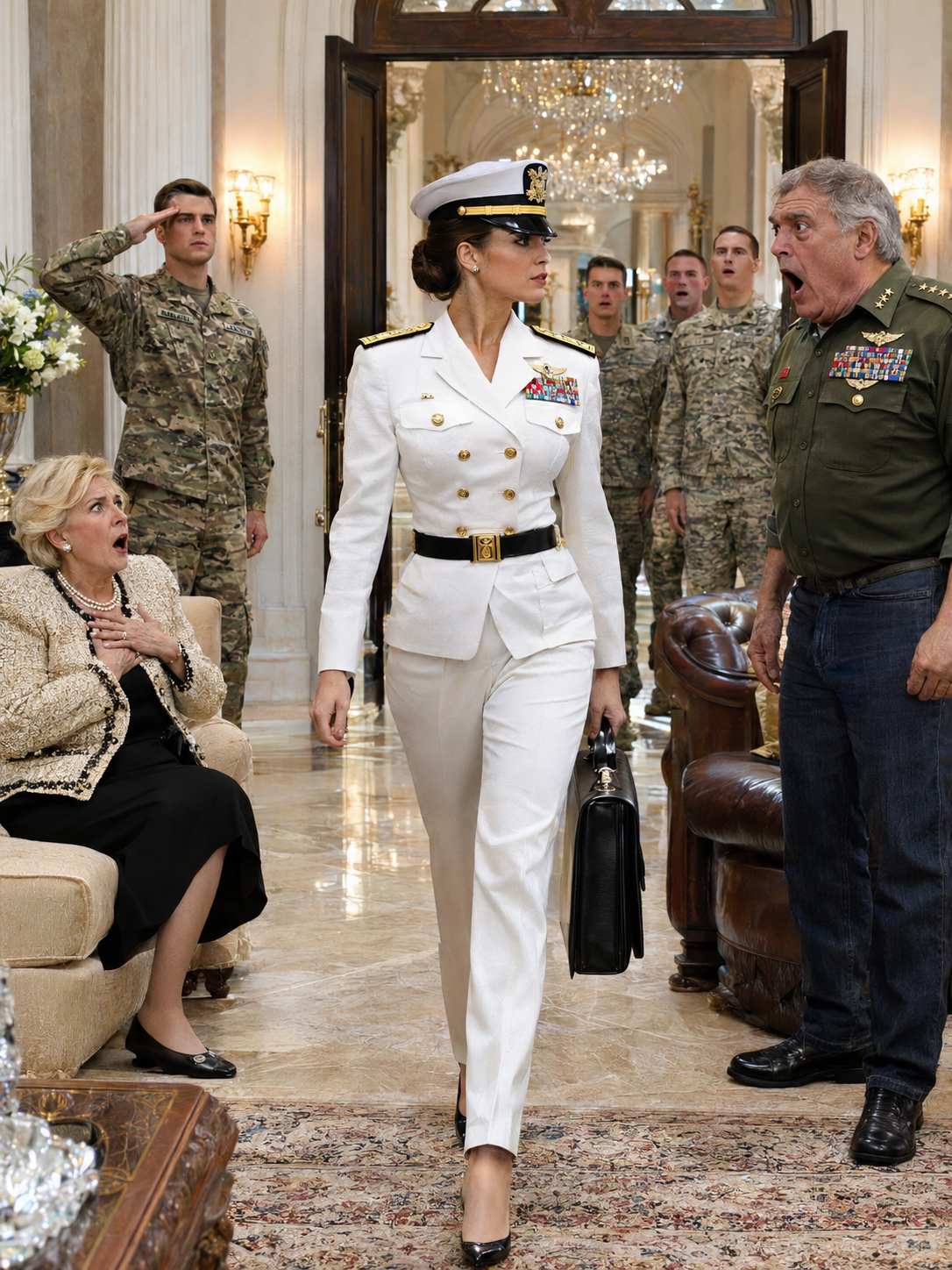
I let him talk. But when I walked back into the living room in my Army dress uniform, one of the soldiers snapped to his feet and shouted, “ATTENTION!” And Wendell Pruitt turned white as a ghost.
PART 1

My name is Josephine Calloway. I am a major in the United States Army.
I’m thirty-one years old, an active-duty military intelligence officer, and at that moment I was on temporary assignment in Georgia, on work I couldn’t discuss with civilians.
Wendell Pruitt knew none of that.
According to him, I was a directionless disappointment, a woman who had reached thirty-one without building a real career.
For my first two days in my mother’s house in Columbus, I let him go on believing it.
On Saturday morning, I came downstairs and found Wendell in the kitchen with a coffee cup in one hand and the other planted on his hip.
“It’s eight o’clock,” he said, without even looking at me.
I opened the cabinet where Mom had kept the mugs since I was twelve.
“It’s Saturday.”
He turned.
“In this house, everybody is up before seven.”
I nearly laughed.
My father and mother had bought that house twenty-six years earlier. Wendell had lived there less than a year.
“I’m in charge here, and I expect discipline,” he added.
Just then my mother walked in.
“Good morning, honey.”
She looked at me, then at Wendell.
For a moment, something crossed her face.
Fear. Caution.
That worried me far more than Wendell’s arrogance.
My mother, Ruth, was a woman who sang while she made pancakes, slammed doors when she was angry, and had once run a contractor off the property for speaking to her with contempt.
Now she moved carefully around Wendell.
He pointed his mug at me.
“Your mother tells me you’re between jobs.”
“Something like that.”
“She’s worried about you.”
Mom frowned at once.
“I never said…”
“Somebody has to tell her the truth,” Wendell cut in. “At thirty-one, you should know what to do with your life.”
I could have ended the conversation right there.
I could have told him my rank. Shown him my military ID. Watched his face change.
Instead, I added a little cream to my coffee.
“What would you recommend?”
His shoulders relaxed.
“Discipline. Responsibility. A real career. When I was in the Army, nobody wasted time trying to figure out who they were.”
There it was.
His favorite subject.
Wendell claimed to have spent decades in uniform. He said he had commanded soldiers overseas, run logistics operations in combat zones, and retired as a command sergeant major.
He even owned three ball caps with the title stitched across the front.
COMMAND SERGEANT MAJOR, U.S. ARMY, RETIRED.
One hung by the back door like a trophy.
Wendell loved that cap almost as much as he loved lecturing about what the service had taught him.
Discipline.
Honor.
Leadership.
And, of course, according to him, I had none of those.
That afternoon he announced he had invited several “real soldiers” to dinner.
“Maybe they can teach you something,” he said.
Then, with a smug smile:
“And stay in the kitchen until I call you. I don’t want you embarrassing me.”
I looked at him.
Then I looked at my mother.
And something inside me went completely still.
Because Wendell Pruitt had spent months building his whole authority on one enormous lie.
He had never been a command sergeant major.
In fact, he had never served in the military the way he claimed.
And the soldiers he’d invited to impress?
At least one of them already knew exactly who I was.
PART 2
They arrived at six, five of them in civilian clothes, all with the posture that gives soldiers away in any room.
From the kitchen, I listened through the doorway.
Wendell held court by the fireplace with a beer in his hand. He told the story about the convoy outside Mosul. He told the one about the colonel who’d begged him to stay. He told them how young people today had no discipline, “like my girlfriend’s daughter in there, thirty-one and still looking for herself.”
A few polite laughs. One man said nothing at all.
I recognized his voice before I saw him.
Lieutenant Colonel Anthony Rhodes had been my battalion commander at Fort Gordon. He was also, that weekend, my direct contact for the assignment that had brought me to Georgia. He had no idea Wendell was my mother’s boyfriend. Wendell had met him at a VFW hall three weeks earlier, and the invitation had landed on Rhodes’s calendar like any other.
My phone buzzed on the counter.
“Ma’am. Is that you in the kitchen? Please tell me you’re not being kept there.”
It was Staff Sergeant Teddy Okafor, who had served under me for two years. He was in the living room, and he had seen my reflection in the hallway mirror.
I typed back: Stand by.
Then I went upstairs.
My dress uniform hung in the guest-room closet, pressed and ready for a Monday ceremony at Fort Moore. The Army green coat. The ribbons. The oak leaf clusters, the Bronze Star, the Meritorious Service Medal. The brass on the collar. I buttoned each button slowly.
I looked at myself in the mirror, and for the first time in two days, I felt exactly like who I was.
When I came down the stairs, the conversation in the living room was in the middle of a laugh.
“…and that’s why you never skip PT,” Wendell was saying.
Then Lieutenant Colonel Rhodes turned his head, saw me, and set his glass on the mantel.
“ATTENTION!”
Every soldier in the room snapped upright. Chairs scraped. Beer bottles clinked as they were hastily set down.
Wendell, still holding his, stared at them with his mouth half open.
“What are you doing?” he said, laughing weakly. “Stand easy, boys, she’s…”
“Good evening, ma’am,” Rhodes said.
“At ease,” I said quietly.
They relaxed. Wendell did not.
I crossed the room slowly, my shoes clicking on the hardwood floor my father had refinished himself.
“Wendell,” I said, “I don’t believe we’ve been properly introduced. I’m Major Josephine Calloway, U.S. Army Military Intelligence.”
His face lost its color in stages.
“That’s… that’s not…”
“Colonel Rhodes,” I said, without looking away from Wendell, “I believe Mr. Pruitt has been telling your soldiers about his service.”
“He has, ma’am.”
“Would you mind asking a few questions?”
Rhodes turned.
“Sergeant Pruitt,” he said, deliberately skipping any title. “Which command sergeant major academy did you attend?”
“I… Fort Bliss. A long time ago.”
“Which class?”
Wendell’s mouth opened and shut.
“Who was your sergeant major of the Army at the time of your promotion?”
Silence.
Staff Sergeant Okafor stepped forward.
“Mr. Pruitt, you said you ran logistics out of Camp Taji in 2006. I was a motor sergeant there. There wasn’t a command sergeant major named Pruitt. And you said you worked with the Third Corps Support Command. It was called the Third COSCOM.”
“It was a long time ago,” Wendell said. “Memory fades…”
“It doesn’t fade that much,” said Okafor, politely.
Another soldier, a gray-haired master sergeant named Dolores Banks, picked up the cap from the table by the door.
“I wore three of these myself before I retired,” she said. “You’ve got the rank insignia on the wrong side of the crest.”
Wendell looked around the room as though searching for a door.
“This is my house,” he said hoarsely.
“No,” said my mother’s voice from the hallway.
Everyone turned.
Mom stood there in her blue cardigan with her arms crossed. Her chin was lifted in a way I hadn’t seen in months.
“It’s my house,” she said. “It’s been my house for twenty-six years. And I’d like you to leave, Wendell.”
PART 3
Wendell did not leave right away.
He stood in the middle of the room with his shoulders sagging, and then, quite suddenly, his entire posture changed. The bluster drained away. What replaced it was something flat, cold, and much more frightening.
“Ruth,” he said, in a voice I’d never heard him use. “You don’t want to do this.”
“Yes, I do.”
“You don’t understand what you’re…”
My phone vibrated in my pocket.
I took it out. It was a text from an unknown number, with a photograph.
It showed me, in civilian clothes and sunglasses, walking out of a secured facility at Fort Eisenhower, with a badge clipped to my belt. It had been taken from a distance with a long lens, three days earlier.
Beneath it were seven words:
“YOUR MOTHER WAS NEVER THE TARGET. YOU WERE.”
My blood went cold.
I looked up. Wendell was watching me. He wasn’t looking at my phone, but he knew. He knew exactly what I had just read.
“Colonel,” I said, very calmly. “Lock the doors.”
Rhodes didn’t ask. Two of the men moved to the front door, and Okafor started toward the back.
Wendell moved first.
He was faster than a man of his age and supposed lifestyle had any right to be. He shoved past a lamp, knocked over a chair, and was through the kitchen before anyone could reach him. The back door slammed.
Okafor made it to the porch just in time to see a gray pickup tearing down the gravel drive.
“I’ve got a plate!” he called. “Georgia, Charlie-Delta-Seven…”
“Call it in,” I said. “Now.”
Behind me, my mother had sat down heavily on the arm of the sofa. Her hands shook. I crossed the room and knelt in front of her, uniform and all.
“Mom. Look at me. Did he hurt you?”
“No,” she whispered. “No, never. He just…” She swallowed. “He took my phone. He said it was for my own safety. He read my mail. He asked me every day about you. What you did, where you were stationed, when you were coming. I thought he was being protective.”
“When did he first ask?”
“Before we ever dated,” she said. Her eyes filled. “He found me at a church supper. He said he’d lost his wife. I felt sorry for him.”
That sentence landed in my stomach like a stone.
Under the lamp by the sofa, something white caught my eye. A photograph had slipped out of the cardigan of the jacket Wendell had thrown on the chair. I picked it up.
It was an old print, creased and faded. Two men in desert camouflage stood in front of a Humvee, smiling. One was younger Wendell, with a mustache and a private’s rank on his collar.
The other was a man I recognized at once from a memorial plaque.
Colonel Lyle Ransom.
He had commanded my first intelligence brigade. He had been declared killed in action eight years earlier, in a convoy ambush outside Kandahar.
I had attended his funeral. I’d carried a folded flag at his memorial.
And on the back of the photograph, in blue ink, in a hand I’d seen on a hundred signed orders, was a message:
“Keep an eye on the girl. — L.R., 6 months ago.”
Six months ago.
Colonel Lyle Ransom, who had died eight years earlier, had written a note six months ago.
PART 4
By midnight, my mother’s living room had become a field office.
Two special agents from Army CID were there, along with an FBI counterintelligence agent named Marisol Vega, and Lieutenant Colonel Rhodes, who had not left my side. A forensic tech was photographing the cap by the back door. Another had taken Wendell’s laptop out of the den, where he had kept it in a locked drawer.
My mother sat at the kitchen table with a cup of tea she hadn’t touched, wrapped in a blanket Master Sergeant Banks had put around her shoulders.
Agent Vega laid the photograph on the table.
“We’ve been looking for a leak at Fort Eisenhower for fourteen months,” she said. “Someone has been selling the names of cyber operations personnel to foreign buyers. We’ve lost two assets overseas. Major Calloway was brought in to run the internal analysis.”
“And Wendell?” Mom asked.
“His real name is Wendell Pruitt,” Vega said. “He’s sixty-one. He enlisted in 1991 and was discharged after four years as a supply clerk for stealing government property. He never rose above specialist. For the last twenty years he’s worked as a courier and fixer, and some of that work has been for Colonel Ransom.”
“Ransom is dead,” I said.
“Is he?” Vega slid a second photograph across the table.
It was a grainy shot from a security camera, timestamped five weeks earlier. A tall, gray-haired man in a baseball cap and sunglasses stood at a bank counter in Panama City. The face was thinner and older. But the jaw, the posture, and the way he held his head were unmistakable.
My mouth went dry.
“The Army declared him dead after a convoy ambush,” Vega said. “No remains were recovered. We reopened the case six months ago, when a financial trail led to his old accounts. We’ve believed since then that he faked it, and that he’s been running the leak from outside the country with a few people on the inside.”
“And my mother’s boyfriend was one of them.”
“He was the one watching you,” said Vega. “And your mother’s house, which is listed as your emergency address, was the best place to do it.”
Mom made a small, wounded sound.
“I let him in,” she said.
“You let in a man who lied to you for a living,” I said, taking her hand. “That’s not the same thing.”
“He used to cook for me,” she whispered. “He remembered my birthday.”
“People who are good at lying are good at remembering things like that.”
She shut her eyes. A tear slid down her cheek.
Agent Vega leaned forward.
“Ms. Calloway, I know this is difficult. But this was a coordinated operation. Mr. Pruitt didn’t take a photograph of your daughter on his own. Someone sent that message tonight, someone who knew exactly when your daughter would put on her uniform. Someone watching this house.”
Everyone in the room went quiet.
Okafor, who had been standing by the window, stiffened.
“Ma’am,” he said. “There’s a white van at the end of the street. It’s been there since before dinner.”
PART 5
Lieutenant Colonel Rhodes handled it better than most men would have.
He didn’t draw a weapon, and he didn’t shout. He called Agent Vega’s team, waited twelve minutes for two unmarked cars to take positions on either end of the street, and then walked down the sidewalk in his civilian clothes with his hands visible, like a neighbor out to check the mail.
The man in the van put it in gear and tried to pull away.
He got eleven feet.
The agents boxed him in against the curb. When they opened the door, they found a thin, nervous man in his thirties with a laptop, a long camera lens, and a phone that was still open to the message thread.
His name was Colby Reese, and he cracked in under an hour.
He was a hired surveillance contractor, he said. He’d been paid in cryptocurrency by an anonymous account. He’d watched my mother’s house for six weeks. Wendell paid him every Friday, and the instructions had come from someone Wendell called “the colonel.”
“Did you ever meet the colonel?” Vega asked.
“No. But I heard Pruitt on the phone once. He called him ‘sir.’ He said the colonel wanted to know when the major would be coming to the house. He said…” Reese swallowed. “He said the major had been getting too close, and that things had to be finished before the end of the month.”
“Finished how?” I asked.
Reese didn’t look at me.
“I don’t know,” he said. “I swear to God. I only took photographs.”
Vega glanced at me. We both knew what the answer probably was, and what it meant that my mother had slept in that house with Wendell for a year.
I put my hand on the table so no one would see it shake.
Wendell Pruitt was found at four-fifteen the next morning, sitting in his pickup at a truck stop outside Macon, with the engine off and a suitcase in the passenger seat. He didn’t resist. When the Georgia State Patrol officer tapped on his window, Wendell reportedly said, “I wondered how long it would take,” and held out his wrists.
In the suitcase were a burner phone, forty-one thousand dollars in cash, two passports, and a handwritten list of names. My name was at the top of it, and my mother’s was beneath it.
Next to my name, in blue ink, was a date.
It was the Monday of my ceremony.
PART 6
The case took fourteen months.
Wendell Pruitt pleaded guilty to conspiracy, espionage-related charges, wire fraud, and identity theft, and agreed to testify. His testimony took six days. He described Colonel Ransom’s network in detail: three active-duty contacts, two civilian contractors, and an offshore bank in Panama that had been funneling payments for nearly eight years.
He had been recruited, he said, out of a VFW hall in Savannah, after a long stretch of unemployment. The colonel offered him money and a purpose. All he had to do was be someone people trusted.
“Being a sergeant major was my idea,” he told the court. “People believe a man in a hat. Nobody questions you if you say you’ve been in combat.”
The judge, a woman with silver hair and a very quiet voice, looked at him for a long time before she spoke.
“Mr. Pruitt,” she said, “you spent a year pretending to love a widow so you could watch her daughter. I find it difficult to say which part of that is worse.”
He was sentenced to twenty-six years in federal prison.
Colonel Lyle Ransom was arrested in Panama City in the spring, after a joint operation between the FBI, the State Department, and Panamanian authorities. He had been living under the name Edgar Moss, in a beachfront condominium paid for with the proceeds of eight years of stolen secrets. He did not seem surprised. When agents entered, he was reportedly sitting at a table with a cup of coffee and a chess set.
He was extradited to the United States, tried at a court-martial, and convicted on all counts. The sentence was life.
I did not attend the sentencing. I was in my mother’s kitchen, helping her take the dishes down from the shelf Wendell had once told her was “inefficient.”
Final Part
My mother went back to singing.
It took three months. First, she hummed while she did the dishes. Then she sang under her breath as she folded laundry. One morning in June, she came downstairs at seven, which was no longer a rule, and put on a record my father had loved, and started making pancakes while she belted out an entire verse to the empty kitchen.
I leaned against the doorframe in a T-shirt and sweatpants and let her.
“You’re staring,” she said, without turning around.
“You sound good.”
“I sound terrible. But I’m happy.”
She flipped a pancake with a flourish. She had put the old mugs back in the cabinet and hung a new curtain in the window over the sink. The cap that had hung by the back door was gone. So was the lock on the den drawer.
“I should have asked more questions,” she said. “About him. About what he wanted.”
“You were lonely, Mom. That’s not a crime.”
“Neither is learning.” She set a plate in front of me. “I’m going to learn.”
She joined a book club that spring and a church choir by the fall. She started dating again, slowly, a retired schoolteacher named Harold who made terrible puns and who, when she told him her whole story over a first dinner, had listened without interrupting and said only, “I’m sorry that happened to you. I’m glad you’re safe.”
When she introduced us, he shook my hand and called me “Major” without any hint of performance.
“Just Josie,” I said.
“Just Josie,” he agreed, and winked at my mother.
In October, I was promoted to lieutenant colonel.
The ceremony took place at Fort Moore, on a bright, clear morning with a thin breeze and a flag snapping against a blue sky. My mother sat in the front row in her best navy dress, holding a program in both hands. Beside her sat Master Sergeant Banks, retired from active duty, and Staff Sergeant Okafor, who had flown in from Fort Eisenhower on his own dime, in his dress blues, his ribbons gleaming.
Colonel Rhodes presided. When he pinned the silver oak leaves on my shoulders, he leaned close and said, very quietly:
“I owe you an apology, Colonel.”
“For what, sir?”
“For standing in that living room and laughing at Pruitt’s jokes.”
“You didn’t know.”
“I should have asked more questions.” He stepped back and saluted. “It won’t happen again.”
I returned the salute, crisp and precise, and for a moment the entire parade ground seemed to hold its breath.
Afterward, when the crowd had thinned, my mother found me beside the reviewing stand. She was crying, and she didn’t try to hide it.
“Your father would have been so proud,” she said.
“I know.”
“He used to tell me you’d be a general someday.”
“I’m a long way from that.”
“You’re a long way from Wendell Pruitt, too.” She touched the oak leaf on my shoulder, lightly, with one finger. “That’s all I ever wanted for you. To be somebody who doesn’t need to pretend.”
I put my arm around her.
I thought about that Saturday morning, the mug of coffee in Wendell’s hand and the pride in his voice as he told me to stay in the kitchen. I thought about the way a man can build an entire life on a hat and a story, and how easy it is for people to believe him, and how much it costs when they do.
“Come on,” I said. “Let’s go get lunch.”
“Where?”
“Wherever you want.”
She smiled through tears.
“Pancakes?”
I laughed.
“Pancakes,” I agreed.
We walked across the parade ground together in the thin October sun, a lieutenant colonel in a dress uniform and a woman in a navy dress, arm in arm, with no one left to tell either of us to stay in the kitchen.
THE END