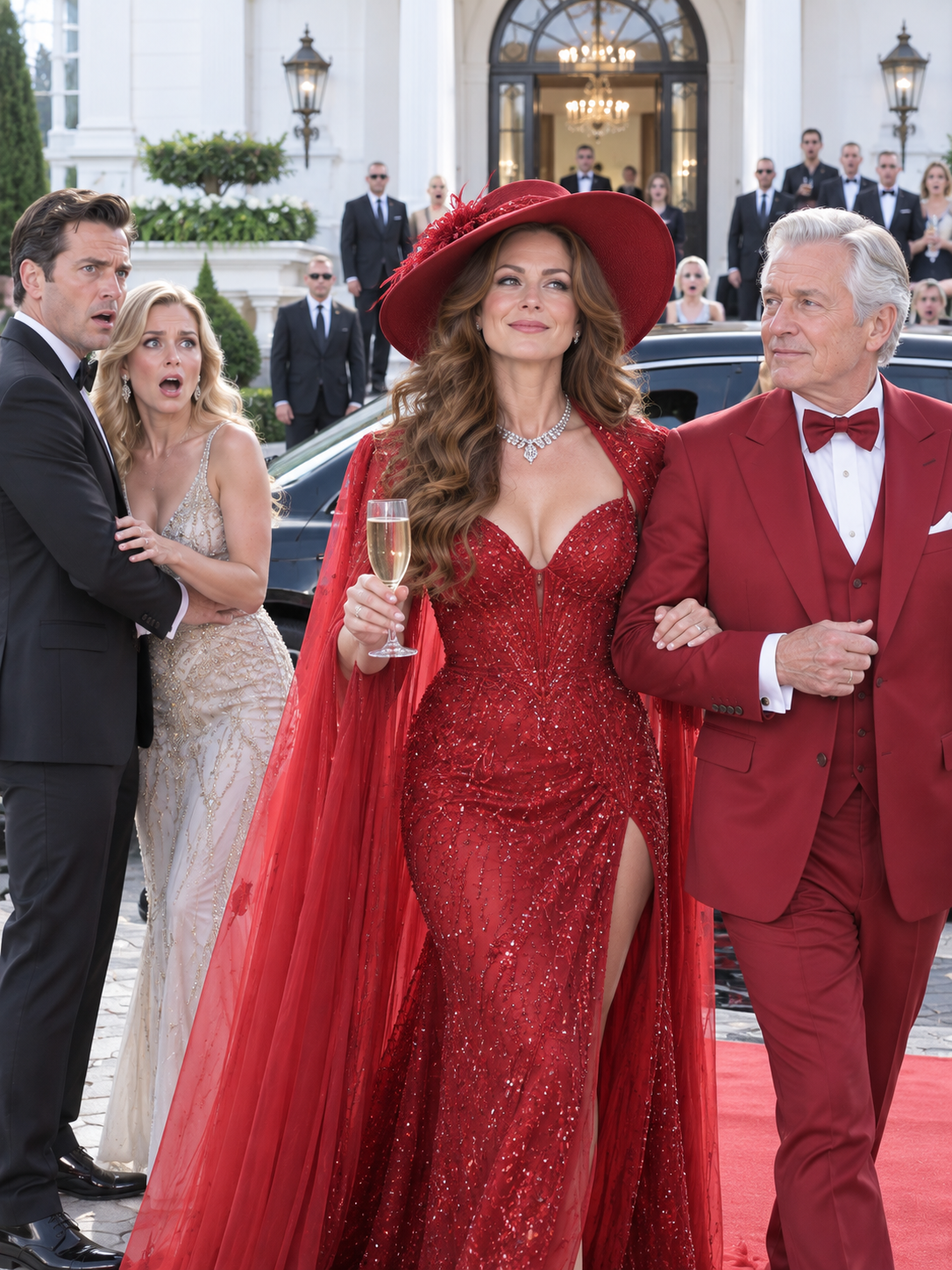
While my family celebrated Christmas Eve without me, someone turned on the national news. The room went completely silent when my face suddenly appeared on the screen.
PART 1

Dad excluded me from the family Christmas celebration with the same detached, businesslike voice he used when firing an employee.
“Don’t come home, Maya. Your Army career might overshadow Derek’s promotion.”
For several seconds, I remained frozen on the edge of my barracks bed. My dress uniform hung nearby, my flight confirmation was still glowing on my phone, and some foolish part of me expected Dad to laugh and tell me he was joking.
He didn’t.
Through the phone, I could hear my stepmother, Eleanor, rearranging glass ornaments on the Christmas tree.
“Tell her it’s nothing personal.”
Then Derek laughed somewhere behind her. My stepbrother had always possessed the remarkable ability to sound proud of himself for achievements he had barely earned.
“It’s Christmas,” I said quietly.
“And this Christmas is about Derek,” Dad answered. “Becoming Regional Vice President at thirty-one is a major accomplishment.”
He paused before adding another reason.
“Your medals, your uniform, your Army career… people always make such a production out of those things.”
“Those things?”
Dad sighed impatiently.
“Don’t make this dramatic, Maya. You know what happens when people see you now. Suddenly everyone starts acting like you’re the real success story in this family. Derek worked hard for this.”
I nearly laughed because I knew precisely what Derek considered hard work. He had lost two important contracts, blamed one disaster on his assistant, and then allowed the company to use photographs from my deployment in promotional newsletters beneath the slogan Serving Those Who Serve.
I could have reminded Dad that I hadn’t relied on him financially since I turned eighteen. Derek, meanwhile, was still issuing company checks from an office partly financed by the trust my late mother had left behind.
Instead, I looked toward the silver bars on my uniform.
“Understood.”
Silence followed.
Dad had never liked hearing that word from me. It sounded too disciplined, too distant, and far too much like the end of a conversation.
“Maya…”
“Merry Christmas, Dad.”
I disconnected before he could hear the emotion entering my voice and canceled my flight to Virginia. Minutes later, I contacted my commander and volunteered for the overnight shift at Fort Mason’s emergency operations center.
A major winter storm was approaching, and several soldiers scheduled for Christmas night had spouses, children, parents, and families waiting for them. Nobody was waiting for me anymore, so giving one of them the night off seemed like the easiest decision I could make.
At 1900 hours, I walked into the operations center carrying coffee. My hair was neatly secured, my uniform was immaculate, and my face wore the controlled calm the Army had taught me whenever personal pain needed to wait.
My phone kept vibrating.
Eleanor messaged first: This really is for the best. Please don’t punish your father over it.
Then Derek sent his contribution: Try not to invade the North Pole tonight, Captain Spotlight.
I read both messages once before placing my phone facedown.
There were several things my family didn’t know.
Two weeks earlier, a civilian attorney had contacted me regarding my late mother’s trust. Dad had no idea that Sterling Logistics, the company he treated as entirely his own, wasn’t completely under his control.
Derek knew even less.
He certainly didn’t know that the promotion everyone was celebrating that Christmas Eve had placed him directly in the path of a federal audit, an investigation from which I had already formally recused myself.
While champagne filled glasses at my father’s house and relatives toasted Derek’s supposed triumph, I watched storm warnings spread across the operations screens. Whatever celebration was happening back home was no longer my concern.
At least, that was what I believed.
Because before Christmas Eve was over, the entire country would learn exactly where I had spent that night.
PART 2
At 10:07 that night, my face appeared on every television screen in my father’s great room.
I didn’t know it had happened until Aunt Beatrice called me in tears, before the last ambulance had even cleared the scene.
“Maya,” she whispered. “The news… sweetheart, everyone here is watching.”
The national broadcast showed a highway almost completely buried beneath snow, soldiers carrying children through the storm, and emergency lights flashing through the whiteout. Then the footage cut to me kneeling beside a stretcher, ice frozen into my hair while the rescue operation continued around me.
Through my aunt’s trembling phone, I heard the anchor explaining what had happened.
“Army Captain Maya Vance, the officer who coordinated the rescue operation, helped evacuate all twenty-six children and four additional civilians before the damaged fuel tanker caught fire. Officials say the unit’s rapid response prevented what could have become a mass-casualty incident on Christmas Eve.”
Then the other end of the call went completely quiet.
It wasn’t normal silence. It was the kind that fills a room when everyone suddenly realizes the story they had been told was starting to fall apart.
Derek was the first to speak.
“Turn it off.”
Aunt Beatrice ignored him.
“Arthur, didn’t you tell everyone Maya decided not to come home?”
Dad answered immediately, his voice sharp.
“This is not the time.”
But for once, Dad was wrong.
There couldn’t have been a better time.
By Christmas morning, forty-seven missed calls were waiting on my phone…
PART 3 + FINAL PART
Thirty-two of those calls were from my father. Twelve were from Eleanor. Three were text messages from Derek, each one increasingly panicked.
“Maya, pick up. Dad is losing his mind.” “The press is calling the company line asking for statements about your military service.” “Answer your damn phone, Maya.”
I ignored every single one of them.
After spending twelve straight hours on Interstate 81 leading a thirty-man response team through sub-zero winds, dragging stranded families from freezing vehicles before a ruptured double-tanker burst into a hundred-foot fireball, I had work to do. My boots were caked in slush and road salt, my hands were numb, and my uniform smelled faintly of diesel exhaust and winter rain.
I sat down at my desk at Fort Mason at 0800 hours on Christmas Day to finish the incident reports. To the Department of Defense and the Governor’s office, last night was an exemplary execution of joint emergency response. To the media, it was a feel-good holiday miracle.
To my father, it was a public relations disaster.
By 10:00 AM, my phone buzzed again, this time displaying an official number from the installation gate.
“Captain Vance,” the guard on duty reported. “You have a visitor at the main gate. A Mr. Arthur Vance. He says it’s an urgent family emergency.”
I adjusted my collar, took a slow sip of black coffee, and spoke into the receiver. “Let him through to the EOC visitor lounge.”
Ten minutes later, I walked down the sterile corridor toward the waiting area. Arthur Vance was pacing back and forth across the linoleum floor, still wearing his expensive tailored wool coat from the night before, though his tie was loosened and the crisp posture he usually maintained was distinctly unspooled. Behind him stood Eleanor, wringing her designer gloves, and Derek, looking pale, disheveled, and remarkably small beneath the fluorescent lights.
When Dad saw me walk in—flanked by my platoon sergeant and looking every bit the Army officer he had dismissed twenty-four hours earlier—he stopped dead in his tracks.
“Maya,” Dad began, taking a step forward, his hands raised in a gesture of sudden, uncharacteristic warmth. “Thank God you’re all right. We watched the news—we were terrified for you!”
“You were terrified of the optics, Dad,” I said, keeping my voice cool, even, and detached. “You didn’t call me when I was on deployment in Syria. You didn’t call me when I graduated top of my class at West Point. You called because Aunt Beatrice realized you lied to the entire family about why I wasn’t at Christmas dinner.”
Eleanor stepped in, her tone dripping with rehearsed sincerity. “Maya, please… your father was just trying to protect Derek’s special night. You know how sensitive these corporate announcements are. You don’t have to be so cold.”
“Sensitive?” I looked directly at Derek. His eyes darted away, unable to hold my gaze. “Is that what we’re calling it?”
“Maya, listen to me,” Dad interrupted, lowering his voice to the sharp, commanding tone he used in boardroom negotiations. “The press is outside Sterling Logistics right now. A reporter from the Washington Post saw the national broadcast and remembered that our company ran those ‘Serving Those Who Serve’ advertisements featuring your deployment photos. They want a joint photo opportunity—you, me, and Derek. A family unity piece. We can fix this whole misunderstanding right now.”
I almost smiled. The sheer, shameless predictability of it was almost impressive.
“You uninvited me from Christmas dinner so I wouldn’t overshadow Derek,” I said softly. “And now you want me to stand beside him on national television so your company can ride the coat-tails of a military rescue operation?”
“It’s good business!” Dad snapped, dropping the affectionate facade completely. “Do you have any idea how much money is riding on this regional expansion? Derek’s promotion is the linchpin for our new logistics contracts!”
“Derek’s promotion is a house of cards,” I replied.
The room went completely dead silent.
Derek cleared his throat, his face flushing crimson. “What the hell is that supposed to mean?”
I reached into my leather folio and pulled out a single sheet of paper, sliding it across the table toward my father.
“Two weeks ago, my personal attorney notified me that my late mother’s trust—which holds forty percent of the non-voting equity in Sterling Logistics—was being used as collateral for an unauthorized $12 million credit line,” I explained, letting every word hit them like a physical impact. “A credit line signed by the newly appointed Regional Vice President.”
Derek choked on his breath. “That… that was an internal corporate restructuring! It was completely legal!”
“It was fraud, Derek,” I said, looking him dead in the eye. “You pledged assets from a private trust that you didn’t own to cover up the contract losses you hid in Q3. You thought because Dad backed you, nobody would audit the trust ledger.”
Dad grabbed the paper, his eyes scanning the legal notice. His face drained of color as he recognized the signature of the lead federal auditor on the bottom of the page.
“Why… why didn’t you come to me with this?” Dad stammered, his voice suddenly hollow. “Why didn’t you tell me?”
“I tried to talk to you three weeks ago, Dad,” I said. “You told me you were too busy helping Derek prepare his promotion presentation. Then yesterday, you told me my career was just ‘a production’ and that I shouldn’t bother coming home.”
“Maya…” Eleanor gasped, clutching Dad’s arm. “You’re his daughter! You can’t let them destroy his company over a financial mistake!”
“I didn’t destroy his company,” I said calmly. “Derek’s greed destroyed it. Dad’s blind favoritism allowed it. Because I am an active-duty military officer, I formally recused myself from the federal investigation two days ago to avoid any conflict of interest. The Defense Logistics Agency has already suspended Sterling Logistics’ vendor eligibility pending the outcome of the audit.”
Dad stumbled back a step, dropping the paper onto the coffee table. The realization hit him with the weight of a collapsing bridge. The company he had built, the golden boy he had nurtured, and the proud reputation he had guarded so ruthlessly were all crumbling simultaneously.
“You could have saved us,” Dad whispered, looking at me as if seeing me for the first time in ten years. “If you had just signed off on the trust waiver…”
“My mother built that trust to protect my future, Dad,” I said, stepping closer until I was standing inches from him, my silver captain’s bars catching the overhead lights. “She didn’t build it so you could buy your stepson a career he couldn’t build on his own.”
I turned to Derek, whose hands were shaking uncontrollably at his sides.
“Merry Christmas, Derek,” I said softly. “You got your spotlight.”
Without waiting for another word, I turned on my heel and walked out of the visitor lounge. Behind me, I heard Eleanor burst into hysterical tears and Dad calling my name in a cracked, broken voice that no longer sounded commanding at all.
I didn’t turn back.
FINAL PART
By mid-January, the storm that had battered Virginia had cleared, leaving behind crisp, blue winter skies over Fort Mason.
The fall of Sterling Logistics was swift and relentless. Following the federal audit triggered by the trust discrepancy, investigators uncovered a paper trail of falsified reporting and misallocated funds spanning nearly two years. Derek’s promotion was revoked forty-eight hours after Christmas; three weeks later, he was formally indicted on charges of corporate fraud and grand larceny.
Arthur Vance was forced to step down as CEO in a desperate attempt to satisfy creditors. To avoid complete liquidation, the board approved a mandatory restructuring plan that liquidated Derek’s unauthorized loans and transferred majority voting control of the remaining corporate assets back into my mother’s trust—which was now managed exclusively by an independent court-appointed trustee.
Dad was left with a diminished title, a disgraced stepson facing federal sentencing, and an empty house. Aunt Beatrice and the rest of the extended family, having learned the true story behind my absence on Christmas Eve, cut ties with Dad and Eleanor entirely, disgusted by the way I had been treated.
On a cold, bright Tuesday morning, I stood on the parade field at Fort Mason in full Army Service Uniform.
The entire battalion was formed up in immaculate ranks behind me. Up on the reviewing stand stood my commanding general, accompanied by representatives from the state governor’s office and local emergency management agencies.
The loudspeaker crackled to life, echoing across the open field.
“For conspicuous gallantry and exceptional leadership on the night of December 24… Captain Maya Vance demonstrated extraordinary devotion to duty, personally coordinating the evacuation of twenty-six children and four civilians under extreme blizzard conditions prior to a hazardous fuel explosion… Her decisive actions reflect the highest credit upon herself, the United States Army, and the armed forces of the United States.”
The General stepped forward, smiling broadly, and pinned the Soldier’s Medal—the highest Army award for heroism outside of direct combat—onto the pocket of my uniform coat.
A thunderous round of applause echoed across the grounds from the assembled soldiers, local community members, and media crews.
As the ceremony concluded and the formation was dismissed, I walked toward the edge of the parade field where Aunt Beatrice was waiting, holding a small bouquet of winter flowers, her eyes red with proud tears.
“Your mother would be so proud of you, Maya,” Aunt Beatrice whispered, wrapping me in a tight, warm hug. “So very proud.”
“Thank you, Aunt Beatrice,” I said, squeezing her back.
I looked past her shoulder toward the parking lot near the main gate.
Standing behind the security chain-link fence, far away from the official guests, was a solitary figure in an old wool coat. He looked older, stooped, and worn thin by the consequences of his own choices. Arthur Vance stood watching from the cold distance he had created, watching the daughter he had pushed aside receive the highest honors of her career.
He took a hesitant step toward the gate, as if wanting to call out, as if hoping for a wave, a nod, or a second chance.
I looked at him for one long, calm second. I didn’t feel anger anymore. I didn’t feel hurt. I felt the profound, settled peace of a person who had built her own life, earned her own honor, and defined her own worth far beyond the walls of a house that had never truly been a home.
I adjusted my green beret, offered Aunt Beatrice my arm, and walked away into the bright afternoon sun, without looking back.