PART 1

Two years ago, after my mother died, I began volunteering at a small hospice, where I met Julian.
He was fifty-nine. While the other patients often had families who visited, Julian had no one. So I started stopping by.
Soon, I became the person he waited for. I brought him coffee, stayed after my shift, and listened to stories about the life he regretted wasting.
One evening, he gripped my hand.
“I have one last wish,” he said. “Pretend you’re my daughter until I’m gone. I know it sounds strange, but life separated me from my little girl before she was even born.”
His words cut deep.
My mother had raised me alone, and my father had left before I was born. I knew nothing about him — not even his name.
I should have found Julian’s request strange. Instead, my heart broke for him.
“Well then, hello, Dad,” I said with a smile.
Julian laughed.
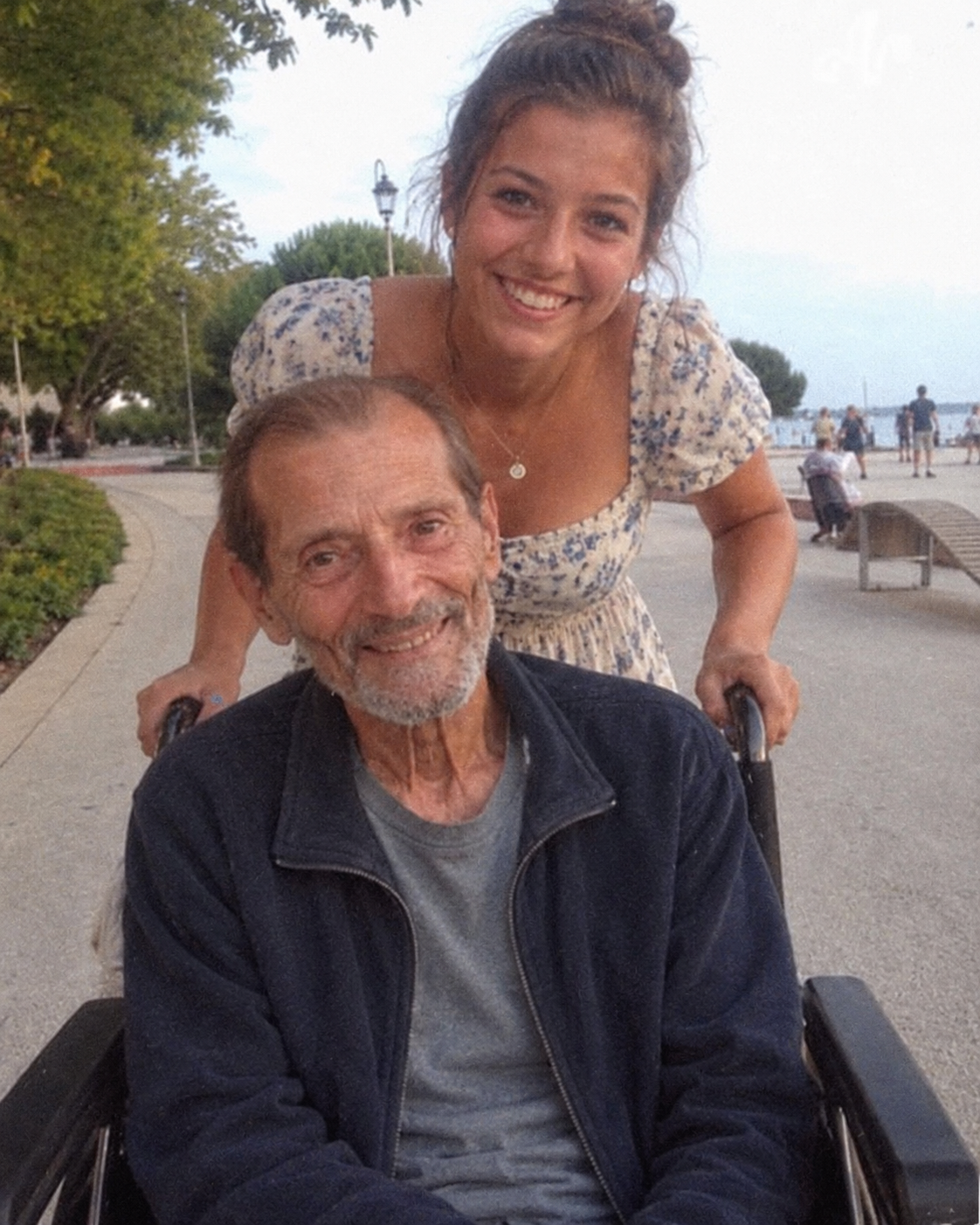
For six weeks, we were inseparable. I pushed his wheelchair through the gardens, took him to his favorite diner, and drove him to the ocean so he could feel sand beneath his feet one last time.
Whenever strangers asked, he smiled.
“This is my daughter.”
I knew most people would never understand how I felt.
But I was the happiest I had been in years because I finally had someone who cared about me.
Last week, Julian passed away quietly in his sleep.
The day after his funeral, his lawyer found me.
“You walked STRAIGHT INTO HIS TRAP,” he said, without even greeting me.
I froze.
Then he placed a box in my hands. My fingers trembled.
“Julian chose that hospice because YOU volunteered there. He searched for you for TWENTY YEARS — but made me promise to reveal the truth only after his death. You’d better sit down.”
PART 2
I stared at the lawyer, Mr. Vance, as my knees gave out. I sank into the nearest wooden chair in the empty hospice lobby, clutching the smooth wooden box against my chest.
“What are you talking about?” I whispered, my voice shaking. “Julian didn’t trap me. He was just a lonely old man…”
“Julian Vance was many things,” Mr. Vance interrupted gently, sitting across from me. “A brilliant engineer, a deeply flawed man, and someone who spent two decades trying to protect you without letting the people who ruined his life find out you existed.”
I lifted the lid of the box.
Inside lay a stack of yellowed photographs, a thick leather journal, a certified birth certificate, and a key to a safe-deposit box.
I picked up the birth certificate first. My eyes scanned down to the father’s line.
Julian Edward Vance.
My breath caught in my throat. Tears blurred my vision as I pulled out the top photograph: my mother, young and radiant, standing beside a youthful Julian on a sunlit pier, her hands resting over her pregnant belly.
“He didn’t abandon you or your mother, Evelyn,” Mr. Vance explained softly. “Twenty-two years ago, Julian’s former business partners framed him in a massive corporate fraud scheme to seize his patents. When the threats turned violent, your mother went into hiding to keep you safe. Julian drew the target onto himself, taking the fall and serving ten years in prison so they wouldn’t look for her or the baby.”
I held the photograph against my heart, the tears finally overflowing. “Why didn’t he just tell me who he was when he found me?”
“Because he knew you,” Mr. Vance smiled faintly. “He monitored your life from a distance for years. He knew how proud you were, how much pain you carried over an ‘abandoning’ father. If he had walked up to you as a stranger claiming to be your long-lost dad, you would have put up a wall. He needed you to see who he truly was—without the weight of the past.”
Mr. Vance pointed to the key inside the box.
“The trap wasn’t meant to hurt you, Evelyn. It was designed to bypass his corrupt former partners who spent years trying to trace his estate. By having you ‘pretend’ to be his daughter in front of witnesses, nurses, and staff for six weeks, he legally re-established your public and social identity as his child without filing court documents that could have alerted his enemies while he was still alive.”
FINAL PART
Mr. Vance handed me a final, handwritten letter sealed in a cream-colored envelope.
I broke the wax seal with trembling fingers and unfolded the paper. Julian’s distinct, elegant script filled the page:
My dearest Evelyn,
If you are reading this, I have finally crossed over, and Mr. Vance has handed you the key. I spent twenty years living in the shadows, watching you grow into the kindest, most courageous woman I could ever have dreamed of calling my daughter.
I know I tricked you into that first ‘hello, Dad.’ Forgive an old man’s cowardice. I was terrified that if I told you the truth, I would see anger in your eyes instead of the warmth you gave me every single day.
Those six weeks were not a lie. Pushing me through the gardens, sitting by the ocean, sharing coffee—those were the only real weeks of my entire life. You didn’t just play a role, Evelyn. You saved my soul.
The safe-deposit box contains the restored patents and the full estate from my original firm, legally secured in your name. Live your life boldly, my sweet girl. You never have to wonder who your father was again.
Love always,
Dad
I sat in the quiet hospice lobby, holding the letter to my chest as the sun broke through the tall glass windows, bathing the room in warm, golden light.
I had walked into his trap—a trap built entirely of love, protection, and twenty years of patient waiting.
For six weeks, I thought I was giving a lonely dying man a final wish. But as I looked down at the photograph of my mother and father smiling in the sun, I knew the truth.
He hadn’t just given me a gift; he had given me back my name, my story, and a father whose love had followed me every single day of my life.
EPILOGUE
The crisp October wind off the Atlantic Ocean carried the scent of salt, pine, and coming rain.
Evelyn stood at the edge of the stone bluff overlooking the coastline, wrapped in a long wool coat, her fingers resting lightly on the cold wrought-iron railing. Below her, gray-green waves crashed against the jagged granite rocks, exploding into plumes of white spray before receding back into the tide.
This was the exact spot along the Maine coast where she had driven Julian in his wheelchair two months before he died.
She remembered how he had sat beside her in the crisp afternoon breeze, his thin shoulders wrapped in a fleece blanket, his eyes fixed on the horizon with a quiet, peaceful intensity. At the time, she had thought he was simply drinking in the beauty of the sea one last time before his failing heart gave out.
Now, holding his leather-bound journal against her ribs, she understood what he had really been doing. He had been standing on the edge of the world with his daughter, watching the water, knowing that the twenty-year storm he had weathered in total isolation was finally coming to an end.
A car door clicked shut behind her on the gravel lane.
Evelyn turned around. Mr. Vance was walking up the slight incline toward the bluff, carrying a slender leather briefcase under his arm. His dark suit was immaculate, though his hair was tossed by the sea breeze.
“I thought I might find you here,” Vance said softly, stopping a few paces away. “He always loved this stretch of coast. It was the last place he visited with your mother before the indictment came down.”
“He told me he wanted to feel the sand beneath his feet one last time,” Evelyn murmured, looking back out at the waves. “I thought I was fulfilling a dying man’s bucket list. But he was just bringing me home.”
“He was,” Vance agreed. “He spent twenty years making sure that when you finally stood in this spot, it would belong to you.”
Vance unzipped his briefcase and pulled out a blue leather folder stamped with the seal of the United States Federal District Court.
“The final probate decrees were entered at 9:00 AM today,” Vance reported, his tone shifting into the crisp, measured cadence of a senior attorney. “The federal court has formally recognized the validity of the hand-written codicil and the DNA match from the state archives. The patents for the Vance Energy architectural frameworks have been fully restored to the estate, and the legal challenge mounted by the surviving board members of Vance Global has been dismissed with prejudice.”
Evelyn took a slow, deep breath. “And the financial assets?”
“Every dollar,” Vance said firmly. “The original offshore escrow accounts, the back-royalties from the stolen patents, and the estate properties have been consolidated into a private trust under your sole authority. You are, as of this morning, the exclusive owner of Vance Global’s intellectual property—a holding valued at roughly seventy-four million dollars.”
Evelyn didn’t answer right away. She looked down at the simple gold band on her left hand, then back at the blue folder.
For two years after her mother died, she had lived in a tiny, one-bedroom apartment over a laundromat in downtown Boston, counting nickels to pay for her shift meals while volunteering at the hospice on her days off. She had spent her entire adult life believing she was an anchorless fragment of a broken family—a girl whose father had vanished before her first breath because he didn’t care enough to stay.
“Seventy-four million dollars,” she repeated quietly. “He lived in a tiny, sixty-square-foot room at the hospice with two shirts and an old radio.”
“He lived like a ghost because he had to keep their eyes on him,” Vance explained gently. “If Julian had spent a single dollar of that money, if he had bought a house, a nice car, or lived in luxury, his former partners’ private investigators would have audited his accounts within forty-eight hours. They would have tracked every wire transfer, followed every paper trail, and eventually, they would have found the quiet nursing assistant working in Boston.”
Vance stepped closer, his voice softening. “He stayed poor so you could stay invisible until he was dead and beyond their reach. He traded twenty years of comfort for your safety.”
Tears pricked the corners of Evelyn’s eyes, but she didn’t let them fall. She reached out and took the folder from Vance’s hands.
“What happens to the men who framed him?” she asked.
“The federal prosecutor’s office served indictments on two of the surviving former partners this morning,” Vance said with a cold, sharp smile. “Fraud, conspiracy, and illegal asset seizure. They’ll spend what’s left of their lives in federal courtrooms. The paper trail Julian left in his safe-deposit box was flawless. He didn’t just protect you, Evelyn—he left an ironclad trap that slammed shut on them the moment his death certificate was signed.”
By mid-afternoon, the rain began to fall as a soft, misting drizzle.
Evelyn drove her modest sedan down the winding coastal highway toward a quiet, wooded cemetery tucked behind an old stone church in Rockport.
The graveyard was silent, save for the rhythmic patter of rain against the autumn leaves. Near the crest of a small hill, under the sprawling branches of a two-hundred-year-old sugar maple, sat two simple granite headstones side by side.
One bore her mother’s name: CLAIRE VANCE — 1978–2024.
The other, newly carved, bore her father’s: JULIAN EDWARD VANCE — 1967–2026.
Beside his name, carved into the stone at Evelyn’s request, was a simple five-word inscription: HE BROUGHT HIS DAUGHTER HOME.
Evelyn walked up the grass, holding a small bouquet of white lilies. She knelt beside the twin graves, placing the flowers gently across the damp earth between them.
She reached into her coat pocket and pulled out Julian’s leather journal.
Over the past seventy-two hours, she had read every single page. It wasn’t a record of business, patents, or legal strategies. It was a diary of a father’s invisible presence.
June 14, 2008:
“Evelyn turned ten today. Claire sent a photograph through the secure mail drop in Chicago. Evelyn has her mother’s smile, but she holds her pencil with her left hand, just like my father did. She won the district spelling bee. I sat in the back row of the auditorium behind the light booth so she wouldn’t see me. She was wearing a yellow dress. I had to leave before the award ceremony so the private eyes following my credit cards wouldn’t spot the rental car.”
October 3, 2017:
“Evelyn started college today. She’s taking literature and ethics. She had to take out a student loan because Claire couldn’t cover the full tuition without triggering a financial audit on her bank account. It broke my heart not to wire the funds directly. But Vance’s lawyers checked Claire’s tax filings again last month. I must remain a deadbeat in their eyes. Just a few more years, my sweet girl. Just a few more years.”
November 20, 2024:
“Claire passed away this morning. I couldn’t go to the funeral. Standing at the back of the cemetery in the rain, watching my daughter stand alone by the casket, was the hardest thing I have ever done. But the hospice near her apartment has an opening for weekend volunteers. I have checked myself into the facility under my legal name. The cancer has spread to my lungs. The clock is running out, but the final stage of the plan is set. Soon, I will get to hear her voice.”
Evelyn closed the journal, pressing it tight against her chest as tears finally spilled down her cheeks, warm against the chilly sea wind.
She remembered that first afternoon at the hospice two years ago. She had walked into his small, sunlit room carrying a tray of ice water and a fresh cup of black coffee. He had been sitting in his armchair, looking out the window, his hands trembling slightly.
When he turned and looked at her for the first time in twenty years, his eyes had filled with such an overwhelming, desperate tenderness that she had nearly dropped the tray. At the time, she had assumed he was just a lonely patient touched by a volunteer’s kindness.
She recalled the sound of his laugh during those six weeks—how his face would light up whenever she walked into the room, how he would insist on holding her hand while they watched the rain against the glass, how he would proudly introduce her to every nurse and visitor in the hallway: “This is my daughter.”
He hadn’t been pretending. He had been living the only six weeks of fatherhood he had ever been allowed to enjoy.
“I’m not angry, Dad,” Evelyn whispered into the quiet air, touching the cold granite of his headstone. “I understand now. You didn’t leave me. You were standing in the back of the room the whole time.”
Four months later, the early spring sun broke through the gray winter clouds over downtown Boston.
On a quiet, tree-lined street in the historic district, a historic three-story brick townhouse had been completely renovated. Beside the heavy oak front door sat a modest brass plaque: THE JULIAN & CLAIRE VANCE FOUNDATION FOR PROTECTED FAMILIES.
Inside, the high-ceilinged rooms were filled with light, soft rugs, and the quiet hum of activity.
Evelyn sat at a large mahogany desk in the main office, reviewing a stack of grant applications.
The foundation—funded entirely by the liquidated assets of the restored Vance estate—had been established with a single, uncompromising mission: providing immediate legal protection, secure housing, and financial independence for mothers and children fleeing domestic violence, financial coercion, and systemic harassment.
Mr. Vance stepped into the office, carrying a warm cup of coffee, which he set on her desk.
“The first three safe-houses in western Massachusetts cleared their licensing inspections this morning,” he said, pulling up a chair across from her. “We have forty families scheduled for intake by the end of the month.”
Evelyn smiled, taking a sip of the coffee. “No paper trails? No shared financial registries?”
“Completely anonymous,” Vance replied with a proud nod. “Every legal wall your father designed to protect you has been built into the foundation’s operating charter. No one can track these women, and no one can use their financial weakness against them.”
Evelyn looked out the tall window at the bustling street below.
A young mother was walking along the sidewalk, holding her little girl’s hand. The child was laughing, jumping over the cracks in the pavement, completely safe, completely free, wrapped in the warm spring air.
Evelyn reached into her desk drawer and pulled out the small, silver-framed photograph she had taken from the wooden box. It was the picture of her mother and father standing together on the sunlit pier twenty-two years ago, their faces bright with hope before the storm had hit.
She set the frame on the corner of her desk, right beside her mother’s favorite pen and her father’s brass pocket watch.
The lawyer had told her that she had walked straight into a trap.
He was right.
It was a trap forged in the fire of twenty years of silence, built from iron legal strategy, and sealed with the ultimate sacrifice of a man who had chosen to live as a ghost so his child could walk in the sun.
Evelyn ran her thumb gently over the glass of the frame, looking at her father’s young, smiling face.
“Hello, Dad,” she whispered softly.
And for the first time in her life, the words didn’t feel like a sweet game played in a hospice hallway.
They felt like the absolute, unshakeable truth.