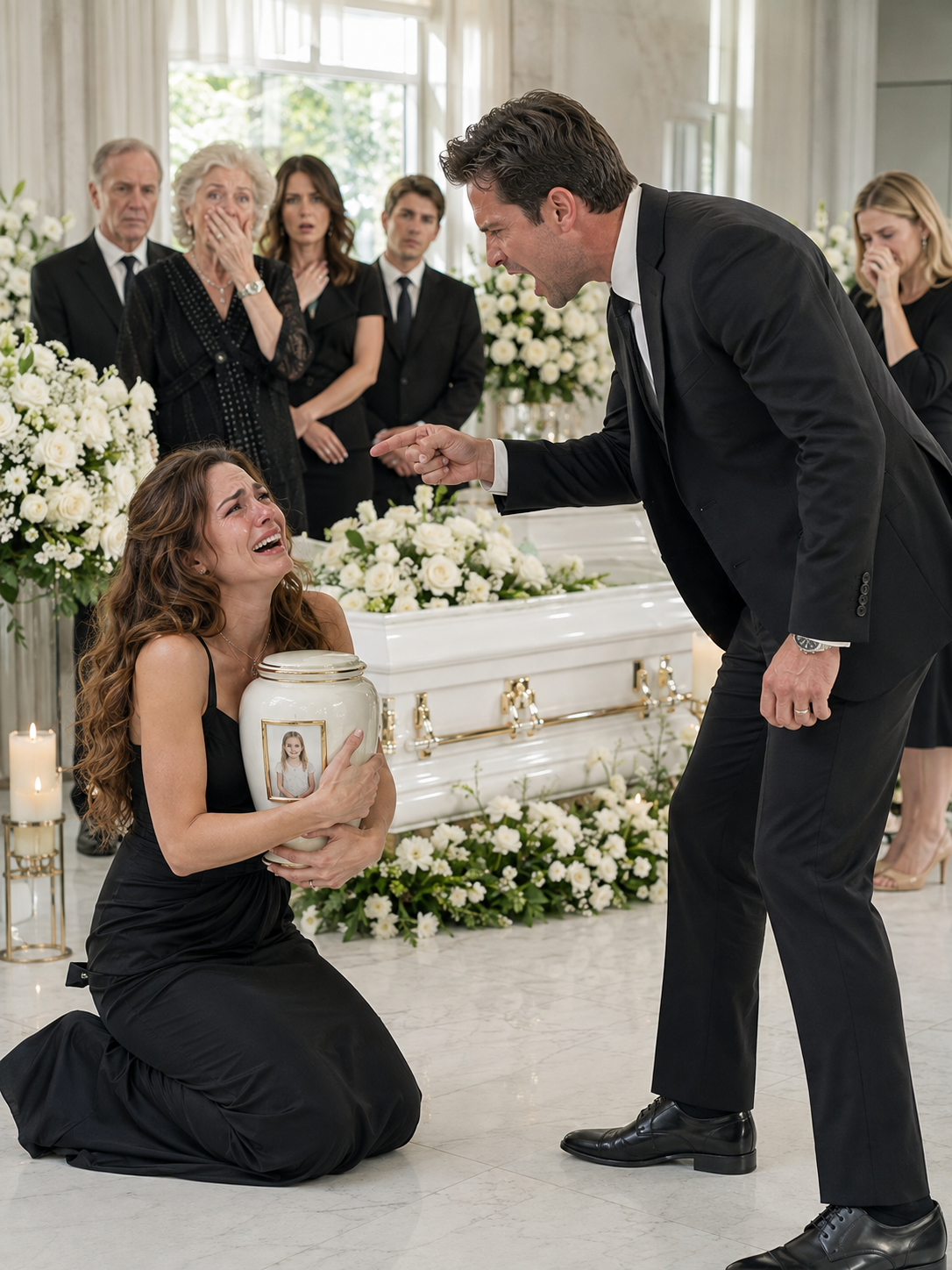
Part 1 – Carrying Her Home

I walked out of the hospital holding a small white urn against my chest when my husband finally answered one of my calls. Brendan sounded irritated rather than worried, and before I could explain why I had been trying to reach him, he said the words I would remember for the rest of my life.
“Stop making a scene and bring the kid home,” Brendan snapped into the receiver. “I already authorized the money for her treatment.”
For several seconds, I could not speak. Our three year old daughter, Chloe, had died three days earlier after spending most of her short life fighting a severe congenital heart condition, yet her own father did not even know she was gone.
“Fine,” I whispered, keeping my voice entirely flat.
Brendan ended the call without waiting for another word.
Behind his voice, I had heard loud background music, glasses clinking, and Samantha Hayes laughing. Brendan had been spending increasingly more time with her while I practically lived beside Chloe’s hospital bed, and I had stopped asking myself whether their relationship was really as innocent as he claimed.
I returned to the Fairchild family estate in Lake Forest with Chloe’s ashes tucked securely under my arm. Brendan’s sister, Brenda, greeted me near the front entrance and immediately complained about how much disruption my daughter’s illness had brought into the house.
“What are you carrying?” Brenda asked, looking down her nose at the ceramic container.
“Your niece,” I replied, staring directly into her eyes.
Brenda frowned in deep annoyance. “Don’t be ridiculous, Nora.”
“It is Chloe’s ashes,” I said quietly.
Her arrogant expression disappeared instantly, replaced by a sudden, pale stillness.
I walked past her toward the bedroom at the far end of the house, where Brendan had insisted Chloe sleep because her medical equipment disturbed everyone. I placed the white urn inside the empty crib that would never be used again and sat down beside it.
For three years, Brendan had controlled almost every dollar I could access.
Before our marriage, I had earned a master’s degree in actuarial science and built a successful career analyzing financial risk. Afterward, Brendan convinced me to step away from work and let him manage our finances while I focused entirely on caring for Chloe.
Eventually, even minor medical expenses required approval through the Fairchild family’s official financial portal.
Prescription formula required a digital request.
Specialist appointments needed written justifications.
Home care nursing had to be pre approved every month.
Everything passed through Brendan’s executive assistant, Ximena, who decided whether each expense was reasonable.
During Chloe’s final crisis, her cardiologist prescribed an urgent medication intended to stabilize her heart condition. I uploaded every single document the portal requested, but Ximena rejected the expense because it exceeded our quarterly dependent allowance.
I called Brendan seventeen times in a row.
He never answered his phone.
I even waited five hours inside his corporate office building until he finally appeared alongside Samantha.
“Don’t embarrass me at work again,” Brendan told me coldly in the lobby. “If you have money problems, deal with Ximena.”
A compassionate doctor eventually paid personally for one dose of Chloe’s medication, buying us a little more time. I submitted another emergency request through the portal, but its status remained listed as Under Review for seven straight days.
On the seventh day, Chloe died in her sleep.
That evening, I heard Brendan downstairs discussing me with his sister in the grand kitchen.
“Ximena did the right thing putting the brakes on her,” Brendan told Brenda. “Nora thinks she can spend family money whenever she wants without asking.”
Something inside me finally became completely quiet.
I opened the back of my closet and removed an old cellular phone I had not switched on since my wedding day. Three years earlier, my father had given it to me with one instruction: if I ever discovered that becoming Brendan Fairchild’s wife had left me without a way out, I was supposed to call the number stored inside.
My father was dead now.
But the phone number still worked.
“Raymond?” I asked into the phone.
The elderly attorney became completely silent when he recognized my voice. “Nora. I have been waiting three years for this call.”
I looked toward Chloe’s white urn resting on the windowsill. “Execute everything my father prepared. All of it.”
Raymond paused on the other end of the line. “Are you absolutely certain?”
“Yes,” I said. “Don’t protect the Fairchilds from anything you find.”
What Brendan had never bothered to learn was that I had not entered our marriage without money, experience, or power. I had voluntarily stepped away from all three because I wanted him to believe I had married him purely for love.
My father had apparently spent his final years preparing for the possibility that one day I would deeply regret that decision.
Raymond was about to explain exactly what he had left waiting for me when heavy footsteps sounded outside Chloe’s bedroom door.
Brendan was coming upstairs.
And while he still believed his wife had nowhere else to go, my father’s attorney was already beginning the process that could place the future of Brendan’s entire family business in my hands.
Part 2 – Uncovering the Truth
Brendan opened Chloe’s bedroom door while I was still holding the old phone in my hand. His attention moved from my face to the white urn resting inside the crib, and for the first time that evening, the irritation disappeared from his expression.
“What is that?” Brendan asked, stepping closer to the crib.
“Your daughter,” I replied.
He frowned deeply, looking at me as though he thought I was trying to provoke him into an argument. “Stop playing games, Nora.”
“Chloe died three days ago,” I said calmly. “I called you seventeen times while she was slipping away.”
Brendan stared directly at the ceramic urn.
For several seconds, he said nothing at all.
Then his face drained of color, leaving him looking thoroughly shaken.
“No,” Brendan stammered, shaking his head. “Ximena told me it was just a routine hospital visit. She said you were exaggerating again.”
I reached into my bag and placed the official divorce petition on Chloe’s mattress. “Then keep believing her.”
Brendan immediately began asking where I expected to go without his money, his house, or his family name. I did not bother to explain, because the version of me who once needed his permission to pay a medical invoice no longer existed.
I packed only what truly mattered to me: Chloe’s stuffed bunny, her blue blanket, the hospital card containing her tiny footprint, and the urn.
That night, I returned to the modest downtown apartment I had owned before marrying Brendan. I had kept the deed quietly throughout our marriage, and stepping inside felt strange after three years of living in a mansion where almost nothing had truly belonged to me.
At nine the following morning, someone knocked firmly on the front door.
A young attorney named Daniel stood outside carrying a heavy leather folder stamped with the gold crest of The Vance Financial Group.
“Raymond asked me to deliver this personally to you,” Daniel said, offering a polite nod.
My father, Harrison Vance, had been one of the country’s most discreet private investors. When I married Brendan, I voluntarily froze my access to much of the Vance family wealth because Brendan hated knowing I had independent resources, and I had foolishly believed surrendering that independence would prove I loved him.
My father never agreed with that foolish decision.
Before his death, he created legal safeguards that could restore my authority whenever I chose to activate them.
Daniel opened the heavy folder on my dining table. “Your voting rights and executive authority were reinstated at eight this morning. You now control the primary Vance trust, its international equity portfolio, and the parent venture fund.”
I stared at the financial numbers printed on the official documents.
Brendan had spent three years making me justify buying simple diapers, while I unknowingly had access to wealth larger than the entire Fairchild family fortune.
Then Daniel placed a small flash drive beside the paper documents. “There is something else your father prepared for you.”
I connected the flash drive to my laptop.
The encrypted files contained detailed financial reports, corporate structures, wire transfers, and internal information concerning Fairchild Global Enterprises. One specific folder focused on a major merger Brendan had been desperately trying to complete for months.
The entire deal depended heavily on securing new financing from an international private equity group.
I recognized the group’s name immediately from the trust documents.
“Who controls this funding group?” I asked Daniel.
Daniel looked directly at me. “You do, Ms. Vance.”
For the first time since Chloe died, the overwhelming helplessness that had followed me through hospital corridors began to disappear. I did not want cheap revenge built on fabricated accusations or emotional threats; I wanted every decision Brendan’s family had made examined without the protection they had always assumed money could buy.
Three days later, I attended a major Miami investment summit as the newly appointed Managing Director of Vance Capital.
Brendan was scheduled to give a keynote speech at the same event.
When the event host announced my name, I walked onto the main stage before hundreds of high level corporate executives. Brendan sat in the very front row, staring up at me as though the woman he had confined to the back wing of his family home had somehow become an absolute stranger overnight.
During the afternoon networking break, Brendan cornered me near the private executive lounge.
“Who the hell is backing you?” Brendan demanded, his voice hushed and furious.
“No one,” I replied smoothly.
“Vance Capital appeared out of nowhere,” he insisted, glaring at me.
“It didn’t appear out of nowhere, Brendan,” I said quietly. “You simply never bothered to learn who your wife was.”
His facial expression hardened. “Keep my company out of our personal divorce.”
“I am not going to destroy your company,” I assured him.
Brendan studied my face suspiciously. “Then what are you doing?”
“I am going to stop protecting it,” I answered before walking away.
That afternoon, I authorized a complete forensic review of the financing behind Fairchild Global’s proposed merger. I demanded no special treatment, no hidden liabilities, and no exceptions simply because the company’s chief executive officer happened to be my husband.
Within forty eight hours, independent auditors found serious financial irregularities within the corporate accounts.
But those accounting discrepancies were not the documents that made me stop breathing.
Buried deep inside the digital records was a complete transaction ledger of Chloe’s medical expenses.
Seven emergency money transfers had been entered into the corporate system.
Each transfer was clearly marked with an official status: APPROVED BY BRENDAN FAIRCHILD.
I stared at the computer screen in complete disbelief.
According to the internal records, Brendan had actually authorized the money for Chloe’s critical medical treatment.
Yet the hospital had never received a single cent of those funds.
Then the auditors traced where every single one of those fraudulent transfers had actually gone.
All seven payments had passed through the exact same person.
Ximena.
And suddenly, I realized the terrifying truth about Chloe’s final weeks might be even more complicated than believing Brendan had simply refused to pay.
Part 3 – Confronting the System
The complete forensic report arrived early the next morning, and the detailed findings changed everything I thought had happened during Chloe’s final weeks. Ximena had created a sophisticated dual entry system inside Fairchild Global’s financial software, making the same medical requests appear completely different depending on who was looking at them.
On Brendan’s administrative dashboard, seven emergency transfers for Chloe had been marked Approved and Paid. On the portal I could access, those exact same requests appeared as Rejected, Over Allowance, or Under Review.
The hospital had received none of the money.
Instead, forensic auditors traced the transfers through vendor accounts controlled by a shell company linked directly to Ximena.
Seven separate payments had been diverted.
Seven times money intended for my dying daughter had been redirected somewhere else.
I sat in front of the printed report for a long time, trying to reconcile those official records with the man I had spent three years resenting. Brendan had apparently approved several of Chloe’s medical expenses, but that discovery did not make him innocent in my eyes.
He had created the heartless corporate system that made Ximena powerful enough to stand between a desperate mother and her sick child.
He had ignored seventeen panicked phone calls.
He had told me to stop embarrassing him when I came to his corporate office begging for help.
Most importantly, he had never bothered to check whether the vital treatment he supposedly authorized actually reached his daughter.
Brendan had not personally stolen Chloe’s medical money.
He had simply made caring about what happened afterward someone else’s responsibility.
I forwarded the complete forensic audit directly to his personal email address without adding any explanatory text.
Brendan called my phone ten minutes later.
“Nora, did you send this to me?” Brendan asked, his voice shaking.
“Yes,” I replied calmly.
His breathing became visibly uneven over the line. “I approved those payments. I swear to you I approved them.”
“I know you did,” I said.
“The hospital never received them?” he asked softly.
“No,” I answered. “They never saw a dime.”
For several seconds, there was absolute silence on the phone.
Then his voice changed into a wave of sudden panic. “Ximena stole Chloe’s medical money?”
The intense corporate rage that followed did not impress me in the slightest. I heard something heavy crash against the wall in his private office while Brendan shouted that he would destroy Ximena and make her pay dearly for what she had done.
“No,” I interrupted sternly.
Brendan stopped shouting instantly. “What do you mean, no?”
“You are going to preserve every single record and let the proper authorities handle it,” I told him.
“She stole money meant for my daughter!” he yelled.
“And while she was doing it, your daughter’s mother called you seventeen times,” I reminded him coldly.
That statement silenced him completely.
“You thought I was exaggerating because believing that was easier than answering your phone,” I added.
His voice dropped to a barely audible whisper. “I thought Ximena was handling everything for the family.”
“That is exactly the problem,” I said before ending the call.
Fairchild Global’s legal department turned the records over to law enforcement for a formal criminal investigation. Auditors soon discovered that Chloe’s medical funds were not the only money missing, as Ximena had allegedly been manipulating vendor payments, travel accounts, and other corporate expenses for years.
Brendan came to my downtown apartment several days later.
He looked nothing like the polished executive who once made me wait five hours in his corporate lobby. He carried printed phone records showing every missed call, text message, and medical notification he had ignored during Chloe’s final crisis.
“I saw all of them afterward,” Brendan admitted, staring down at the papers in his hands.
I looked at the seventeen unanswered calls highlighted in bright yellow across the pages. “I was desperate.”
“I thought you were just trying to get my attention,” he whispered.
“I was,” I said. “Not for myself, but for Chloe.”
Brendan lowered his head into his hands. “I should have gone to the hospital.”
“Yes,” I agreed. “You should have.”
“I should have checked the payment receipts personally,” he continued.
“Yes.”
“I should have listened to you,” he said softly.
“Yes.”
Then Brendan asked the painful question I knew would eventually come. “Can you ever forgive me, Nora?”
I looked toward Chloe’s white urn resting on the sunny windowsill. “My forgiveness cannot give her those lost days back.”
Brendan covered his face completely, but I felt no satisfaction watching him finally understand what his negligence had cost us. Chloe’s death was not something I could turn into a weapon simply because I now possessed enough financial power to hurt him.
“I want the divorce finalized, Brendan,” I stated firmly.
“I can fix this between us,” he pleaded.
“No,” I said. “You can cooperate with the criminal investigation, and you can sign the papers.”
He refused to sign them.
At least initially.
But while Brendan was trying to save our ruined marriage, the forensic review I had authorized was uncovering deep financial problems far beyond Ximena’s theft. Fairchild Global’s pending merger contained massive undisclosed liabilities, questionable accounting practices, and risky transactions that Vance Capital could not responsibly approve without further investigation.
I did not manufacture any false evidence against his firm.
I simply refused to hide what the independent auditors found.
That decision brought another powerful member of the Fairchild family into the conflict.
Gideon Fairchild, Brendan’s stern grandfather and the family patriarch who had controlled the family business for decades, requested a private meeting with me at his estate.
When I arrived at his library, the old man skipped all pleasantries.
“What do you want from us, Nora?” Gideon asked, looking over his spectacles.
“My divorce,” I answered directly.
“And my grandson’s company?” he pressed.
“If it can survive an honest financial audit, it will survive,” I replied.
The old patriarch studied my face carefully.
Then he mentioned my late father.
That was the exact moment I realized Gideon knew far more about the Vance Trust than Brendan ever had.
But before our meeting ended, the old man revealed something I had not expected to hear.
My father had apparently contacted Gideon shortly before his death.
And whatever the two men had discussed during that final meeting had been specifically about Chloe.
Suddenly, I needed to know what my father had discovered about the Fairchild family before I ever made that desperate phone call to Raymond.
Part 4 – The Legacy Left Behind
Gideon Fairchild remained completely silent for several seconds after telling me my father had contacted him before his death. Until that moment, I had assumed Harrison Vance’s safeguards were meant only to protect me financially if my marriage collapsed, but apparently my father’s concerns had eventually extended to Chloe as well.
“What did my father tell you?” I asked, leaning forward in my chair.
Gideon leaned back slowly in his leather armchair. “He believed Brendan was becoming far too dependent on the family structure. Money, staff, daily decisions, he was outsourcing everything that required personal responsibility.”
“That doesn’t fully explain Chloe,” I noted.
“No,” Gideon conceded softly. “But your father was deeply worried that eventually Brendan would treat his own family the same way he treated his company.”
My father had noticed something I spent years trying not to see. Brendan believed providing money was the exact same thing as providing actual care, and once he delegated a responsibility to someone else, he rarely questioned what happened afterward.
Gideon told me my father had specifically asked whether medical expenses for Chloe could ever be delayed by the Fairchild family’s internal approval system. Gideon had personally assured him that emergency treatment would always take immediate priority.
“But it didn’t,” I said coldly.
“No,” the old man admitted. “It did not.”
“And you never checked on her either,” I added.
The old patriarch lowered his eyes in silent shame.
Neither had Brendan.
That was the absolute truth none of them could escape.
Ximena had allegedly stolen the money, but the system surrounding her had been designed by people wealthy enough to believe paperwork could replace genuine human attention. My daughter became another line item moving between assistants, digital portals, and quarterly allowances while the adults responsible for her safety assumed someone else was handling everything.
Gideon finally pushed an official paper document across the desk toward me.
It was an original signed letter from my father.
“If Nora ever asks for control of the Vance Trust again, give it back immediately,” my father had written. “Do not ask her to justify leaving her marriage.”
My throat tightened as I read his familiar handwriting.
My father had understood long before his death that I might eventually need an escape route from the Fairchild estate.
“He wanted you protected from harm,” Gideon said quietly.
“I needed him alive,” I replied, my voice breaking slightly.
“I know,” the old man said gently.
I folded the letter carefully and placed it inside my leather bag.
Then I returned directly to the main reason I had come to his mansion. “I want the divorce finalized immediately.”
Gideon nodded slowly. “And what about Fairchild Global?”
“If the company corrects every flagged account, fully discloses its liabilities, and accepts independent oversight, Vance Capital will evaluate the merger on its actual merits,” I explained.
“You could destroy them completely,” Gideon observed.
“I could,” I acknowledged.
“But you won’t do that?” he asked.
I looked directly into his eyes. “I am not interested in manufacturing Brendan’s destruction. If his company fails because the truth comes out, that failure belongs to him.”
We eventually reached a formal legal agreement. Brendan would stop delaying the divorce proceedings, while Fairchild Global would submit to three full years of independent financial oversight before receiving any consideration for revised financing from Vance Capital.
An hour later, Brendan entered my attorney’s office.
He looked completely exhausted, with deep dark circles under his eyes.
The final divorce papers were waiting on the conference table between us.
He picked up the pen but did not sign his name immediately.
“Do you hate me, Nora?” Brendan asked, looking across the table.
I thought about Chloe struggling through endless hospital nights while I repeatedly defended Brendan to myself. I remembered begging his assistant for medical approvals and convincing myself my husband was simply busy rather than accepting that he had chosen not to look closely enough.
“Hating you would mean I am still spending my energy on you,” I told him honestly.
Brendan signed the papers without another word.
Before I stood up to leave, he removed a small velvet box from inside his coat pocket.
Inside rested a delicate gold chain with a tiny diamond star hanging from it.
“I bought it when Chloe was born,” Brendan said quietly.
I stared at the sparkling necklace. “Why are you showing me this now?”
“I was going to give it to her when she reached a hundred days old,” he confessed.
“Why didn’t you?” I asked.
His eyes filled with tears. “I kept putting it off until work calmed down.”
That simple answer somehow represented our entire failed marriage.
There was always another business meeting.
Another corporate dinner.
Another financial quarter.
Another day when he would finally become the attentive father Chloe needed.
Until Chloe ran out of days.
Brendan pushed the velvet box across the table toward me. “Please keep it with her urn.”
I slid the box back across the smooth wood. “No. You keep it.”
He looked deeply confused by my refusal.
“You bought something beautiful for your daughter and spent three years waiting for the perfect moment to show her you loved her,” I said softly. “I think you need to keep it to remember what waiting cost you.”
I left the attorney’s office legally free.
But the consequences of the audit were far from finished.
Ximena’s criminal case continued to move forward, and the police investigation expanded into years of questionable transactions. Fairchild Global also remained under intense financial scrutiny, while Brendan faced a board of directors increasingly unwilling to accept his explanation that he had simply trusted the wrong assistant.
Three months later, the company failed its second independent financial audit.
Then my cell phone rang.
Daniel was calling directly from the Vance Capital offices.
“The Fairchild board just officially removed Brendan as Chief Executive Officer,” Daniel reported.
I closed my eyes in silence.
It should have felt like a massive victory.
It didn’t.
Then Daniel continued speaking over the phone. “There is something else you need to know.”
Investigators reviewing Ximena’s deleted computer accounts had recovered a hidden file she had tried to erase before her arrest.
It concerned Chloe directly.
Not her final week in the hospital.
Not the seven missing transfers.
The record dated back almost two full years.
And according to Daniel, it suggested Ximena had been manipulating information about my daughter’s medical expenses long before anyone realized money was disappearing.
For the first time, I wondered whether Chloe’s final crisis had truly been the beginning of Ximena’s betrayal.
Or merely the tragic moment it became impossible to hide any longer.
Part 5 – Moving Forward
The deleted file recovered from Ximena’s accounts contained almost two years of hidden records connected to Chloe’s medical care. When Daniel sent me the reconstructed ledger, I discovered that the seven missing emergency transfers were only the final stage of a much longer pattern involving delayed reimbursements, altered expense classifications, and medical requests that had quietly been changed before they ever reached Brendan’s administrative dashboard.
Some requests had originally been marked urgent by Chloe’s doctors but appeared inside the Fairchild system as routine dependent expenses. Others had been reduced, delayed, or bundled into quarterly allowances, allowing Ximena to redirect small amounts without immediately attracting any attention.
The discovery did not mean every difficulty Chloe experienced had been caused by missing money. Her congenital heart condition had always been severe, and no forensic audit could tell me what different medical outcomes might have occurred under different circumstances.
But it proved something undeniable.
For almost two years, the corporate system surrounding my daughter had been manipulated while Brendan and the rest of the Fairchild family barely looked at it.
When I sent Brendan the new records, he did not call me immediately.
Instead, a short email arrived hours later.
“How long was this happening?” Brendan wrote.
“Almost two years,” I replied.
His final message took several minutes to arrive.
“And I never noticed,” he wrote back.
For once, I did not send an answer.
Ximena’s criminal trial eventually established a broader pattern of financial misconduct involving corporate expenses and funds connected to Chloe’s care. The legal system determined her full responsibility for the fraudulent transactions, while I stopped trying to calculate whether one different decision might have given my daughter another month, another year, or another birthday.
That painful question had no answer capable of giving me peace.
Fairchild Global faced severe economic consequences of its own. Three months after my divorce became final, the company failed another independent audit, Brendan was permanently removed as CEO, and the weakened business was eventually absorbed by a larger international competitor.
I did not celebrate his downfall.
I had once imagined that watching Brendan lose everything might make Chloe’s absence easier to carry. Instead, his corporate ruin only confirmed how completely meaningless financial victories looked beside an empty crib.
I moved into a quiet high rise condo overlooking Lake Michigan and placed Chloe’s white urn on a wide windowsill where afternoon sunlight reached it every single day. Brendan had spent years wanting her medical equipment and illness kept away from the main rooms because visitors asked uncomfortable questions, so I refused to let her memory be hidden away ever again.
Every Sunday morning, I placed a fresh white dahlia beside her urn.
I also returned fully to the financial world.
Under my executive leadership, Vance Capital established a new venture capital program focused specifically on pediatric medical research and emergency healthcare access for families struggling to obtain specialized treatment. I could not rewrite Chloe’s tragic story, but I could use what my father left me to make money serve families instead of becoming another cruel barrier between them and the care they desperately needed.
Then, several months after the divorce was finalized, an envelope arrived at my private office.
There was no return address on the outside.
Inside was a photograph of Chloe at roughly three months old, smiling brightly from her crib. Part of Brendan’s suit arm was visible near the edge of the frame.
I turned the photograph over.
His distinct handwriting covered the back.
Brendan wrote that Chloe had smiled at him for the first time that day, and he admitted he had kept the photograph hidden because acknowledging how deeply he loved her had frightened him. Brendan explained that he had spent his entire life believing emotional affection created dangerous vulnerability, so he hid behind endless work, money, corporate assistants, and absolute control until the people he supposedly loved could no longer reach him.
I stared at Chloe’s sweet smile for a long time.
The old photograph did not change my decision to leave him.
It did not erase those seventeen unanswered calls during her final hours.
It did not change the painful fact that when his daughter needed him most, Brendan had chosen convenience over personal attention.
But it allowed me to understand something fundamental I had long resisted admitting to myself.
Brendan had truly loved Chloe.
He had simply been too emotionally cowardly to make that love useful while she was still alive.
I placed the photograph inside a polished silver frame right beside her urn.
Nearly a year after Chloe passed away, I wrapped the white urn securely in her small blue blanket and flew to the Oregon coast. I had always promised her that I would take her to see the vast ocean whenever she became strong enough to travel.
Standing on a high cliff above the Pacific Ocean, I held her close against my chest while the cold coastal wind moved through my hair.
I opened my phone and found Brendan’s contact information.
For months, I had kept his phone number saved without really knowing why.
Then I tapped the screen and deleted it forever.
“First we will watch the ocean, sweetheart,” I whispered softly into the wind. “Then we will go see the whole world together.”
I had once foolishly believed my ultimate victory would be Brendan losing his family company, Ximena facing legal consequences, or the Vance fortune returning to my complete control.
It wasn’t any of those things.
My real victory was no longer allowing the Fairchild family’s choices to decide what happened to the rest of my life.
Chloe had spent three short years teaching me that love was measured in true presence, not empty promises.
Brendan learned that bitter lesson long after she was gone.
I intended to spend the rest of my life remembering it while I was still here to live it.